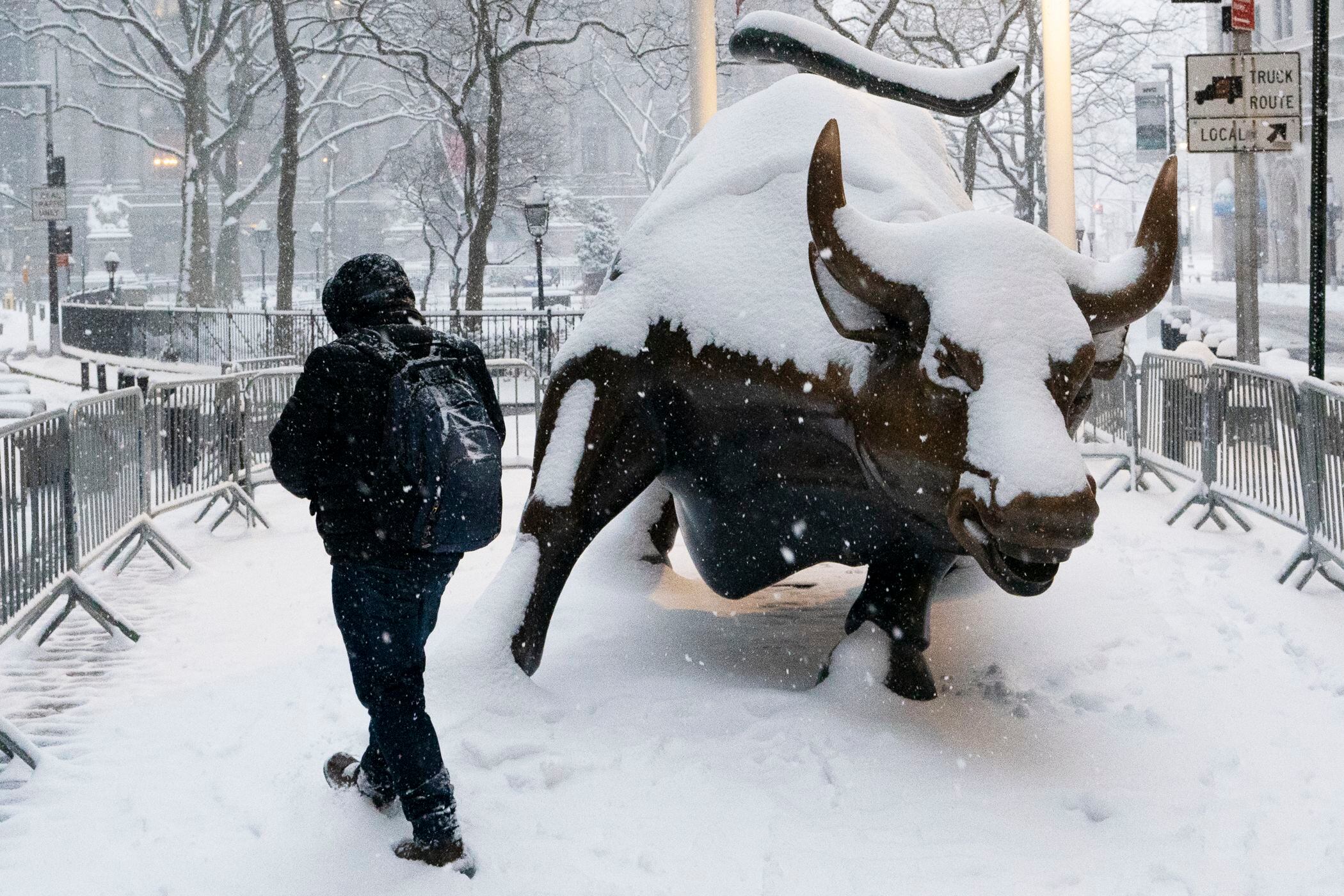
A man walks past the Charging Bull statue during a snowstorm, Monday, Feb. 1, 2021, in New York's financial district. (AP Photo/Mark Lennihan)
By Damian J. Troise and Alex Veiga
Stocks notched broad gains on Wall Street Monday, clawing back some of their losses following the market's worst weekly loss since October.
The S&P 500 rose 1.6%. The benchmark index was coming off a 3.3% slide last week, when volatility spiked as online traders hoping to inflict damage on hedge funds fueled a frenzy in GameStop and a few other stocks.
Investors large and small continued to focus those stocks Monday, and GameStop slumped 30.8% to $225 a share, the latest rocky ride for the stock, which ended last year at about $18.
Meanwhile, the price of silver jumped at one point to its highest level in eight years. Analysts said the precious metal became another target for online investors seeking to go up against big Wall Street players.
A measure of fear in the market, the VIX, fell Monday, suggesting some of last week's market jitters were easing, said Pauline Bell, analyst at CFRA Research.
“Today the market is sensing that the heightened volatility that we saw over the last week is reverting to a more settled type of volume,” Bell said. “The market is sensing the return to normalcy.”
The S&P 500 gained 59.62 points to 3,773.86. The Dow Jones Industrial Average rose 229.29 points, or 0.8%, to 30,211.91. The Nasdaq composite climbed 332.70 points, or 2.6%, to 13,403.39.
The gains were broad, with technology companies leading the way higher. Communication stocks and a variety of companies that rely on direct consumer spending such as Starbucks and AutoZone also helped lift the market.
Smaller companies also notched solid gains. The Russell 2000 index of small-cap stocks picked up 52.52 points, or 2.5%, to 2,126.16.
Monday's steep drop in GameStop echoed what has become a typical move for a company that has regularly seen double-digit swings most of the last two weeks. Trading of the retailer was still limited on trading platforms like Robinhood.
Silver for March delivery rose $2.50, or 9%, to settle at $29.42 an ounce. Some analysts called the price jump the latest assault by the smaller investors who sent GameStop soaring recently. But many of those same traders instead called it a trap set by hedge funds to divert their attention away from GameStop, as the saga captivating Wall Street gets even more dramatic.
While volatility eased Monday, analysts said the market is likely to remain choppy as small investors continue to play a bigger role in stock trading than they have in the past.
“Definitely having easy access to information, encouragement on social media and a very easy trading experience has gotten more people involved,” said Sunitha Thomas, national portfolio advisor at Northern Trust Wealth Management. “All of that combined is going to lead to more volatility as investors with a shorter outlook are a bigger part of the daily trading volume.”
Investors are watching negotiations in Washington over President Joe Biden’s proposed $1.9 trillion economic aid package. Hopes for aid, along with the Federal Reserve’s pledge to keep low-cost credit plentiful, have carried the S&P 500 and other major indexes to record highs.
“Ultimately, what’s going to drive this recovery is consumer spending coming back,” Thomas said.
Investors bid up stocks heading into 2021 in expectation the rollout of coronavirus vaccines would allow global business and travel to return to normal. That optimism has been dented recently by new infection spikes and disruptions in vaccine deliveries.
Markets were rattled last week by AstraZeneca’s announcement it would supply the European Union with fewer than half the promised doses, which prompted the EU to impose export controls. On Sunday, AstraZeneca promised to increase European supplies and start delivery earlier. This helped boost shares of European companies on Monday. Germany's DAX rose 1.4%, France's CAC-40 gained 1.2% and the U.K.'s FTSE-100 added 0.9%.
The yield on the 10-year Treasury rose to 1.08% from 1.07% late Friday.
The nation's largest vacation rental management company, Vacasa, made its public debut on the Nasdaq via a SPAC merger with TPG Pace Solutions. CEO Matt Roberts joined Cheddar to talk about the company's better-than-expected success and the plans to leverage its IPO to expand the business and refine Vacasa's tech. He noted that with five million second homes across the country, the company has much more room to grow as it currently has just 35,000 rental properties in 400 locations available. Roberts also said that there has been no impact on bookings due to the omicron variant of COVID-19.
Marvel's "Shang-Chi and the Legend of the Ten Rings" is gearing up for a sequel following its earlier this year topping the domestic box office to date. Destin Daniel Cretton will return to write and direct while also taking on additional projects in a multi-year deal.
Online platform Assemble is looking to provide career instruction and inspiration to Black, Indigenous, People of Color (BIPOC) of all age groups for access to industries they might not have been privy to prior. Actor, activist, and one of Assemble's three co-founders, Jesse Williams, and CEO Cortney Woodruff joined Cheddar's "Between Bells" to discuss the Assemble mission and what people can expect from the program. "There's a lot of jobs that folks don't know even exist in the first place, and what we know is that there are incredible innovators at the peak of their field that are Black and brown – in every single field," Williams noted.
Payoneer CEO Scott Galit joined Wake Up With Cheddar to talk about the company's partnership with Walmart to provide working capital to retailers on Walmart's marketplace.
As the country continues to bounce back from the job losses felt at the start of the pandemic, businesses are still struggling to fill jobs, mainly due to the record number of people who have voluntarily left the workforce. and experts say that the challenge of finding the people to fill those roles will likely follow us well into 2022. Beth Ann Bovino, U.S. Chief Economist at S&P Global Ratings explains what’s behind the ‘Great Resignation’.
Between uncertainty over the Omicron variant, and the possibility of a sooner-than-expected taper from the Fed, it was an especially volatile week for the markets. The release of the November jobs report on Friday, with job growth coming in way lower than estimates also caused movement on the market. Frances Stacy, Director of Strategy at Optimal Capital explains why all of this, combined with Bitcoin’s huge drop over the weekend, could make for another rough week for investors.
It was a chaotic week for the market, as investors reacted to the new omicron variant. Today though is all about jobs. Just ahead of the November jobs report, David Riley, Chief Investment Strategist at Blue Bay Asset management gave a run down of what to expect from the report, and what it could mean for investors.
Developers for the video game "Call of Duty: Warzone" staged a walkout in protest of 12 quality assurance testers being laid off by parent company Activision Blizzard. This marks the latest work stoppage for the embattled game publishing giant.
Troubled Chinese real estate giant Evergrande is once again nearing the brink of collapse. Shares of Evergrande sunk to a new record low on Monday, closing down 20 percent, as debt default fears resurfaced. Drew Bernstein, co-chairman at consultancy MarcumBP, joined Cheddar's Opening Bell to discuss. He said U.S. investors have to understand that "there is no company in China that's too big to fail, that's for sure," and that the Chinese government will be prioritizing the social welfare of the populace. Bernstein did note that it would be a managed collapse in some form.
Earlier this year, JetBlue flew its inaugural flight into the United Kingdom. It was a game changer — not only did the airline enter the transatlantic market, but the plane that completed the flight was a single-aisle jet. For decades, flying the distance was synonymous with jumbo jets, but today narrow-body aircraft are now proving they are up for the task — and maybe even the best option. In this episode, Cheddar examines why airlines are betting on narrow-body aircraft.