By Stan Choe, Damian J. Troise, and Alex Veiga
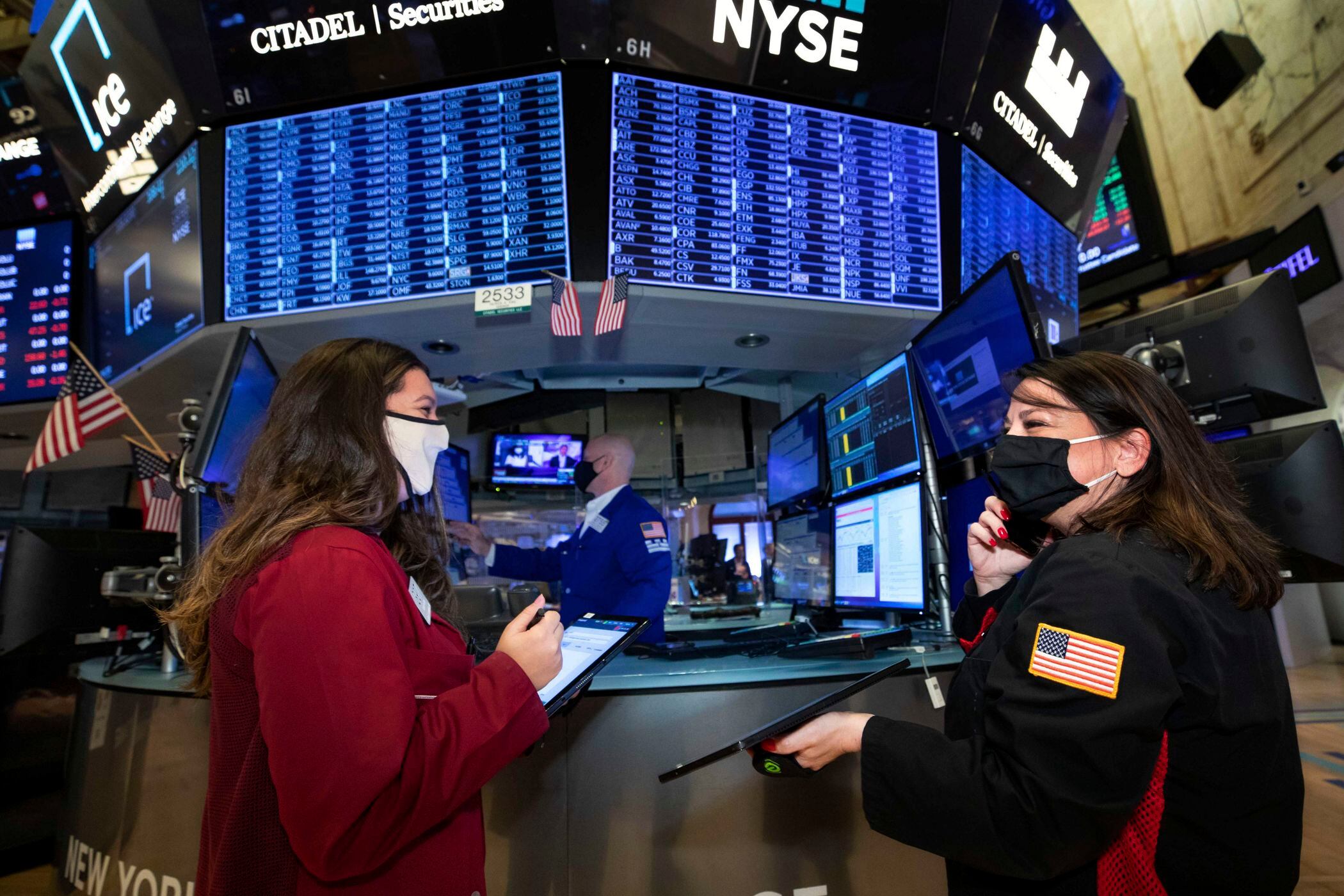
Stocks closed mostly lower on Wall Street Monday after an early rally faded, extending the market's recent pullback from record highs.
The S&P 500 fell 0.4% after having been up 0.9% in the early going. The reversal handed the benchmark index its fourth straight decline, something that hasn't happened since September. Losses in the financial, industrial and health care sectors accounted for much of the decline, outweighing gains by technology stocks and companies that rely on consumer spending. Treasury yields were mostly higher, a sign of optimism in the economy.
Stocks initially headed higher as Americans began receiving the country’s first vaccinations against COVID-19, a process that's expected to take months. Meanwhile, investors are still waiting to see whether Congress can break a logjam on delivering more aid to people, businesses and local governments affected by the coronavirus pandemic. They're also monitoring talks on reaching a trade deal between Britain and the European Union.
“To a large degree, we’re in a wait-and-see mode,” said Terry Sandven, chief equity strategist at U.S. Bank Wealth Management. “The good news is the vaccine is being distributed, which suggests we’re on the road to recovery.”
The S&P 500 fell 15.97 points to 3,647.49. The index declined 1% last week, its worst weekly performance since Halloween.
The Dow Jones Industrial Average dropped 184.82 points, or 0.6%, to 29,861.55. The Nasdaq rose 62.17 points, or 0.5%, to 12,440.04. Smaller companies held up better than their larger rivals, an indication that investors are feeling more confident about the economy’s prospects. The Russell 2000 index gained 2.16 points, or 0.1%, to 1,913.86.
Hospital workers are unloading the first batches of a coronavirus vaccine developed by Pfizer and its German partner, BioNTech, following its approval for emergency use by U.S. regulators. Health care workers and nursing home residents will be first in line for vaccinations, and the hope in markets is that a wider rollout next year will help pull the economy back toward normal following its devastation this year.
Such optimism has helped Wall Street's rally broaden out beyond Big Tech stocks, which were pulling the market higher almost singlehandedly earlier in the pandemic, though Monday's pullback dragged down many of the companies that desperately need the economy to get healthier and reopen. American Airlines dropped 2.1%, while Carnival slid 1.8%. Marriott International gave up 1.5%.
Alexion Pharmaceuticals soared 29.2% for the biggest gain in the S&P 500. It’s the first trading day for the stock since AstraZeneca said on Saturday that it would buy the company for $39 billion in cash and stock.
Of course, the hopes for the economy in the future are tempered by the worsening pandemic in the present. Surging coronavirus counts have forced a downshift to the economy’s momentum, including last week’s worse-than-expected report on joblessness. The increasing death toll is pushing governments around the world to bring back varying degrees of restrictions on companies, and it’s also scaring potential customers away from businesses on its own.
To help in the interim, economists and investors have been asking Congress to deliver another round of financial support for the economy. Democratic and Republican legislators have been discussing a bipartisan possibility, which has raised hopes on Wall Street recently. But bitter partisanship has prevented a deal for months, and a deep divide still dominates on Capitol Hill.
Even without another round of stimulus, investors are facing a robust environment heading into next year that includes low inflation and an accommodative Federal Reserve.
“The market is prepping itself for a really good year in 2021 with earnings starting to kick in during the second and third quarter,” said Marc Chaikin, founder of Chaikin Analytics.
Across the Atlantic, hope was rising that talks are making progress in what has been just as frustrating as the stalemate in Washington, a potential deal on the terms of the United Kingdom’s exit from the European Union.
The EU’s chief negotiator Michel Barnier said Monday he believes a trade agreement is possible following nine months of negotiations, now that remaining disputes have been whittled down to just two. Both sides are still teetering on the brink of a no-deal departure, though. They have committed to a final push ahead of Jan. 1, when a transitional period following Britain’s Jan. 31 departure from the bloc is to end.
Hope for a deal helped the value of the British pound rise against other currencies. European stock markets closed mostly higher, and Asian markets ended mostly lower.
The yield on the 10-year Treasury rose to 0.90% from 0.87% late Friday.
___
Associated Press Business Writer Elaine Kurtenbach and writer Raf Casert contributed.
Updated on December 14, 2020, at 5:15 p.m. ET with updated trading information.