By Alex Veiga and Damian J. Troise

Updated 5:04 pm ET

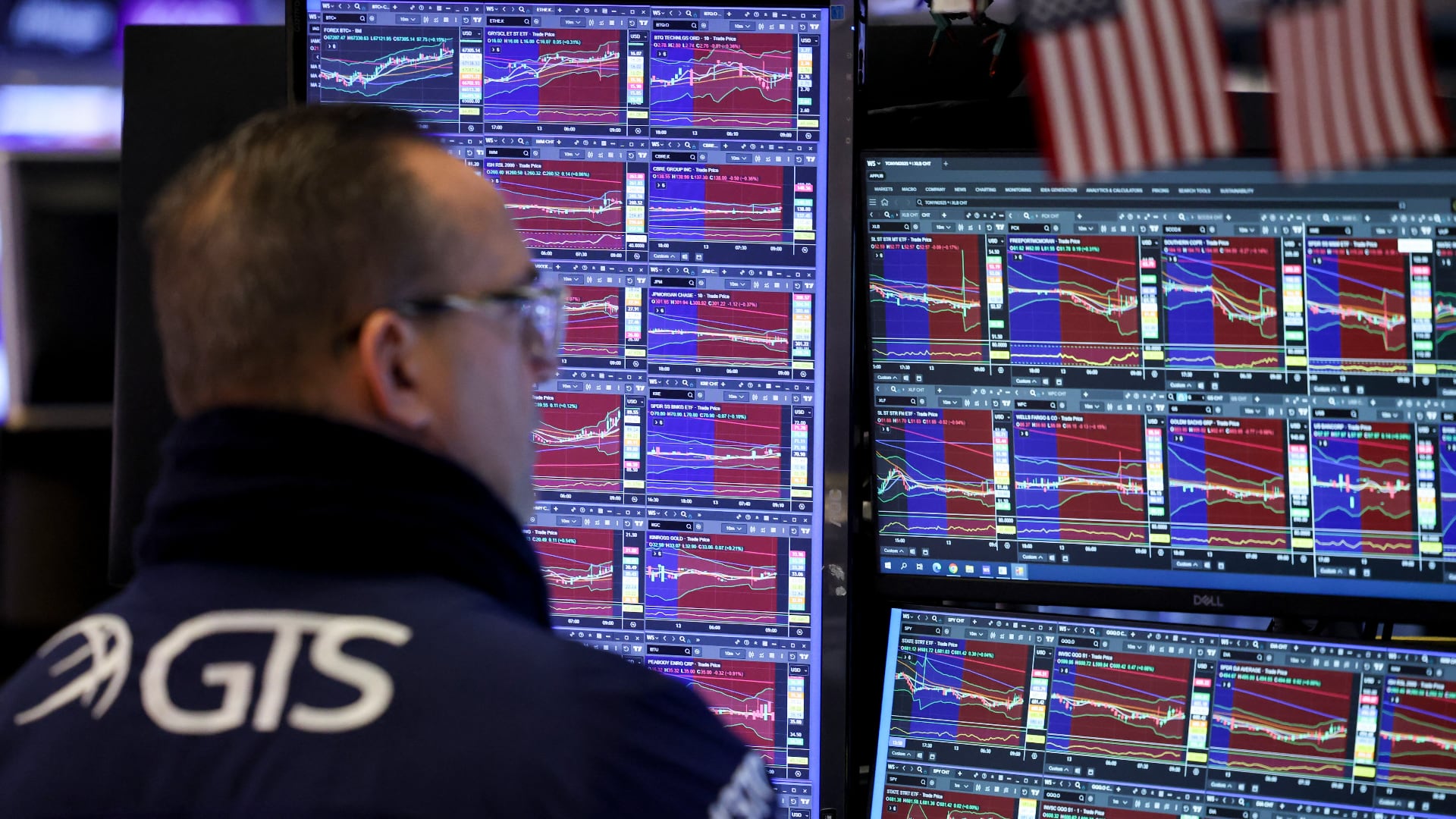
Stocks ended broadly lower on Wall Street Tuesday as trading turned wobbly a day after the market notched its biggest jump in more than five weeks.

The S&P 500 fell 1% after having been up by 0.4% in the early going. Losses in banks, health care stocks, and household goods companies accounted for a big portion of the selling. A late-day slide erased early strength in technology stocks and companies that rely on consumer spending.

Bond yields mostly fell and the price of gold rose, signs that investors were feeling cautious.

“Today is a little bit of a pause day after a significant rally,” said Eric Freedman, chief investment officer at U.S. Bank Wealth Management.

Investors are betting that the economy and corporate profits will begin to recover from the coronavirus pandemic as the U.S. and countries around the world slowly open up again. However, concerns remain that the relaxing of stay-at-home mandates and the reopening of businesses could lead to another surge in infections, potentially ushering in another wave of shutdowns.

The S&P 500 lost 30.97 points to 2,922.94, snapping a three-day winning streak. The Dow Jones Industrial Average fell 390.51 points, or 1.6%, to 24,206.86. The Nasdaq composite dropped 49.72 points, or 0.5%, to 9,185.10. The Russell 2000 index of small-company stocks gave up 25.97 points, or 1.9%, to 1,307.72.

Wall Street kicked off the week with a bang, as optimism about a potential vaccine for COVID-19 and hopes for a U.S. economic recovery in the second half of the year pushed stocks sharply higher Monday, reversing all of the market's losses so far this month. Tuesday's selling cut into some of those gains. The S&P 500 is now down 13.7% from its all-time high in February.

Investors are focused on gauging the risk for a second or third wave of coronavirus cases as more swaths of the U.S. reopen for business.

“As long as we have a supportive Fed, a responsive legislative branch that is at least open to considering more stimulus, and we see openings occur on a measured, but consistent basis, we still think there’s still basis for this market to be propelled higher,” Freedman said.

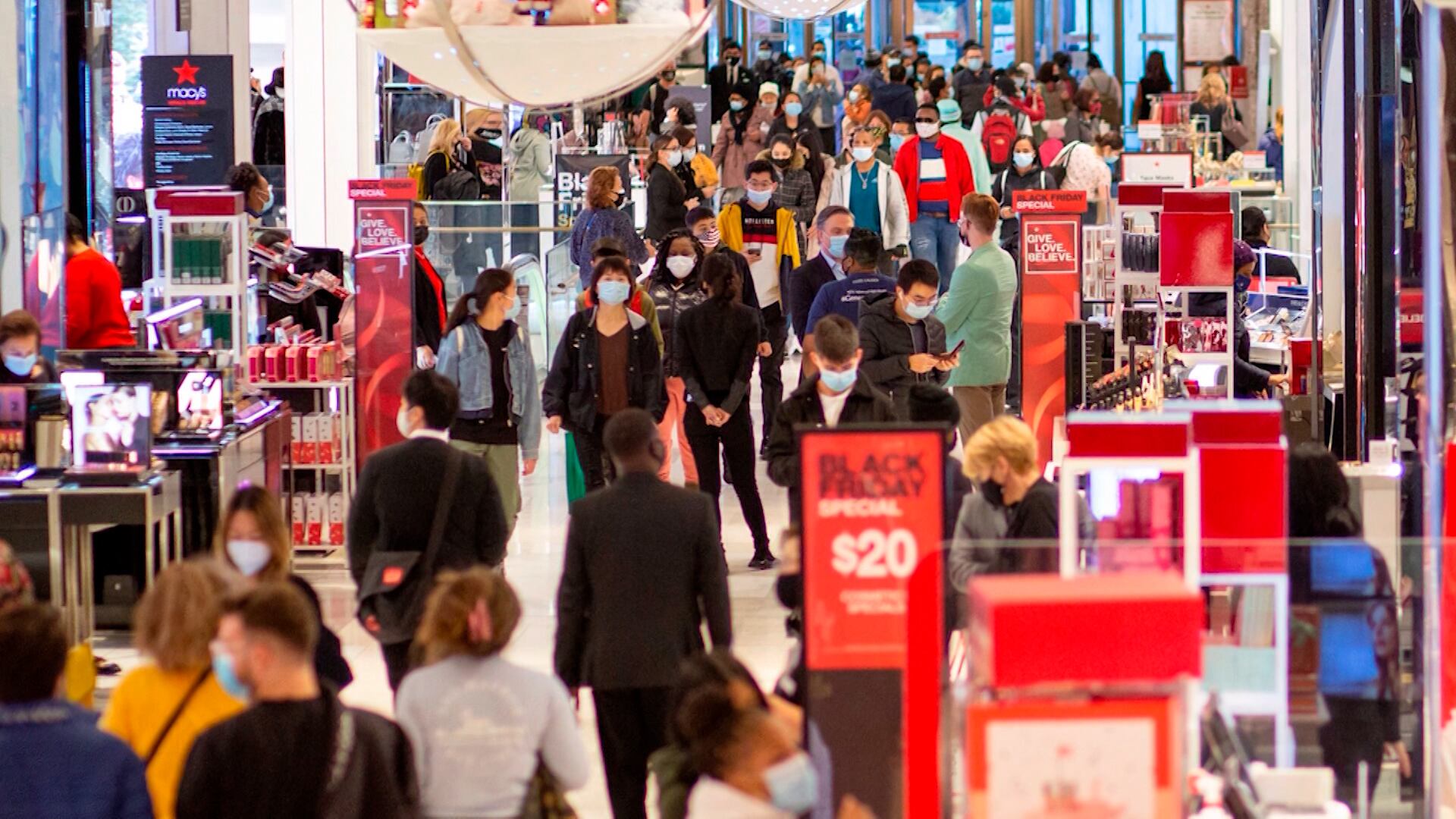
Still, quarterly results from big retailers Tuesday underscore the challenges companies face as long as the outbreak weighs on consumers and compels government officials to mandate restrictions on commerce. Companies that have been able to remain open or effectively amplify their e-commerce business have been able to fare far better than those that have had to temporarily close doors.

Walmart reported a 74% surge in fiscal first-quarter sales as people stocked up on crucial supplies while sheltering in place due to the coronavirus. Its earnings fell as it spent $900 million in additional compensation for workers, but still topped Wall Street's forecasts. Its shares initially headed higher but finished 2.1% lower.

Meanwhile, Kohl’s, whose stores have been closed during the outbreak, fell 7.7% after reporting that it swung to a $541 million quarterly loss as its revenue sank more than 40%.

Traders also hammered shares in Home Depot after the home improvement supply chain reported quarterly results that fell short of Wall Street's estimates. While the company benefited from a surge in homeowners rushing to buy essential supplies, increased spending on employee compensation and other costs related to the coronavirus dragged on its profits. The stock fell 3%.

“Investors have been looking for companies and sectors that could do well in the current environment,” said Sal Bruno, chief investment officer of IndexIQ. “Looking forward, where does that continued leadership come from?”

The Commerce Department said residential construction ground breakings fell in April to their lowest level in five years. But building permits, a gauge of potential future construction activity, fell less than analysts had expected. That helped push several homebuilder stocks higher. Beazer Homes USA led the pack, surging 5.9%.

Oil prices ended mixed, though they remained above $30 a barrel. Benchmark U.S. crude oil for June delivery rose 68 cents, or 2.1%, to settle at $32.50 a barrel. July delivery of Brent crude oil, the international standard, fell 16 cents, or 0.5%, to $34.65 a barrel.

Prices have firmed up as oil-producing nations cut back on output and as the gradual reopening of the economies around the globe helps spur demand, which crashed earlier this year due to widespread travel and business shutdowns related to the coronavirus. Crude oil started the year at about $60 a barrel.

Bonds yields mostly fell. The yield on the 10-year Treasury note, a benchmark for interest rates on many consumer loans, slid to 0.68% from 0.74% late Monday.

France’s CAC 40 lost 0.9%, while Germany’s DAX inched up 0.1%. Britain’s FTSE 100 dropped 0.8%. Markets in Asia finished higher.


Share:
More In Business
Web3 Project Tool Thirdweb Raises $5 Million
Web3 software startup Thirdweb has raised $5 million in a funding round, coming from a group of high-profile investors, including Gary Vaynerchuk and Mark Cuban. Thirdweb says it is paving the way for the revolution surrounding the new iteration of the internet known as web3, by offering users free tools to build their own web3 projects. Thirdweb's co-founders Steven Bartlett and Furqan Rydhan join Cheddar News' Closing Bell to discuss.
Coatue and Tiger Global Purchase $100 Million Braintrust Tokens to Seed Decentralized Web3 Talent Network
Decentralized talent network Braintrust recently closed an atypical equity deal that involved investors buying $100 million in Braintrust tokens, the company's cryptocurrency. Braintrust's talent network is built on blockchain technology, which the company says allows it to be owned and built by users, instead of a centrally-controlled corporation. Braintrust users can also earn tokens for their contributions to the network and its growth. Braintrust co-founder Adam Jackson joins Cheddar News' Closing Bell to discuss.
Evaluating Blue Origin's Potential After Third Successful Manned Launch
Blue Origin launched its third manned mission over the weekend with 'Good Morning America' host Michael Strahan and Laura Shepard Churchley, daughter of astronaut Alan Shepard on board, alongside several Blue Origin investors. This comes after the spaceflight firm launched two successful missions to the edge of space earlier this year. How will these missions set up Blue Origin for success as it competes with SpaceX and other companies for space tourism domination and more? Joey Roulette, space reporter at The New York Times, joins Cheddar News' Closing Bell to discuss.
Inflation Surges Faster Than Expected to 6.8% in November
If there's any question about whether inflation is here to stay, today's November consumer price index data gives us an answer. This is the second month in a row we've seen a hot inflation reading — CPI last month rose to 6.8%, after jumping to 6.2% in October. Amid the holiday shopping season, what does this mean for consumers? And how will the Federal Reserve move forward after previously announcing it would speed up its asset taper timeline? Art Hogan, Chief Market Strategist at National Securities, joins Cheddar News' Closing Bell to discuss November's CPI jump, where consumers are hurting the most, what the Fed could do to help ease inflation, and more.
Getty Images CEO on Now Being the Right Time to Go Public
Editorial and stock photo provider Getty Images is gearing up to make its public debut via a SPAC merger with CC Neuberger Principal Holdings II bringing it to a $4.8 billion valuation. CEO Craig Peters joined Cheddar to break down the decision to go public and noted that the merger will help to pay down debt. "That's going to really enable a lot of additional free cash flow and financial flexibility into the business," he noted. "That's just going to allow us to just invest more aggressively into the business to accelerate what is already accelerating growth." Peters also discussed the legacy image platform's place going forward in the expanding world of digital assets like NFTs and the metaverse.
Coindesk Unveils List of the Most Influential People in Crypto for 2021
Ben Schiller, the managing editor for features and opinion at CoinDesk, breaks down how the year's top 10 crypto influencers were selected and what to expect from the blockchain ecosystem, especially the growth of NFTs, in 2022. "This whole crypto story has become not just a story about money or the future of money," he said. "It's also become a cultural story where it's getting into gaming, it's getting into artwork, into collectibles, and all kinds of cultural categories it wasn't in before." Schiller noted that he expects the U.S. and other world governments to establish crypto regulations in the coming year.
Astrazeneca COVID Antibody Treatment for the Immunocompromised Gets FDA Approval
Mina Makar, senior vice president of respiratory and immunology, Astrazeneca, joined Cheddar to discuss the FDA's decision to give emergency use authorization to the pharma giant's COVID-19 antibody treatment called Evusheld for immunocompromised patients For about 2 percent of the U.S. Makar noted that the injection is supposed to provide antibody protection for those who can't generate their own adequate immune response via the vaccines for a minimum of six months, though long-term trials are underway.
Salesforce Chief Medical Officer on Growing Need for C-Suite Healthcare Role
The pandemic has forced corporate America to reshape itself to adapt, including onboarding doctors as chief medical officers to help maintain the health and safety of staff. Dr. Geeta Nayyar, chief medical officer at Salesforce, joined Cheddar to break down her role and how it has become relevant and necessary in the evolving workplace. "Every business today is now in the business of healthcare," she said. "It is a priority to empower employees to then serve your customers."
Load More