By Alex Veiga and Damian J. Troise
Stock indexes were mostly flat Friday afternoon after a wobbly day of trading on Wall Street as optimism over the gradual reopening of businesses shuttered due to the coronavirus is kept in check by more data showing how the pandemic is crippling the economy.
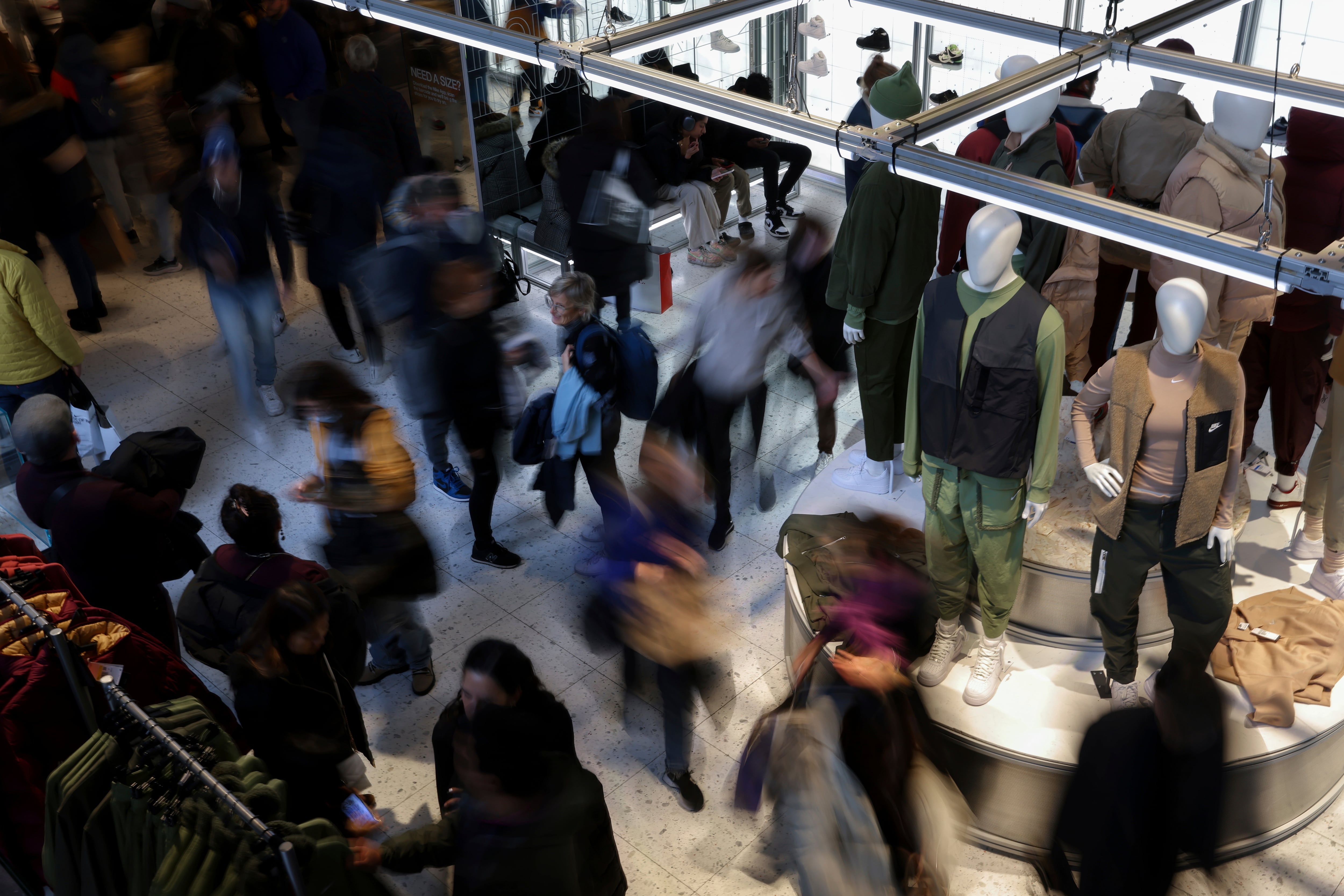
The government reported that U.S. retail sales sank a record 16% in April, the second steep decline in a row as store closures kept shoppers away. The Federal Reserve also reported that industrial production plunged a record 11.2% last month. Overseas, Germany’s economy shrank in the first quarter, meaning that Europe’s largest economy is in a recession.
At the same time, investors have grown cautiously optimistic that the economic fallout from the outbreak will begin easing as more U.S. states and countries around the world take steps to reopen their economies.
“Investors are really torn,” said Chris Zaccarelli, chief investment officer for Independent Advisor Alliance. “There’s one camp of thinking that it's always darkest before the dawn. And the other camp is thinking this is just the tip of the iceberg.”
Stocks initially fell in response to the dour economic data, then wavered between small gains and losses for much of the afternoon. The S&P 500 was up 0.2% after falling 1.3% in the early going. It's still on track for its worst weekly loss since March.
The Dow Jones Industrial Average was up 52 points, or 0.2%, to 23,679. The Nasdaq composite, which is heavily weighted with technology stocks, rose 0.5%. Small-company stocks were doing better than the rest of the market. The Russell 2000 index rose 1.4%.
Bonds yields rose. The yield on the 10-year Treasury note, a benchmark for interest rates on many consumer loans, rose to 0.64% from 0.61% late Thursday.
Communication services stocks and companies that rely on consumer spending were among the biggest gainers as investors continued to bet on internet providers, wireless companies and others seen as being less affected by the stay-at-home orders that have hurt so many other types of businesses.
Chipmakers among the biggest losers after the U.S. government moved to impose new restrictions on Chinese tech giant Huawei. The Commerce Department said Friday the restrictions, which impede Huawei's ability to use U.S. technology and software to design and manufacture its semiconductors abroad, aim to cut off the company's undermining of existing U.S. sanctions.
The U.S. government blacklisted the Chinese tech company a year ago, deeming it a national security risk. But there have been numerous loopholes that U.S. officials say the new restriction is meant to address. The news weighed on shares in several chipmakers. Lam Research and Qualcomm were down more than 4%.
Energy stocks rose as crude oil prices climbed. Benchmark U.S. crude oil for June delivery rose $1.87, or 6.8%, to settle at $29.43 a barrel Friday. Brent crude oil for July delivery rose $1.37, or 4.4% to $32.50 a barrel.
Fears of a crushing recession due to the coronavirus sent the S&P 500 into a skid of more than 30% from its high in February. Hopes for a relatively quick rebound and unprecedented moves by the Federal Reserve and Congress to stem the economic pain fueled a historic rebound for stocks in April, with the S&P 500 recouping nearly all of its losses.
So far this month, however, stocks have been headed mostly lower. Investors are balancing cautious optimism of a recovery as economies around the world slowly ease the restrictions on people and businesses against worries that the moves could lead to another surge in coronavirus infections and more economic uncertainty.
Earlier this week, Federal Reserve Chair Jerome Powell warned the downturn could be lengthy, while the top infectious diseases expert in the U.S. said that reopening the economy too quickly could backfire and lead to more deaths.
Wall Street is looking ahead to the fall and next year in hopes that the recession doesn't drag out, paving the way for corporate profits to bounce back. But much depends on how the reopening of businesses goes and the trajectory of the outbreak.
“Looking at states that have (begun) reopening to see what happens with the virus data, do you see an acceleration? That’s going to be very important,” said Tom Hainlin, national investment strategist at U.S. Bank Wealth Management.
While many companies have ceased to provide earnings forecasts for the rest of this year, citing uncertainty over the when the pandemic will be under control and how soon the economy will recover, investors may get some insights next week when Walmart, Home Depot, Best Buy, Target and other retailers report quarterly results.
Major stock indexes in Asia ended mixed Friday. Markets in Europe closed mostly higher despite a report showing that Germany, the continent's largest economy, fell into recession in the first quarter with a 2.2% quarter-on-quarter decline. That pullback echoed economic declines in France and Italy.