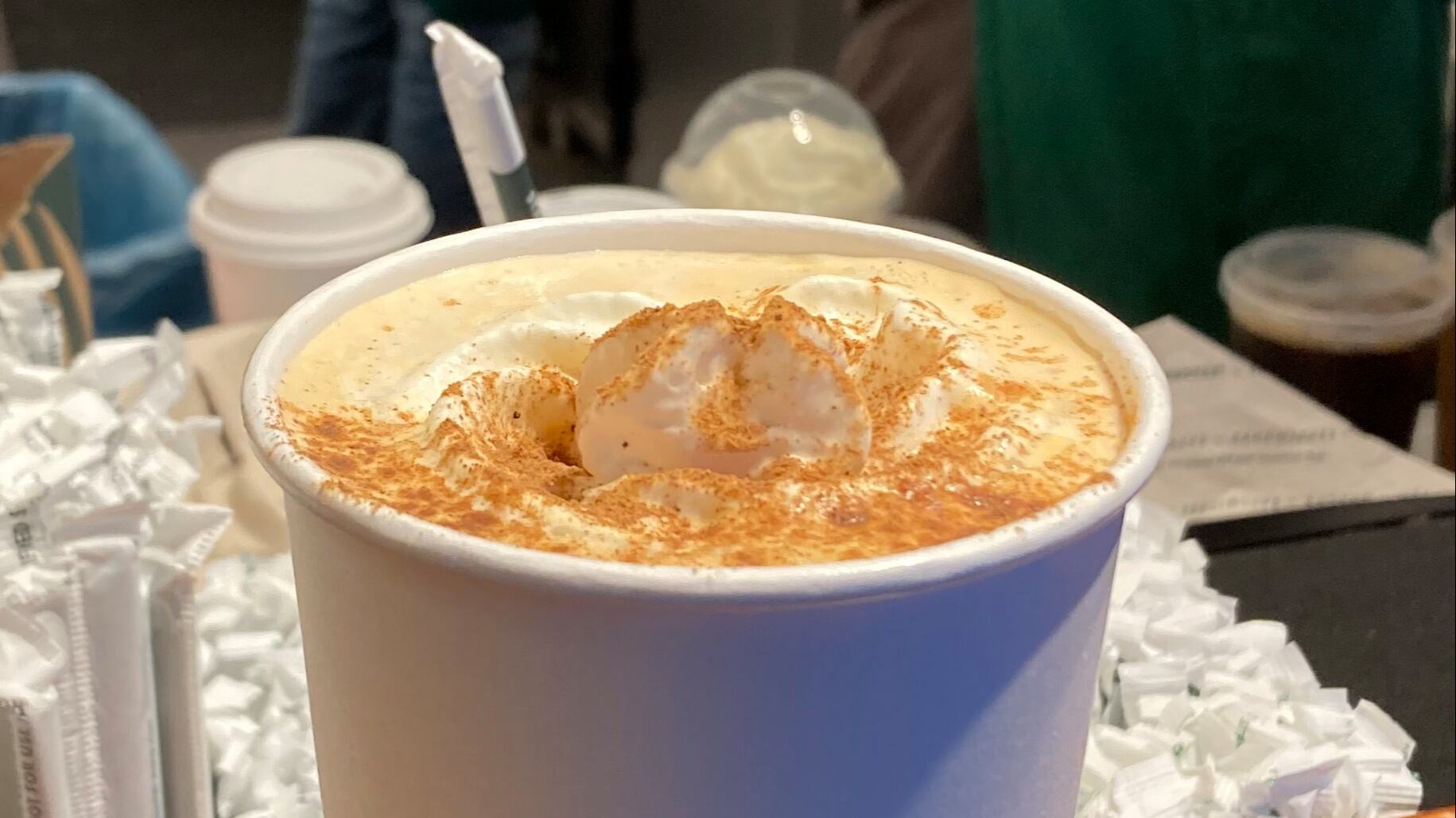
The seasonal drink that made pumpkin spice a star is turning 20. And unlike the autumn days it celebrates, there seems to be no chill in customer demand.
Starbucks’ Pumpkin Spice Latte goes on sale Thursday in the U.S. and Canada, as it does each year when the nights start getting longer and the fall winds gather. It’s the coffee giant’s most popular seasonal beverage, with hundreds of millions sold since its launch in 2003. And it has produced a huge — and growing — industry of imitators flecked with cinnamon, nutmeg and clove.
In the year ending July 29, U.S. sales of pumpkin-flavored products reached $802.5 million, according to Nielsen. That’s up 42% from the same period in 2019. There are pumpkin spice Oreos, protein drinks, craft beers, cereals and even Spam. A search of “pumpkin spice” on Walmart’s website brings up more than 1,000 products. A thousand products that smell or taste like, well, pumpkin pie.
For better — and, some might say, for worse — the phenomenon has moved beyond coffee shops and groceries and into the larger world. Great Wolf Lodge is featuring a Pumpkin Spice Suite at five of its resorts this fall, decked out with potpourri, pumpkin throw pillows and bottomless pumpkin spice lattes.
It has also spawned a vocal group of detractors — and become an easy target for parodies. Comedian John Oliver once called pumpkin spice lattes “the coffee that tastes like a candle.” There's a Facebook group called “I Hate Pumpkin Spice” and T-shirts with slogans like “Ain't no pumpkin spice in my mug.”
The haters, though, appear to be in the minority. Last year, Starbucks said sales of its pumpkin spice drinks — including newer offerings like Pumpkin Cream Cold Brew — were up 17% in the July-September period. And in a 2022 study of 20,000 Twitter and Instagram posts mentioning pumpkin spice, just 8% were negative, according to researchers at Montclair State University in New Jersey.
BEFORE THE LATTE: WHAT PUMPKIN SPICE WAS
It wasn’t always this way.
Canned pumpkin and pie spices were relegated to the baking aisle when Starbucks began experimenting with an autumn drink that would replicate the success of the Peppermint Mocha, which took the winter holidays by storm in 2002. Customer surveys suggested chocolate or caramel drinks, but Starbucks noticed that pumpkin scored high for “uniqueness.” That would turn out to be prescient.
In the spring of 2003, a team gathered in a lab in Starbucks’ Seattle headquarters, bringing fall decorations to set the mood. They sipped espresso between bites of pumpkin pie, figuring out which spices most complemented the coffee. After three months, they offered taste tests; pumpkin spice beat out chocolate and caramel drinks.
Starbucks tested the Pumpkin Spice Latte in 100 stores in Washington, D.C., and Vancouver, British Columbia, that fall. The company quickly realized it had a winner and rolled it out across the United States and Canada the following fall. And in 2015, a watershed: The company added real pumpkin to the recipe.
These days, Starbucks' Pumpkin Spice Latte has its own handle on X — formerly known as Twitter — with 82,000 followers, and a Facebook fan group called the Leaf Rakers Society with 43,000 members. And it has fans like Jon McBrine, who drinks black iced coffee for most of the year but eagerly awaits the latte's return each fall.
“I love the flavor and I love the subculture that has evolved from this huge marketing campaign,” says McBrine, a graphic designer and aspiring author who lives in the Dallas area.
It’s hot through the end of October where he lives, so McBrine typically orders his with ice. But at least once a year, he gets a hot latte, savoring memories of the autumns of his childhood in Delaware.
“It’s part of getting into the season,” he says. “It’s almost like a ritual, even if you’re just waiting in the drive-thru.”
THE PUMPKIN SPICE LATTE AS SENSORY EXPERIENCE
Jason Fischer, an assistant professor at Johns Hopkins University who studies human perception through sight, sound and smell, says odor and flavor have a more direct route than other senses to the area of the brain that processes memories.
That’s due to evolution; humans needed to remember which foods were safe to eat. But it means smells and memories are closely linked.
Still, he said, people’s sense of smell can be malleable. In experiments, subjects have taken a sniff of something and described it in many different ways. But when they’re shown a label for that smell — say, “pumpkin spice” — their perceptions shift and their descriptions become more similar.
“Odors and sights go with certain places, like the aroma of pine and the crunching of needles beneath your feet,” he says. “They’re associated with a certain kind of experience. And then marketing taps into that, and it’s a cue for a product.”
Pumpkin spice doesn’t conjure happy memories for everyone. Kari-Jane Roze, who lives in Fredericton, Canada, loves many things about autumn, including back-to-school routines, changing leaves and hockey. But she’s not a fan of pumpkin pie or pumpkin bread — and she has a particular dislike for pumpkin spice lattes.
“The artificial flavor is disgusting,” says Roze, who works at New Brunswick Community College. “The only thing I do not like about fall is seeing everyone obsess over PSLs. Makes me want to shut off social media for a month.”
She won’t have to deal with those "PSLs" for long. The limited-time nature of the product is another thing that keeps customers hooked, marketing experts say. Last year, Starbucks’ holiday-themed drinks arrived on Nov. 3. And then, for devoted fans, the wait begins anew.