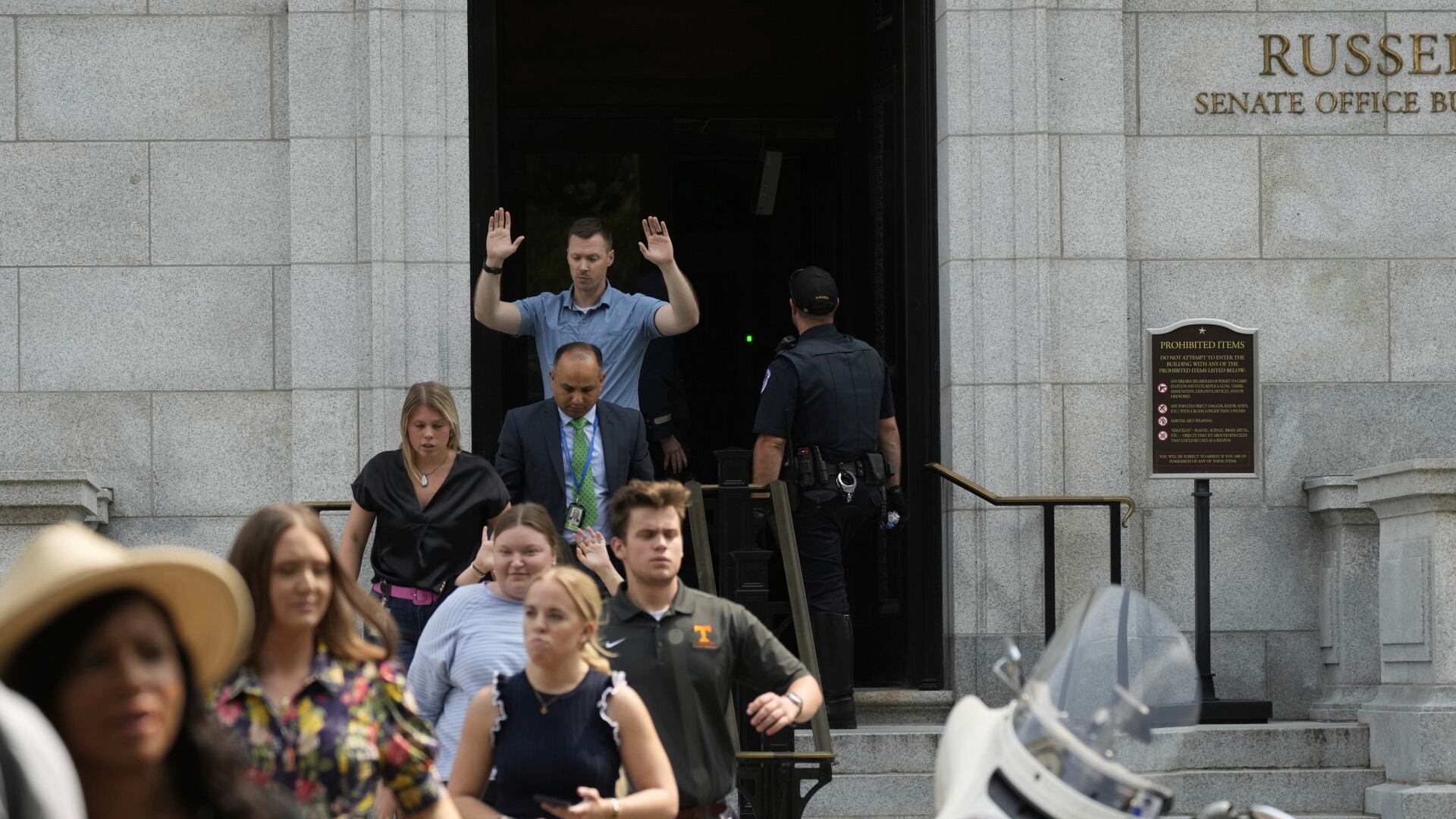
Government staffers walk out of the Russell Senate Office Building, Wednesday, Aug. 2, 2023, on Capitol Hill in Washington. Authorities issued a shelter-in-place order and began searching Senate office buildings near the U.S. Capitol Wednesday afternoon amid reports of an active shooter. (AP Photo/J. Scott Applewhite)
Authorities issued a shelter-in-place order and searched Senate office buildings near the U.S. Capitol Wednesday afternoon after a 911 call warned of a possible active shooter. But a floor-by-floor search of the three buildings found nothing, and Capitol Police Chief Tom Manger said the cause of the security scramble “may have been a bogus call.”
“We found nothing concerning,” he said. “We got nobody who actually heard shots and certainly no victims.”
The incident comes amid heightened security concerns created by former President Donald Trump’s indictment on charges relating to his attempts to overturn the results of the 2020 presidential election. Trump is due in federal court Thursday just a few blocks from the Capitol.
Manger said Washington's multiple law enforcement agencies had been planning “for a couple weeks now” for a possible indictment and had “a security plan in place” in case Trump supporters attempt to disrupt the legal proceedings.
The lockdown Wednesday started when local police received a call around 2:30 Wednesday afternoon warning of a “heavyset Hispanic male wearing body armor” inside the Hart Senate Office Building, one of three structures near the Capitol housing offices for senators and their staffs.
Capitol Police began a search, going floor by floor through the massive buildings.
Inside the Russell Senate Office Building, officers evacuated the hallways and shouted at people to run outside and away from the building. Outside, tourists watched as dozens of police cars surrounded the area. Staff and journalists working in the building received an email instructing them to take shelter in a locked room, remain quiet and silence all electronics.
Manger said about 90 minutes later that all three Senate office buildings had been cleared and the call appeared to have been false.
Both the House of Representatives and the Senate are currently on recess and the office buildings are generally less crowded than usual.
Emily Hoeven, newsletter editor at CalMatters, joins Cheddar News to discuss California Governor Gavin Newsom's gun law modeled after Texas's abortion law.
Chuck Rocha, host of 'Nuestro' podcast and opinion contributor at The New York Times, joins Cheddar News to discuss why Democrats are losing Hispanic voters.
More businesses are requiring workers to return to the office, but there is concern that many employees in the middle class, especially women and people of color, need remote work options for reasons including childcare and financial security. Joan Williams, director of the Center for WorkLife Law at the University of California, joined Cheddar to discuss why office mandates could be detrimental to the middle class. She noted that while companies claim a return to offices would help foster more collaboration and efficiency, reports show that they are successfully able to do their jobs from home.
The U.S. postal service has confirmed that it secretly developed and tested a blockchain-based mobile voting system ahead of the 2020 election. Susan Greenhalgh, senior advisor on election security, Free Speech for People, joins Cheddar News to discuss the cybersecurity complications of a mobile voting system.
The U.S. Supreme Court ruled to allow the controversial Texas abortion law to remain in effect, banning abortion at six weeks and allowing any private citizen to sue a person or doctor aiding or abetting someone seeking an abortion. Outraged at this decision, California Governor Gavin Newsom is working to draft a proposal in line with the law as it relates to guns. Shawn Hubler, California correspondent at the New York Times, joins Cheddar News to discuss.
Even as tech giant Google implements a vaccination mandate, charging its employees to declare their vaccine status within a time frame or risk dismissal, the federal government is tangled up in the court system trying to impose one of its own. Cindy Cohn, the executive director of the Electronic Frontier Foundation, and Harry Nelson, founder and managing partner of Nelson Hardiman LLP, joined Cheddar to debate the ethics, efficacy, and legality surrounding the issue. While Cohn noted that she thinks the federal mandate might be legally sound, her organization is also concerned with a separate question of privacy. "At EFF what we're most interested in is the digital surveillance that's going along with some of these attempts to try to track and confirm whether people are vaccinated or not," she said.