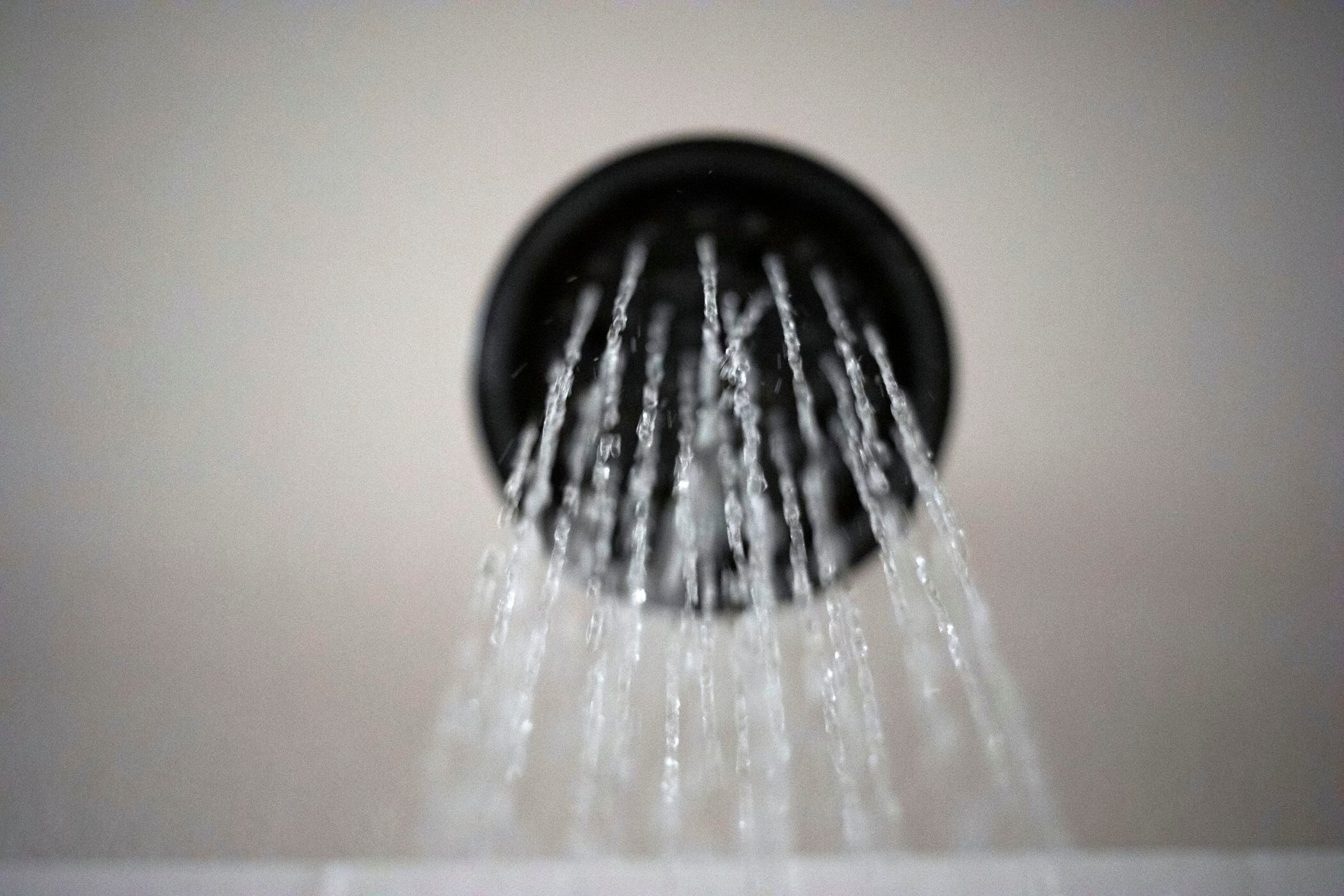
In this Aug. 12, 2020, file photo water flows from a showerhead in Portland, Ore. The Trump administration on Wednesday, Dec. 16, relaxed a regulation restricting water flow from showerheads, a pet peeve of President Donald Trump who complained that he needed more water to make his hair “perfect.” (AP Photo/Jenny Kane, File)
By Deb Riechmann
The Trump administration has relaxed a regulation restricting water flow from showerheads, a pet peeve of President Donald Trump, who complained that he wanted more water to make his hair “perfect.”
Since 1992, federal law has dictated that showerheads shouldn’t spew more than 2.5 gallons (9.5 liters) of water a minute. As newer shower fixtures came out with multiple nozzles, the Obama administration updated the ruling, stating that 2.5 gallons was still the limit regardless of how many nozzles were running. The new ruling, issued on Tuesday, now says each showerhead can emit 2.5 gallons a minute.
“So showerheads — you take a shower, the water doesn’t come out,” Trump said last summer. “You want to wash your hands? The water doesn’t come out. So what do you do? You just stand there longer or you take a shower longer? Because my hair — I don’t know about you, but it has to be perfect. Perfect.”
Also this week, the Energy Department issued a ruling that sets no limits on energy or water use for new washers and dryers with short cycle times in their “normal” setting. The rule sets up separate product classifications for residential clothes washers and dryers with cycle times of fewer than 30 minutes and 45 minutes for front-loading washers.
The Energy Department said the rule on washers and dryers lets manufacturers offer new products that meet consumer demand for products with shorter cycle times. Environmental advocates had a different response.
“With millions of washers and dryers sold in the United States every year, the rule announced today could lead to higher utility bills and additional carbon emissions from powering them,” said the Natural Resources Defense Council. “It also comes at a time when areas of the country are increasingly subject to extended droughts and can’t afford to waste water through unnecessary regulatory loopholes like the one just created by DOE.”
Most members of the Federal Reserve’s interest-rate setting committee supported further reductions to its key interest rate this year, minutes from last month’s meeting showed.
Sinead O’Sullivan breaks down Taylor Swift’s genius marketing for The Life of a Showgirl, which just set the record for most albums sold in a single week.
Markets are emerging from a turbulent Q3. Horizon’s Mike Dickson shares insights on interest rates, small caps, and where investors should look in Q4 and beyond
Bambu Ventures's Kyle Pretsch dives into Lemonaid’s $10M buyout, down from 23andMe’s $400M price tag, and what’s next after Chrome Co.’s dramatic pivot.
Former Cisco Systems CEO John Chambers learned all about technology’s volatile highs and lows as a veteran of the internet’s early boom days during the late 1990s and the ensuing meltdown that followed the mania. And now he is seeing potential signs of the cycle repeating with another transformative technology in artificial intelligence. Chambers is trying take some of the lessons he learned while riding a wave that turned Cisco into the world's most valuable company in 2000 before a crash hammered its stock price and apply them as an investor in AI startups. He recently discussed AI's promise and perils during an interview with The Associated Press.
Grove Collaborative’s CEO shares how the company is reinventing everyday goods with sustainability at the core and working toward a plastic-free future.
Atlanta Mayor Andre Dickens shares plans for affordable housing, community-led growth, and why private and public grocery stores could be key to food equity.