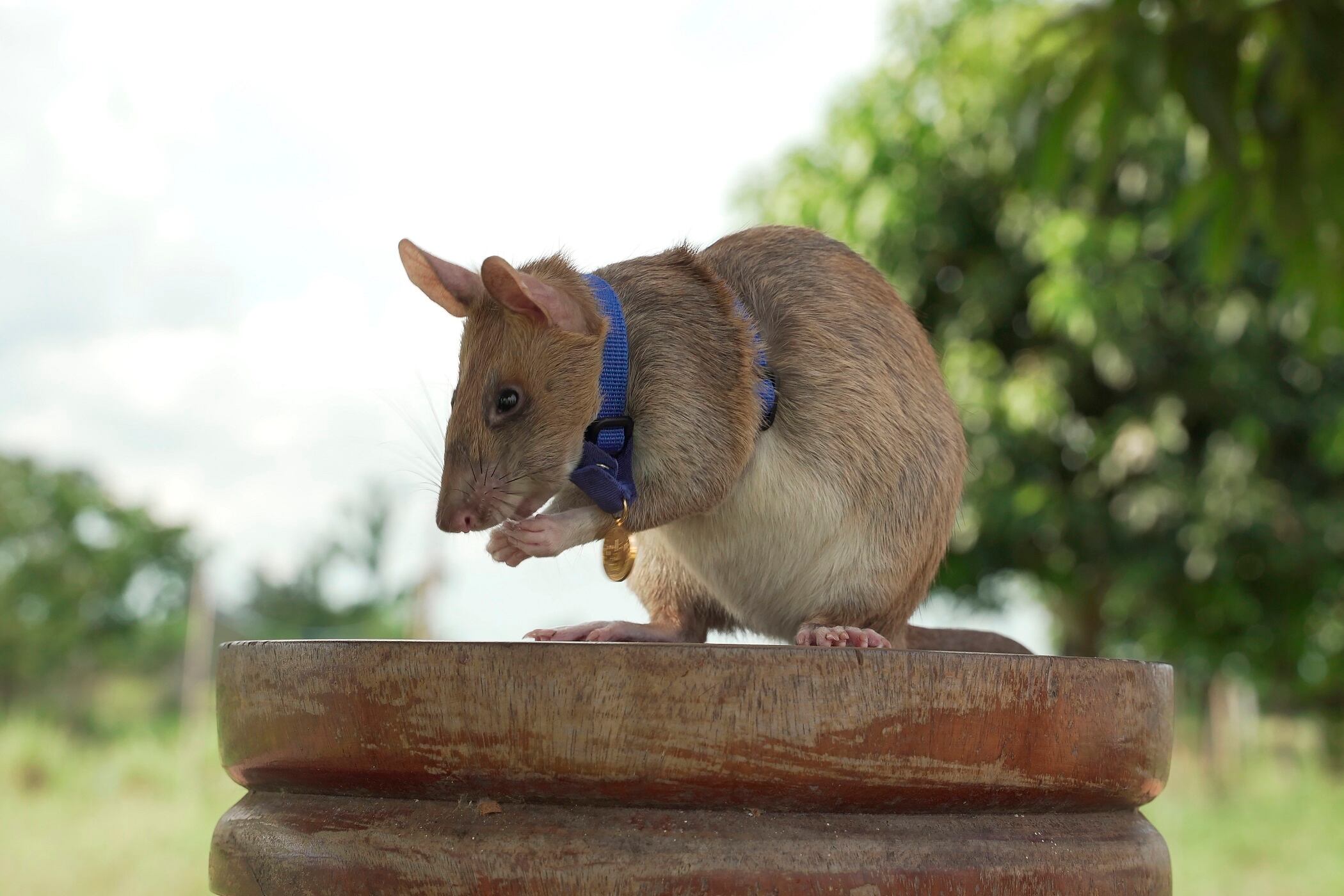
In this undated photo issued by the PDSA, People's Dispensary for Sick Animals, Cambodian landmine detection rat, Magawa is photographed wearing his PDSA Gold Medal, the animal equivalent of the George Cross, in Siem Reap, Cambodia. Magawa passed away in early Jan. 2022, said an announcement on the website of APOPO, a Belgium-headquartered non-profit group. The organization trains rats and dogs to sniff out land mines and tuberculosis. (PDSA via AP, File)
By Sopheng Cheang
A land mine-detecting rat in Cambodia who received a prestigious award for his life-saving duty has died in retirement, the charity for which he had worked has announced.
Magawa, an African giant pouched rat, passed away last weekend, said an announcement on the website of APOPO, a Belgium-headquartered non-profit group. The organization trains rats and dogs to sniff out land mines and tuberculosis.
“All of us at APOPO are feeling the loss of Magawa and we are grateful for the incredible work he’s done,” the announcement said. Magawa was born in November 2013 in Tanzania, where APOPO maintains its operational headquarters and training and breeding center. He was sent to Cambodia in 2016.
The death of Magawa was announced a day after three mine removal experts working for another group were killed by an accidental explosion of an anti-tank mine in Cambodia’s northern province of Preah Vihear. Almost three decades of civil war that ended in 1998 left Cambodia littered with land mines and other unexploded ordnance that continues to kill and maim.
APOPO’s office in Cambodia posted condolences for the three dead and one wounded from the Cambodia Self Help Demining group.
According to APOPO, Magawa detected more than 100 land mines and other explosives during his five-year career before retiring last year.
“His contribution allows communities in Cambodia to live, work, and play without fear of losing life or limb,” said the group. In 2020, the rat also won a gold medal from the Britain-based People’s Dispensary for Sick Animals, considered the highest award for gallantry an animal can receive.
African giant pouched rats are believed to be especially well-suited for land mine clearance because their small size lets them walk across mine fields without triggering the explosives.
In retirement in Cambodia’s northwestern province of Siem Reap, Magawa was housed in his usual cage, and fed the same food — mostly fresh fruit and vegetables — that sustained him during his active career. To keep him trim, he was released for 20-30 minutes a day into a larger cage with facilities such as a sandbox and a running wheel. His death at 8 years of age was not unusual for the species.
As half a million Ukrainians fled when Russia invaded its neighbor, some civilians chose to stay in harm's way. Igor Gamaniuk, a 17-year-old Ukrainian college student, joined Cheddar News to talk about his decision to remain in his beloved country and volunteer to support soldiers with food, clothing, and supplies. "Right now people are pretty calm in my town. We are trying not to panic. But we have to be cautious because every day and every night the siren could sound and we have to move away from the window or go to the nearest shelter," Gamaniuk explained.
A hospital basement in Ukraine’s coastal city of Mariupol has transformed into a bomb shelter and maternity ward amid shelling during Russia’s invasion.
To kick off Women's History Month, Luminary will be hosting its first annual #InThisTogether Summit. Cate Luzio, founder and CEO of Luminary, joins Cheddar News to discuss the event.
President Biden says the union is strong, Russia is attacking civilians, and Mardis Gras returns! Here is all you Need2Know for Wednesday, March 2, 2022.
World leaders are currently dealing with a handful of pressing issues, including Russia's invasion of Ukraine, inflation, and not to mention the COVID-19 pandemic; but it could be argued that the most pressing issue is one that has experienced its fair share of neglect in the past -- climate change. As tensions escalate between Russia and Ukraine, there is fear the focus on climate will once again be pushed aside. However, the White House appears to be making some effort to prevent that from happening. The White House Office of Science and Technology held a first-of-its-kind roundtable discussion with some of the nation's leading climate scientists on Thursday. Michael Mann, Director of the Earth System Science Center at Pennsylvania State University, and author of the book 'The New Climate War' joins Cheddar News' Closing Bell to discuss his experience as one of the climate scientists at the White House event.
U.S. stocks rebounded to end higher on Thursday after President Biden announced new sanctions against Russia following the country's attack on Ukraine. The Dow was down 859 points at its lowest point of the session, before ultimately finishing the day in the green. Melissa Armo, founder and owner of the Stock Swoosh, joins Cheddar News' Closing Bell to discuss.
Professional golfer Phil Mickelson issued an apology this week after facing backlash over comments he made in support of a golf tour backed by Saudi Arabia. The proposed golf league is called the Super Golf League and is funded by the Public Investment Fund, the financial arm of the Saudi government. Mickelson faced criticism after seeming to imply that he was willing to overlook the Middle Eastern country's human rights record in order to create a league that would rival the PGA Tour. David Salituro, PGA sportswriter for fansided.com, joins Cheddar News' Closing Bell to discuss.
HearHere bills itself as a mobile audio entertainment app for road trips. The company just announced $3.2 million in seed funding led by Camping World, a retail company that sells recreational vehicles and camping supplies. HearHere's GPS-powered app offers over 8,880 stories across the continental U.S. and serves up the stories based on a users' geographic location and interests. The stories are narrated by some big-name celebrities including actor Kevin Costner, who is a co-founder of the company. Woody Sears, co-founder and CEO of HearHere, joins Cheddar News' Closing Bell to discuss.
On December 25, 2021, NASA got into the holiday spirit by launching the James Webb Space Telescope, the largest and most powerful space science observatory in history.
It is intended to succeed the Hubble Space Telescope as NASA's flagship mission in astrophysics and is able to view objects too old and distant for Hubble. Gregory Robinson, director of NASA's James Webb Space Telescope program, joins Cheddar News' Closing Bell to discuss the mission. "I think a lot of what we don't know today is what I'm expecting to find and certainly really understand what took place more than 13.5 billion years ago and see the formation of some of the first galaxies in our universe," said Robinson.