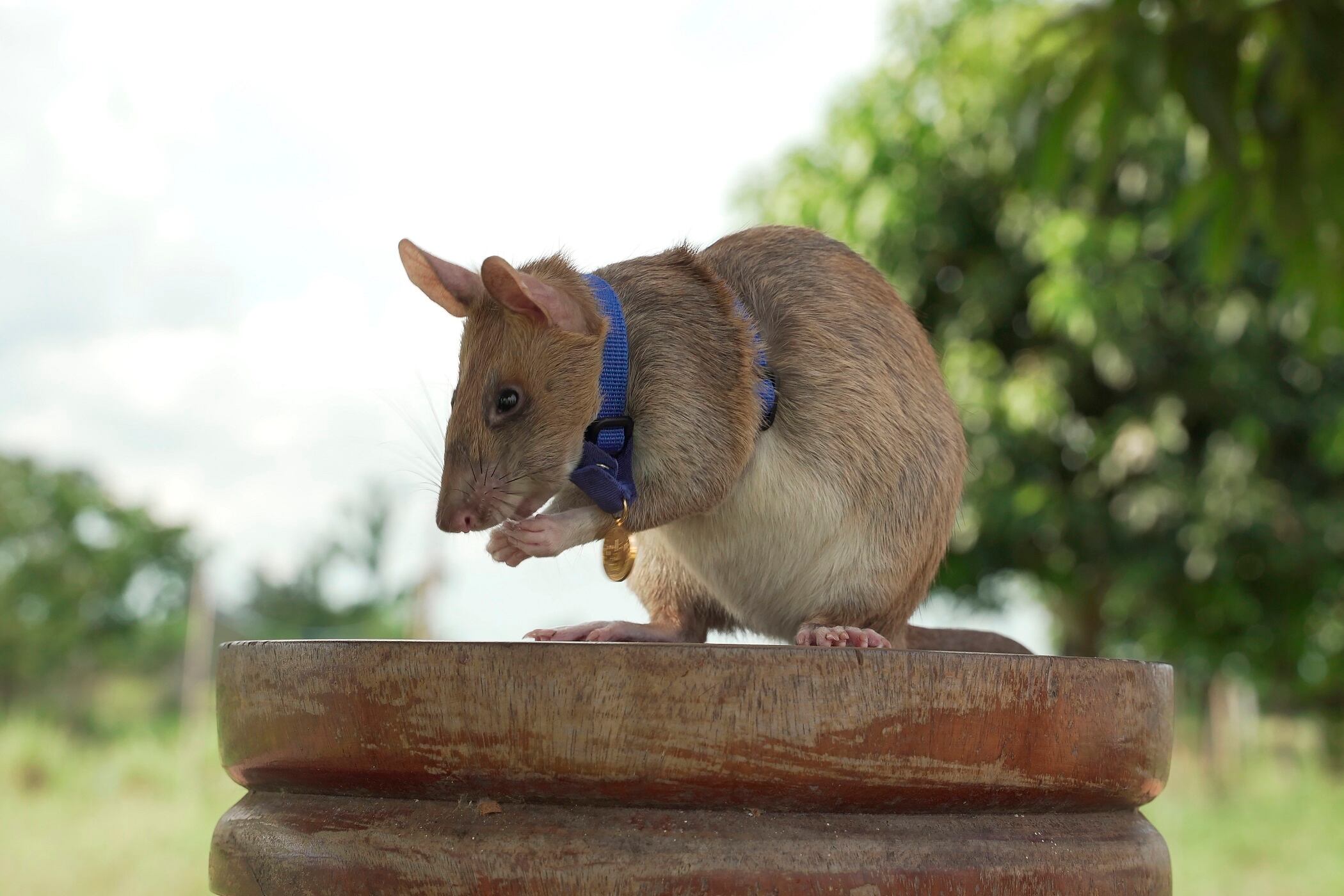
In this undated photo issued by the PDSA, People's Dispensary for Sick Animals, Cambodian landmine detection rat, Magawa is photographed wearing his PDSA Gold Medal, the animal equivalent of the George Cross, in Siem Reap, Cambodia. Magawa passed away in early Jan. 2022, said an announcement on the website of APOPO, a Belgium-headquartered non-profit group. The organization trains rats and dogs to sniff out land mines and tuberculosis. (PDSA via AP, File)
By Sopheng Cheang
A land mine-detecting rat in Cambodia who received a prestigious award for his life-saving duty has died in retirement, the charity for which he had worked has announced.
Magawa, an African giant pouched rat, passed away last weekend, said an announcement on the website of APOPO, a Belgium-headquartered non-profit group. The organization trains rats and dogs to sniff out land mines and tuberculosis.
“All of us at APOPO are feeling the loss of Magawa and we are grateful for the incredible work he’s done,” the announcement said. Magawa was born in November 2013 in Tanzania, where APOPO maintains its operational headquarters and training and breeding center. He was sent to Cambodia in 2016.
The death of Magawa was announced a day after three mine removal experts working for another group were killed by an accidental explosion of an anti-tank mine in Cambodia’s northern province of Preah Vihear. Almost three decades of civil war that ended in 1998 left Cambodia littered with land mines and other unexploded ordnance that continues to kill and maim.
APOPO’s office in Cambodia posted condolences for the three dead and one wounded from the Cambodia Self Help Demining group.
According to APOPO, Magawa detected more than 100 land mines and other explosives during his five-year career before retiring last year.
“His contribution allows communities in Cambodia to live, work, and play without fear of losing life or limb,” said the group. In 2020, the rat also won a gold medal from the Britain-based People’s Dispensary for Sick Animals, considered the highest award for gallantry an animal can receive.
African giant pouched rats are believed to be especially well-suited for land mine clearance because their small size lets them walk across mine fields without triggering the explosives.
In retirement in Cambodia’s northwestern province of Siem Reap, Magawa was housed in his usual cage, and fed the same food — mostly fresh fruit and vegetables — that sustained him during his active career. To keep him trim, he was released for 20-30 minutes a day into a larger cage with facilities such as a sandbox and a running wheel. His death at 8 years of age was not unusual for the species.
Dr. Celeste González de Bustamante, professor and director of the Center for Border and Global Journalism at the Univerity of Arizona, and Dr. Jeannine E. Relly, professor and director of Global Initiatives at the Center for Border and Global Journalism at the University of Arizona, join Cheddar News to discuss the recent journalist killings in Mexico.
Kim Kardashian’s shapewear brand Skims has doubled its valuation to $3.2 billion. Investors have taken a bet on the success of this brand in the form of fresh funds for the two-year-old company.
Nathan Harding, CEO of Luum, joins Cheddar Innovates to discuss the process of having a robot put on eyelash extensions, and how automation is making its way into the beauty industry
Kevin Yu, Founder and CEO of Sidechef, joins Cheddar Innovates to discuss how it's building a platform to make recipe shopping easy, and how its features help you discover new recipes with the same ingredients to fight the massive problem of food waste.
On this episode of Cheddar Innovates: Sidechef CEO breaks down how it's building a platform to make recipe shopping easy; Luum CEO explains the process of having a robot put on eyelash extensions; A look at Curiosity Stream's new original series, 'Evolve.'
Wednesday marked two years since the basketball legend Kobe Bryant, his daughter Gianna, and seven others died in a tragic helicopter crash. In remembrance, a bronze statue has been temporarily placed at the site with all of the passenger's names included on the memorial.
McDonald's missed on both the top and bottom lines in its Q4 earnings, marking the fourth loss for the fast-food giant in the past eight quarters. It comes as higher costs from food to wages ate into the blue-chip company's profits. George Seay, CEO of investment advisor Annandale Capital, joined Wake Up with Cheddar to discuss the recent numbers and the better-than-expected success of the McPlant burger made with plant-based Beyond Meat. "They're changing with the times, and they have to," Seay noted. "You can just sell a Big Mac to everybody. There's a lot of people who don't want to eat a Big Mac anymore."