By Janie Har and Haven Daley

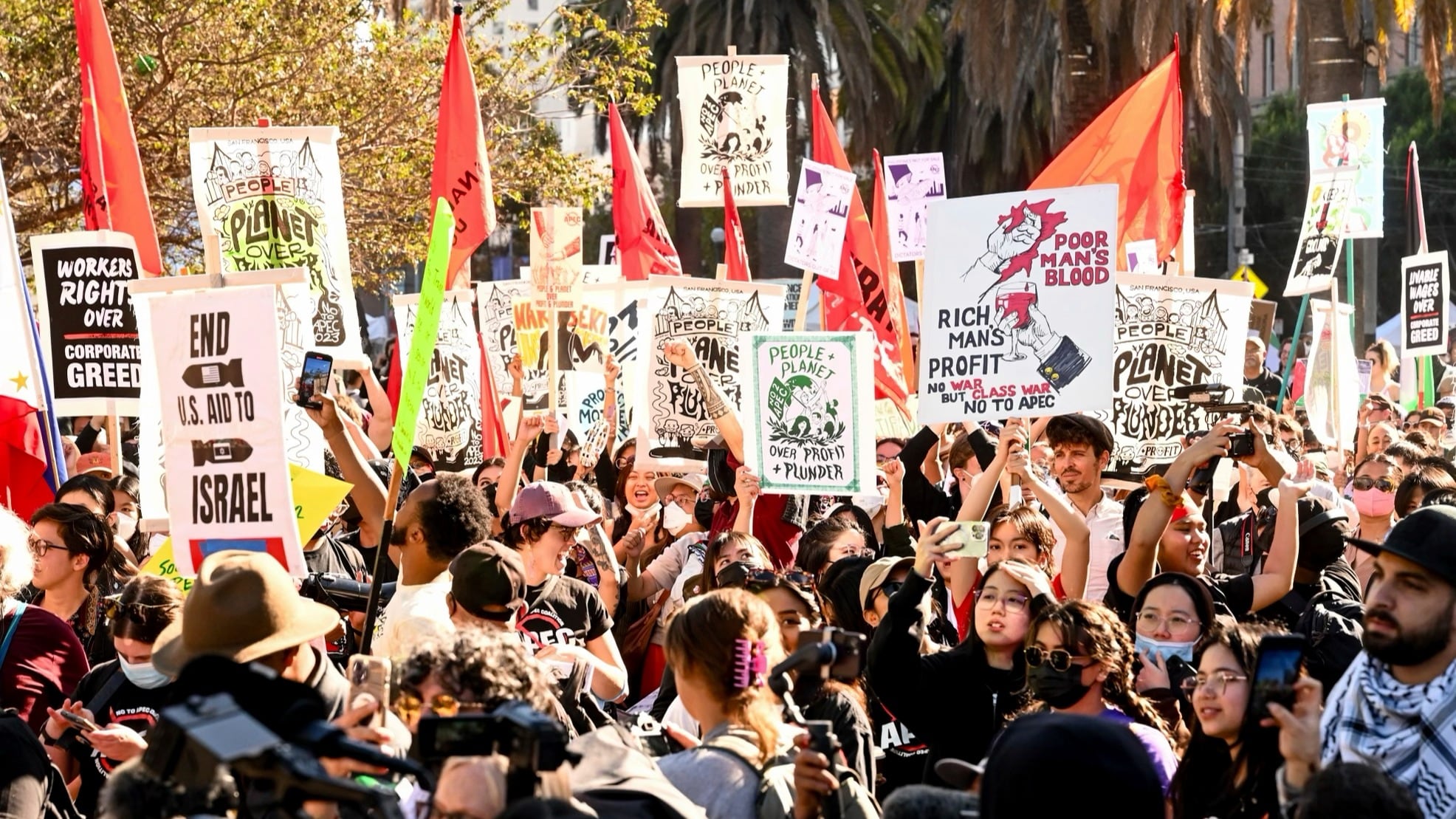
Activists protesting corporate profits, environmental abuses, poor working conditions and the Israel-Hamas war marched in downtown San Francisco on Sunday, united in their opposition to a global trade summit that will draw President Joe Biden and leaders from nearly two dozen countries.

Protests are expected throughout this week's Asia-Pacific Economic Cooperation leaders’ conference, which could draw more than 20,000 attendees, including hundreds of international journalists. The No to APEC coalition, made up of more than 100 grassroots groups, says trade deals struck at summits such as APEC exploit workers and their families.

It's unlikely world leaders will even glimpse the protests given the strict security zones accessible only to attendees at the Moscone Center conference hall and other summit sites. But Suzanne Ali, an organizer for the Palestinian Youth Movement, says the U.S. government needs to be held to account for supplying weapons to Israel in its war against Hamas.

“Even if they cannot see us, as we’re mobilizing and marching together, they will know that we’re out there,” she said.

Thousands of demonstrators gathered Sunday to hear speeches from activists supporting various causes, followed by a march through downtown. Among the voices were environmentalists chanting “Rise up” and carrying banners that read “People and planet over profit and plunder!”

They're opposed to the framing of “supposed ‘clean’ and ‘green’ economies that are really propping up corporate profits,” said Nik Evasco, an organizer with the climate block of the No to APEC coalition.

“Any time there are so-called free trade deals, what we’ve seen historically is that it’s really about opening up pristine lands that go toward making money for corporations,” Evasco said.

San Francisco has a long tradition of loud and vigorous protests, as do trade talks. In 1999, tens of thousands of protesters took to the streets of Seattle during a World Trade Organization conference. Protesters succeeded in delaying the start of that conference and captured global attention as overwhelmed police fired tear gas and plastic bullets and arrested hundreds of people.

Chile withdrew as APEC host in 2019 due to mass protests. Last year, when Thailand hosted the summit in Bangkok, pro-democracy protesters challenged the legitimacy of the Thai prime minister. Police fired at the crowd with rubber bullets that injured several protesters and a Reuters journalist.

Chief Bill Scott of the San Francisco Police Department said he expects several protests a day, although it's uncertain how many will materialize. He warned against criminal behavior.

“People are welcome to exercise their constitutional rights in San Francisco, but we will not tolerate people committing acts of violence, or property destruction or any other crime,” Scott said. “We will make arrests when necessary.”

APEC, a regional economic forum, was established in 1989 and has 21 member countries, including the world's two largest economic superpowers — China and the U.S — as well as Mexico, Brazil and the Philippines. An accompanying CEO summit is scheduled for this week, which critics also plan to protest Wednesday.

Headlining the summit is a highly anticipated meeting between Biden and Chinese President Xi Jinping, who rarely — if at all — encounters protesters on home soil.

China has heavy security ahead of any events within its borders to ensure no protests occur. It also steps up border checks at city limits and at transit points such as railway stations and airports. Human rights activists based in China will often receive visits or phone calls from police ahead of important events as reminders to not demonstrate.

Rory McVeigh, sociology professor and director of the Center for the Study of Social Movements at the University of Notre Dame, said politicians use protests to gauge public opinion and that media attention helps.

“Probably a lot of protests just don’t make much difference, but occasionally they do, and occasionally they can make a huge difference," he said.

The United Vietnamese American Community of Northern California plans to protest Xi and Vietnam President Vo Van Thuong. The International Coalition for Human Rights in the Philippines will be rallying for the rights of Indigenous Filipinos and protesting the presence of President Bongbong Marcos, the son of dictator Ferdinand Marcos.

Protesters are disappointed that San Francisco, with its rich history of standing up for the working class, would host CEOs of companies and leaders of countries that they say do great harm.

“It's silly, from the mayor to the governor to the president, they want to say this is a great idea to have all these people who have been profiting off the intersecting crises of our time,” Evasco said. “It's just sickening.”

Associated Press writer Huizhong Wu in Bangkok contributed to this report.

Share:
More In Politics
States Turn to Unusual Solutions as Schools Face Staffing Shortages
With an increasing number of teachers and staff calling out sick by the day, the state of Oklahoma is turning to an unusual solution. Republican Governor Kevin Stitt has issued an executive order that permits state employees to work as substitute teachers. Shaily Baranwal, founder and CEO of Elevate K-12, joins Cheddar News to discuss.
Possible Cracks Between U.S. and Allies on Issue of Ukraine and Russia
On Thursday, Secretary of State Antony Blinken addressed the stance of the U.S. and its allies should Russia make any forays into Ukraine, a seeming response to President Biden's remarks that should Putin engage in something short of a full invasion, there might be some indecision among allied nations regarding what to do. Ariel Cohen, a senior fellow at the think tank Atlantic Council, joined Cheddar to discuss the difficulty faced by Blinken wrangling unity as tensions run high in the region. "There'll be a smaller incursion, and the president implied, there'll be a weaker response because our European allies have created this horrible situation where they are dependent on Moscow for their gas supply," Cohen explained.
Biden Approval Rating Tanking at One-Year Mark Over Issues Like Inflation
During a nearly two-hour press conference on Wednesday, President Biden spoke on his accomplishments and challenges from the first year of his presidency, and what his administration hopes to accomplish in the coming year. However, his approval ratings are underwater as COVID remains a big concern for voters — as does inflation, noted Tom Bevan, co-founder and president of polling aggregator RealClearPolitics. "The public thinks [inflation] is priority number one, and the administration is concerned about it, they talk about it, but they're not spending enough time on it as far as the public is concerned," said Bevan.
Behind Australian Judges Ruling for Allowing Novak Djokovic Deportation
The drama surrounding tennis star Novak Djokovic continues after he was deported from Australia over the weekend due to the nation's COVID-19 vaccine requirements. Djokovic was forced to leave the country on the eve of what was to be his first match in defense of his Australian Open title after three judges ruled in favor of his removal and revealed their reasoning for doing so. Adding to his woes, a law recently passed in France is putting his chances of defending his French Open title in jeopardy. The director of Marist's Center for Sports Communication, Jane McManus, joined Cheddar to discuss the ongoing fallout.
Louisiana Senate Candidate on Smoking Weed in His Campaign Ad
As the midterm elections get ever closer, candidates have been getting creative with their campaigns to stick out and to connect with voters. Gary Chambers, a Democratic candidate for the U.S. Senate from Louisiana, has definitely attracted attention with an advertisement featuring him smoking a blunt, making a point about the inequity of anti-cannabis laws. "We wanted to bring the seriousness of the moment," he said of the ad. "But we also wanted to make sure that people understand that there are 19 states that are legal right now but Black people and brown people are being over-incarcerated in mostly Southern and Midwestern states in America for cannabis possession."
TLDR Act Provides the 'TLDR' on Sites' Terms of Service
If some members of Congress have their way, there might finally be a 'TLDR' on sites' terms of service, introduced by the terms-of-service labeling, design, and readability act – or TLDR for short. With this act, users will actually understand what they're agreeing to or the many ways in which their data is being used before pressing 'accept.' J.D. sat down with co-sponsor of the bill and Senator Bill Cassidy, to discuss.
All Eyes on Biden: Amid Inflation, Pandemic, How Can President Push Agenda While His Party Controls Washington?
President Joe Biden's first year in office is wrapping up. What has he achieved, and what else remains on the table while the Democrats have control of Washington? Amid an ongoing pandemic and rising inflation, Biden's approval rating is at an all-time low and his party is plagued by infighting. Will he be able to continue pushing key parts of his agenda? Paul Glastris, former Bill Clinton speechwriter & Editor-in-chief of 'Washington Monthly,' joins Cheddar News' Closing Bell to discuss the president's achievements in his first year, where he's fallen short, and what he must do in order to get more of his agenda signed into law.
Senate Bills to Reign in Big Tech Anticompetitive Practices Could Hurt Consumers
Tech giants Meta, Amazon, Alphabet, and Apple are faced with a bipartisan antitrust legislation effort underway in the Senate Judiciary Committee. The companies stand accused of promoting their own goods and services over smaller competitors on their platforms, holding too much monopolistic power via their app stores and services. Adam Kovacevich, founder and CEO of Chamber of Progress, a technology industry trade group, joined Cheddar to argue that the bills that are being debated currently could end up hurting consumers, rather than helping.
Load More