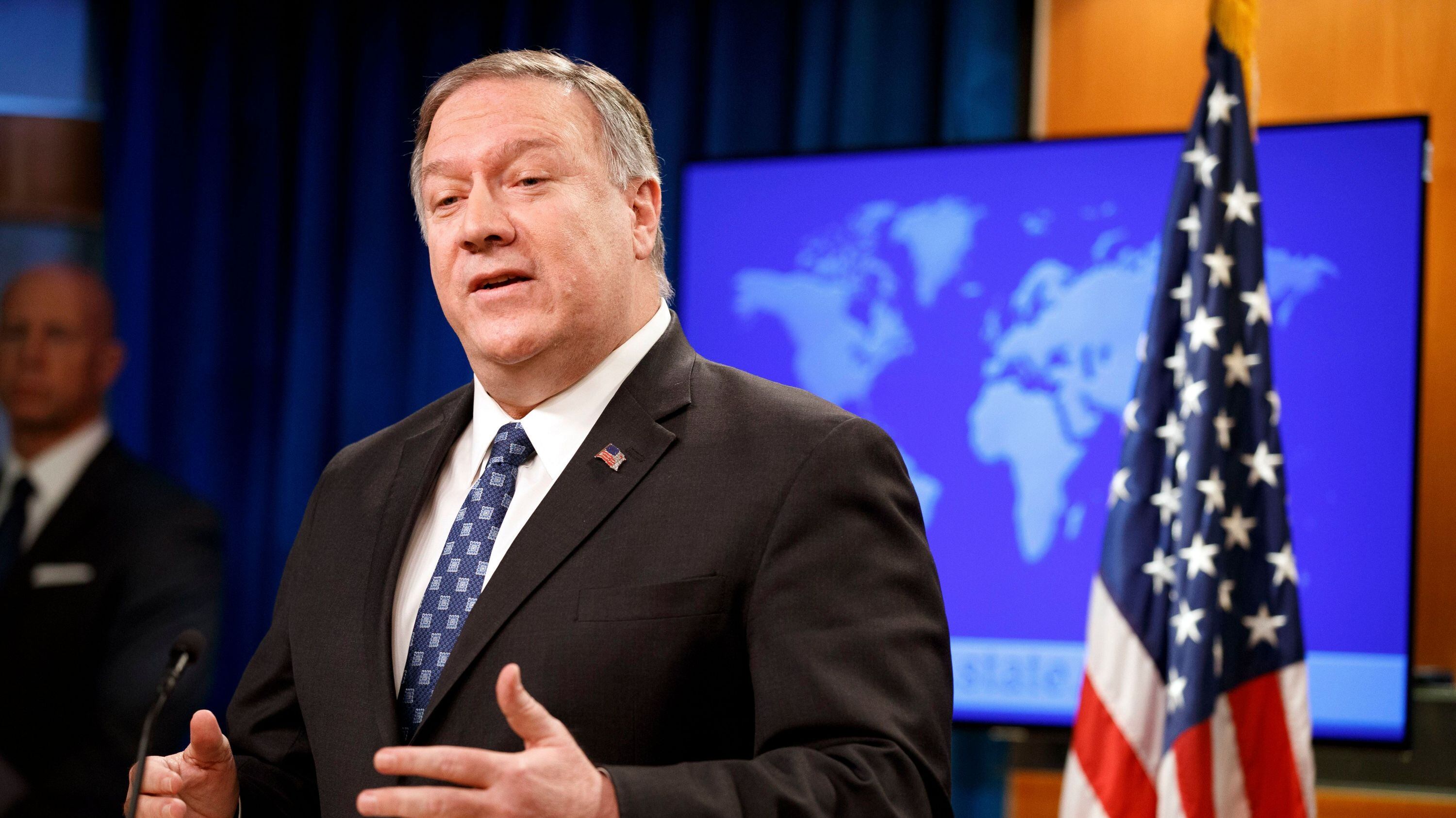
Secretary of State Mike Pompeo said Tuesday that reports Gen. Qassem Soleimani was on a diplomatic mission when he was killed are "fundamentally false" and asserted that the president's actions that led to his death were both legal and appropriate.
As tensions continue to rise in the Middle East, Pompeo answered questions from reporters at the State Department after making remarks on issues that included turmoil in Venezuela and the Australian wildfires, for which he offered his condolences.
Pompeo, the former C.I.A. director, declined to provide evidence of what has been repeatedly described by the White House as an "imminent" threat from Iran that led to the assassination. He further said the timing of the attack was less important than the fact that American lives were threatened.
"If you're looking for imminence, you need to look no further than the days that led up to the strike that was taken against Soleimani," he said.
An American contractor was killed late last month in a rocket attack by an Iran-backed militia in Iraq. After the U.S. ordered a retaliatory missile strike, protesters stormed the embassy in Baghdad on New Year's Eve. Some Pentagon officials have said intelligence did not show an imminent attack.
He added, "And then you, in addition to that, have what we can clearly see were continuing efforts on behalf of this terrorist to build out a network of campaign activities that were going to lead potentially to the death of many more Americans."
"It was the right decision, we got it right," and U.S. intelligence supported that conclusion, Pompeo claimed, defending both the president's authorization of the strike and the broader Iran policy.
Pompeo said the U.S. would also abide by international law. On Monday, Defense Secretary Mark Esper acknowledged that striking cultural sites is a war crime, despite the president tweeting about such potential targets in Iran. When questioned on the subject, Pompeo said "let me tell you who's done damage to the Persian culture. It's not the United States of America. It's the ayatollah."
Meanwhile, U.S. forces were placed on high alert in the Middle East amid military intelligence suggesting Iran is moving equipment to launch drone strikes.
Pompeo said the president had acted in an "entirely legal, appropriate" way that was "perfectly within our strategy," which he described as a "pressure campaign we have in place … diplomatic component, economic component, and military component."
"In the event that the Iranians make another bad choice, the president will respond in the way he did last week," he said.
Last week, President Trump authorized the airstrike killing Soleimani and his adviser Abu Mahdi al-Muhandis at the Baghdad airport, angering Tehran for killing the high-profile commander of the Quds Force and frustrating some American politicians who feel he took his power too far. The president ordered the strike without giving notice to Congress, seemingly conflicting with the War Powers Act of 1973. Speaker Nancy Pelosi said she will hold votes this week when the House of Representatives is back in session to limit the president's ability to act unilaterally. A Senate vote is expected as well.