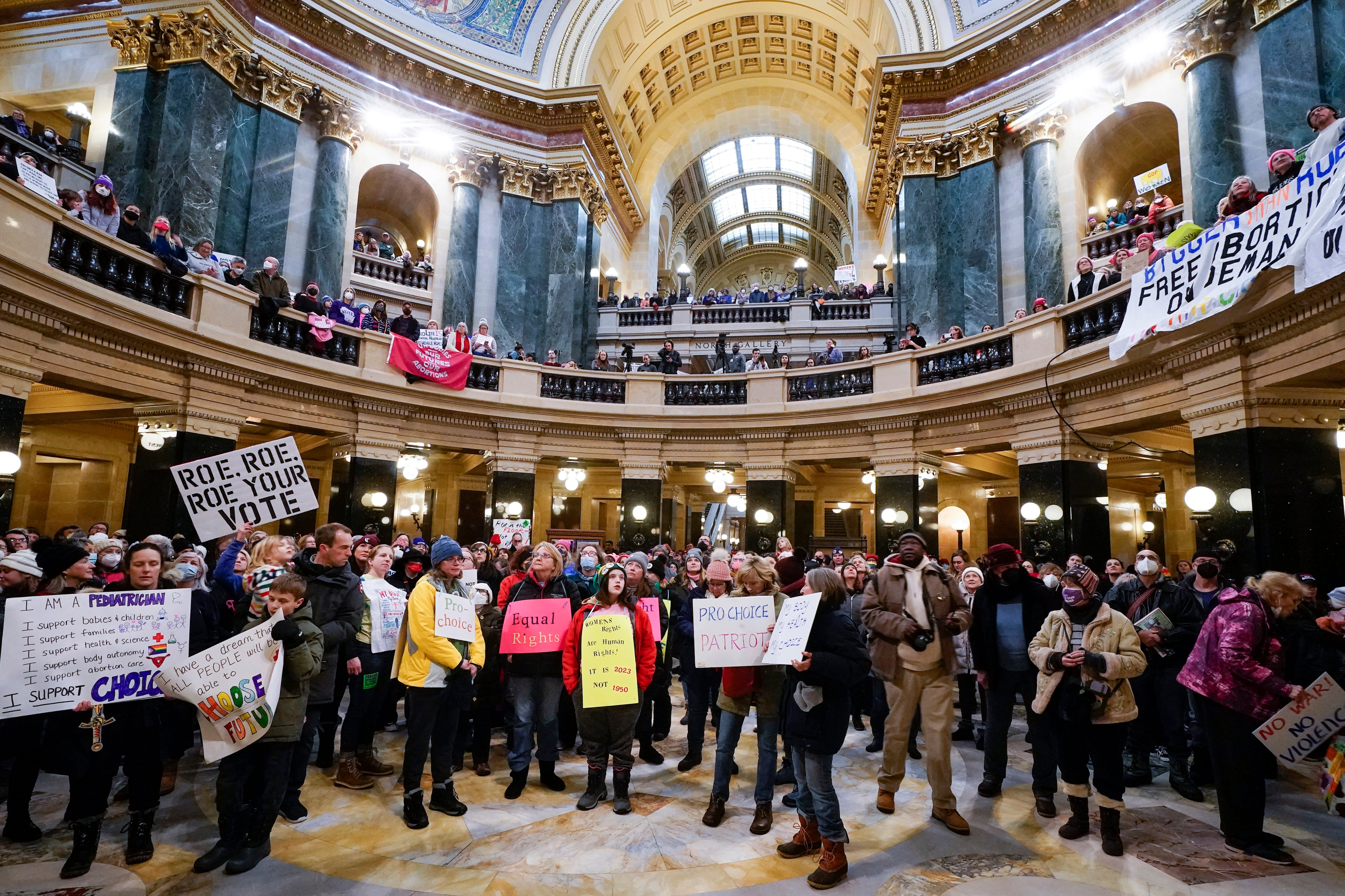
Protesters are seen in the Wisconsin Capitol Rotunda during a march supporting overturning Wisconsin's near total ban on abortion, Jan. 22, 2023, in Madison, Wis. Planned Parenthood has resumed offering abortions in Wisconsin at clinics in Madison and Milwaukee. The resumption of services on Monday Sept. 18 2023 is the first time abortions have been available in the state since the U.S. Supreme Court overturned Roe v. Wade in June 2022. (AP Photo/Morry Gash)
By Harm Venhuizen
Planned Parenthood resumed offering abortion services in Wisconsin on Monday after halting them for more than a year since the U.S. Supreme Court overturned Roe v. Wade.
Providers across the state stopped offering abortions following the June 2022 decision, fearing enforcement of an 1849 state law that appears to ban the procedure but had previously been nullified by the 1973 Roe ruling. A judge ruled last month that the 144-year-old law doesn't apply to medical abortions.
In light of the ruling, Planned Parenthood of Wisconsin began offering abortions at clinics in Madison and Milwaukee again on Monday. The group did not say how many abortions it expected to perform but said appointments at its Milwaukee clinic on Monday were completely filled within 24 hours of announcing that services would resume.
Without access to abortion care in Wisconsin for the past 15 months, many patients have sought assistance in neighboring Illinois, where abortions have remained widely available. According to Planned Parenthood of Illinois, its clinics have seen a seven-fold increase in patients from Wisconsin since the Supreme Court overturned Roe.
Women's Medical Fund of Wisconsin, which offers financial assistance for abortion procedures and related costs, helped 477 patients from Wisconsin obtain abortions outside the state in the first six months of 2023, according to board president Cynthia Lin. Most of those appointments were in Minnesota or Illinois, she said.
“There’s a lot of work still to do, even within the return of legal abortion care in Wisconsin,” Lin said on Monday, pointing to the long distances many patients still have to travel to reach clinics in Madison or Milwaukee. Lin also highlighted barriers created by state laws that require people seeking an abortion in Wisconsin to have an ultrasound and a counseling appointment before waiting 24 hours for the procedure.
The lawsuit challenging Wisconsin's 1849 law was brought by the state's Democratic attorney general and is expected to end up in front of the Wisconsin Supreme Court, which flipped to liberal control last month.
Democrats, including Wisconsin Gov. Tony Evers, praised the resumption of abortion services. Meanwhile, anti-abortion rights groups in the state condemned the move and promised to continue fighting in court for the procedure to be outlawed.
Harm Venhuizen is a corps member for the Associated Press/Report for America Statehouse News Initiative. Report for America is a nonprofit national service program that places journalists in local newsrooms to report on undercovered issues.
Emily Hoeven, newsletter editor at CalMatters, joins Cheddar News to discuss California Governor Gavin Newsom's gun law modeled after Texas's abortion law.
Chuck Rocha, host of 'Nuestro' podcast and opinion contributor at The New York Times, joins Cheddar News to discuss why Democrats are losing Hispanic voters.
More businesses are requiring workers to return to the office, but there is concern that many employees in the middle class, especially women and people of color, need remote work options for reasons including childcare and financial security. Joan Williams, director of the Center for WorkLife Law at the University of California, joined Cheddar to discuss why office mandates could be detrimental to the middle class. She noted that while companies claim a return to offices would help foster more collaboration and efficiency, reports show that they are successfully able to do their jobs from home.
The U.S. postal service has confirmed that it secretly developed and tested a blockchain-based mobile voting system ahead of the 2020 election. Susan Greenhalgh, senior advisor on election security, Free Speech for People, joins Cheddar News to discuss the cybersecurity complications of a mobile voting system.
The U.S. Supreme Court ruled to allow the controversial Texas abortion law to remain in effect, banning abortion at six weeks and allowing any private citizen to sue a person or doctor aiding or abetting someone seeking an abortion. Outraged at this decision, California Governor Gavin Newsom is working to draft a proposal in line with the law as it relates to guns. Shawn Hubler, California correspondent at the New York Times, joins Cheddar News to discuss.
Even as tech giant Google implements a vaccination mandate, charging its employees to declare their vaccine status within a time frame or risk dismissal, the federal government is tangled up in the court system trying to impose one of its own. Cindy Cohn, the executive director of the Electronic Frontier Foundation, and Harry Nelson, founder and managing partner of Nelson Hardiman LLP, joined Cheddar to debate the ethics, efficacy, and legality surrounding the issue. While Cohn noted that she thinks the federal mandate might be legally sound, her organization is also concerned with a separate question of privacy. "At EFF what we're most interested in is the digital surveillance that's going along with some of these attempts to try to track and confirm whether people are vaccinated or not," she said.