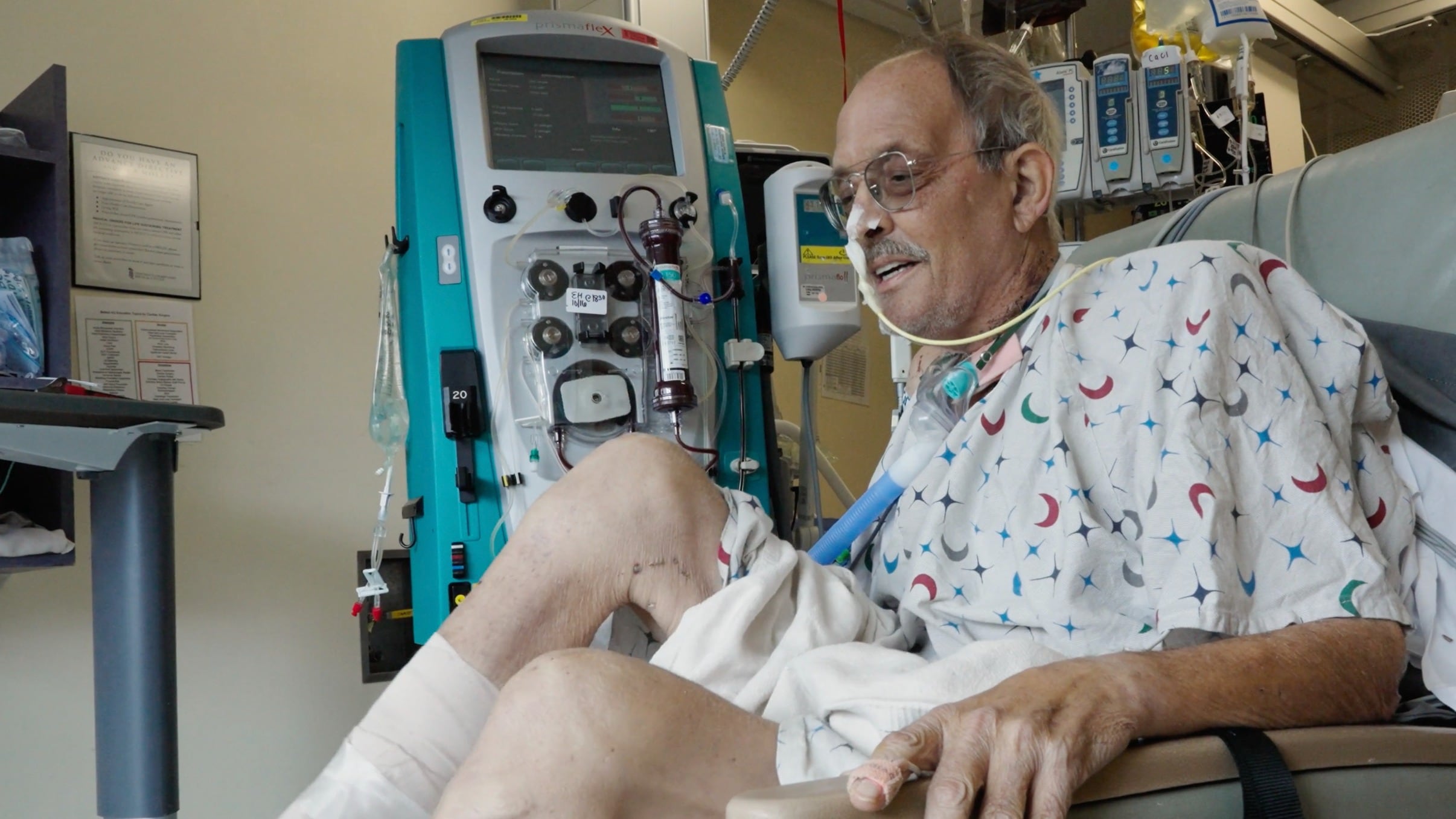
In this image from video provided by the University of Maryland School of Medicine, Lawrence Faucette, a pig heart transplant patient, works with a physical therapist at the school's hospital in Baltimore, Md., on Wednesday, Oct. 18, 2023. (Tom Jemski/University of Maryland School of Medicine via AP)
Lawrence Faucette was dying from heart failure and ineligible for a traditional heart transplant because of other health problems when doctors at the University of Maryland School of Medicine offered the highly experimental surgery.
In the first glimpse of Faucette provided since the Sept. 20 transplant, hospital video shows physical therapist Chris Wells urging him to smile while pushing through a pedaling exercise to regain his strength.
“That’s going to be tough but I’ll work it out,” Faucette, 58, replied, breathing heavily but giving a smile.
The Maryland team last year performed the world’s first transplant of a heart from a genetically altered pig into another dying man. David Bennett survived just two months before that heart failed, for reasons that aren’t completely clear although signs of a pig virus later were found inside the organ. Lessons from that first experiment led to changes before this second try, including better virus testing.
Attempts at animal-to-human organ transplants — called xenotransplants — have failed for decades, as people’s immune systems immediately destroyed the foreign tissue. Now scientists are trying again using pigs genetically modified to make their organs more humanlike.
In Friday’s hospital video, Faucette’s doctors said the pig heart has shown no sign of rejection.
“His heart is doing everything on its own,” said Dr. Muhammad Mohiuddin, the Maryland team’s cardiac xenotransplantation chief.
A hospital spokeswoman said Faucette, of Frederick, Maryland, has been able to stand and physical therapists are helping him gain strength needed to attempt walking.
Many scientists hope xenotransplants one day could compensate for the huge shortage of human organ donations. More than 100,000 people are on the nation’s list for a transplant, most awaiting kidneys, and thousands will die waiting.
A handful of scientific teams have tested pig kidneys and hearts in monkeys and in donated human bodies, hoping to learn enough for the Food and Drug Administration to allow formal xenotransplant studies.
The Associated Press Health and Science Department receives support from the Howard Hughes Medical Institute’s Science and Educational Media Group. The AP is solely responsible for all content.
Carlo and Baker cover the latest developments after a devastating tornado outbreak over the weekend, plus an eye on Omicron and inflation, and not even Spielberg can save the box office.
Reusable rocket developer Stoke Space Technologies raised $65 million in a Series A round led by Breakthrough Energy Ventures, a firm founded by Bill Gates. Stoke says its reusable rockets provide the satellite industry with low-cost, on-demand access to and from orbit. As companies like SpacX and Blue Origin are also making commitments to rocket reusability, Stoke says it is taking a different approach with a system designed to be 100% reusable, comprised of rockets designed to fly daily, like an airplane. Stoke co-founder and CEO Andy Lapsa joins Cheddar News' Closing Bell to discuss.
Humans are set to return to a place we have not been in nearly 50 years: the moon. NASA's Artemis program is expected to have astronauts back on the lunar surface by 2025. NASA says it will use what it learns on the moon to take the next giant leap - sending the first astronauts to Mars. The Artemis program also includes contributions from private companies like SpaceX, as well as academic research institutions like Georgia Tech. Georgia Tech professor of practice and former NASA astronaut Sandra Magnus joins Future of Space: Humankind's Leap Forward to discuss.
The CDC warns that COVID-19 is rapidly spreading with Omicron variant cases doubling every two days in the United States. How do current vaccines hold up against the new strain, and what does it mean for your upcoming holiday travel? Cheddar News breaks things down with infectious diseases specialist Dr. William Schaffner of Vanderbilt University School of Medicine.
President Joe Biden is expected to meet with his COVID-19 response team as the omicron variant continues to surge across the country. Experts say Delta is driving this surge but Dr. Anthony Fauci says Omicron will take over. Emergency physician Dr. Daniel Fagbuyi joins Cheddar News to discuss.
Omicron is on course to become the dominant COVID strain in the U.S., even as Delta is causing another spike in cases. According to Johns Hopkins University data, cases across the country are up 40% from last month, with New York City as a major hotspot. Outbreaks are now causing Broadway performances to be canceled, colleges and universities to shift to online classes, sports leagues to postpone games, and more. Dr. Jen Caudle, family physician and associate professor at Rowan University, joined Cheddar to discuss the surge in cases and how we can best protect ourselves against the new variant.