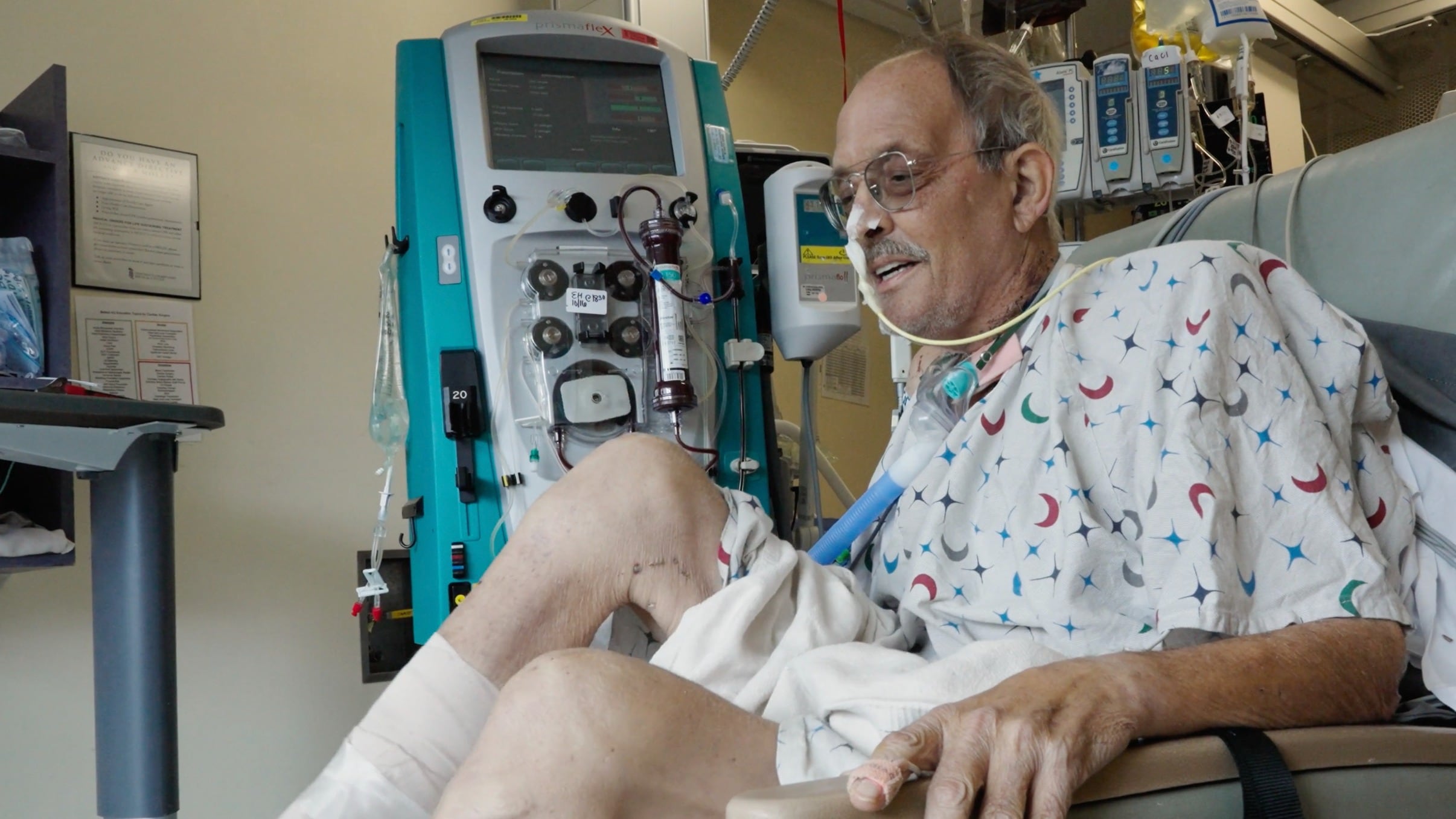
In this image from video provided by the University of Maryland School of Medicine, Lawrence Faucette, a pig heart transplant patient, works with a physical therapist at the school's hospital in Baltimore, Md., on Wednesday, Oct. 18, 2023. (Tom Jemski/University of Maryland School of Medicine via AP)
Lawrence Faucette was dying from heart failure and ineligible for a traditional heart transplant because of other health problems when doctors at the University of Maryland School of Medicine offered the highly experimental surgery.
In the first glimpse of Faucette provided since the Sept. 20 transplant, hospital video shows physical therapist Chris Wells urging him to smile while pushing through a pedaling exercise to regain his strength.
“That’s going to be tough but I’ll work it out,” Faucette, 58, replied, breathing heavily but giving a smile.
The Maryland team last year performed the world’s first transplant of a heart from a genetically altered pig into another dying man. David Bennett survived just two months before that heart failed, for reasons that aren’t completely clear although signs of a pig virus later were found inside the organ. Lessons from that first experiment led to changes before this second try, including better virus testing.
Attempts at animal-to-human organ transplants — called xenotransplants — have failed for decades, as people’s immune systems immediately destroyed the foreign tissue. Now scientists are trying again using pigs genetically modified to make their organs more humanlike.
In Friday’s hospital video, Faucette’s doctors said the pig heart has shown no sign of rejection.
“His heart is doing everything on its own,” said Dr. Muhammad Mohiuddin, the Maryland team’s cardiac xenotransplantation chief.
A hospital spokeswoman said Faucette, of Frederick, Maryland, has been able to stand and physical therapists are helping him gain strength needed to attempt walking.
Many scientists hope xenotransplants one day could compensate for the huge shortage of human organ donations. More than 100,000 people are on the nation’s list for a transplant, most awaiting kidneys, and thousands will die waiting.
A handful of scientific teams have tested pig kidneys and hearts in monkeys and in donated human bodies, hoping to learn enough for the Food and Drug Administration to allow formal xenotransplant studies.
The Associated Press Health and Science Department receives support from the Howard Hughes Medical Institute’s Science and Educational Media Group. The AP is solely responsible for all content.
William Li and Danielle Chang, co-founders of The Hao Life, join Cheddar Innovates to discuss how they're shaking up the $71 billion supplement industry by putting a modern spin on traditional natural Chinese remedies.
The Coca-Cola Company is teaming up with science education personality Bill Nye as part of its World Without Waste Initiative to describe the bottle-to-bottle plastic recycling process through a vividly animated, stop-motion short film. Christine Yeager, director of sustainability at The Coca-Cola Company, North America, joined Cheddar News to talk about their initiative and the partnership. "We really wanted to partner with someone who can help us make recycling relatable, but also has a very um respected voice in the climate change space," she said.
Catching you up on what you need to know on Apr 14, 2022, with the U.S. sending $800M to Ukraine, updates on the subway shooting in Brooklyn, Gov. Abbott putting a pause on his southern border truck inspections, migrants being bused from Texas to Washington, DC, the travel mask mandate extending until May 3, and more.
Energy costs continue to rise, our electrical grid is outdated, and the focus on renewable energy is more important than ever. One company says it has an answer: pods that store solar energy for long-term, 24-hour usage that can also function as mini power grids and charge electric vehicles. Azelio's TES.PODs store solar energy during the day, and hold it for use around the clock, providing a solution for charging electric vehicles, powering rural areas, and much more. Jonas Wallmander, CEO of Azelio, joins Closing Bell to discuss the company's solar energy storage technology, how it can be used to power communities and build out electric vehicle charging infrastructure, and more.
Catching you up with what you need to know on Apr 12, 2022, with Russia concentrating forces in eastern Ukraine, rising inflation, severe weather from Minnesota to the Gulf Coast, Philadelphia brings back its indoor mask mandate, PG&E pays $55 million for wildfire settlement, and more
Catching you up on what you need to know on April 11, 2022, with updates on the Russia-Ukraine War, France’s presidential election, the record deforestation of the Amazon Rainforest, retail giant Amazon's objection to the Staten Island union vote, the worsening baby formula shortage, a lawsuit against Rutgers Law School, and a stomach illness possibly linked to Lucky Charms cereal.
SpaceX launched its first all commercial-crew mission to the International Space Station on Friday. Cheddar News speaks with Jim Cantrell, CEO and President of Phantom Space Corporation why this launch is a big leap for space tourism.
Nautilus Labs closed $34 million in funding from investors including the Microsoft Climate Innovation Fund. The company plans to use its funding to improve shipping industry efficiency with its software. Nautilus CEO Matt Heider joined Cheddar News to talk about how it tackles the carbon emissions in the global supply chain. "We've seen on 10-day voyages saving $60,000 worth of fuel just by managing speed with greater confidence around the future. The environmental impact of that is also huge," he said. "Saving that amount of fuel is a kind of taking over 1000 cars off the road this year."