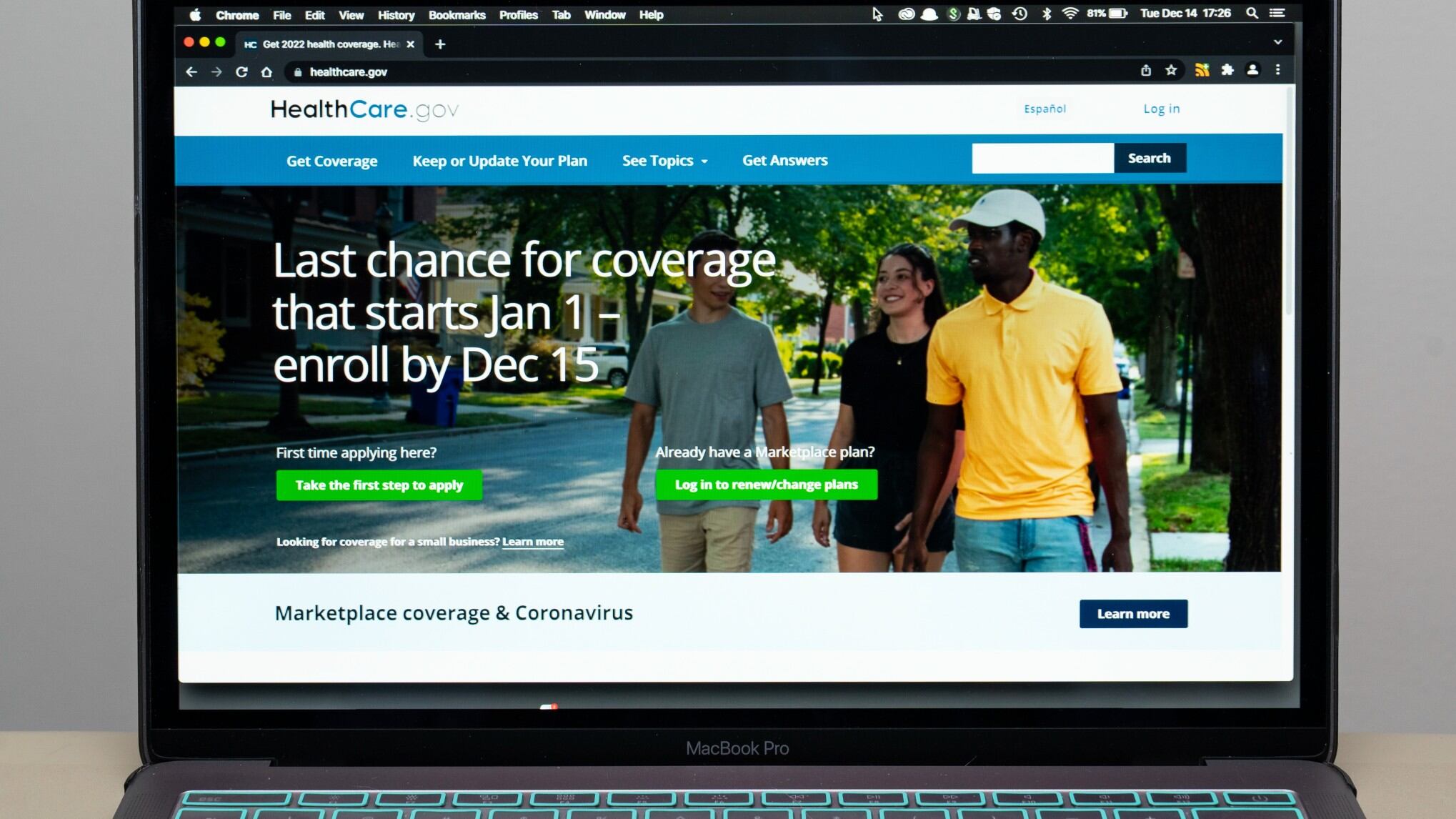
The healthcare.gov website is seen on Dec. 14, 2021, in Fort Washington, Md. (AP Photo/Alex Brandon, File)
By Kevin McGill
The government can keep enforcing “Obamacare” requirements that health insurance plans cover preventative care — such as HIV prevention, some types of cancer screenings and other illnesses — while a legal battle over the mandates plays out, under a court agreement approved Tuesday.
The pact approved by the 5th U.S. Circuit Court of Appeals preserves — at least for now — cost-free preventive care coverage for millions of Americans under the Affordable Care Act.
That coverage was thrown into question by a March ruling from a federal judge in Texas, who said some of the preventive care requirements under former President Barack Obama’s 13-year-old health care law are unconstitutional.
The ruling by U.S. District Judge Reed O'Connor had nationwide effects. The Biden administration had argued last week at the appeals court that the ruling should be stayed while appeals are pursued.
The agreement was filed with the court Monday. In it, the plaintiffs in the case, including a Christian dentist who opposes coverage for contraception and HIV prevention on religious grounds, agreed to a broad stay nationwide. In return, during the appeal process, the handful of plaintiffs would be allowed to provide insurance plans that don't include the preventive care. If O'Connor's ruling were reversed, they would have to provide the coverage, but they would not be penalized for having dumped the coverage during appeals.
O’Connor's March ruling deals with requirements for coverage driven by recommendations by the U.S. Preventive Services Task Force. The judge ruled that because the task force is made up of volunteers, enforcing its recommendations violates the Constitution’s Appointment Clause, which lays out how government officials can be appointed.
Not all preventive care was threatened by O'Connor’s ruling. An analysis by the nonprofit KFF foundation found that some screenings, including mammography and cervical cancer screening, would still be covered without out-of-pocket costs because the task force recommended them before the health care law was enacted in March 2010.
Matt Hayden, vice president of govtech solutions at Exiger and a former assistant secretary of cyber at Department of Homeland Security, joined Cheddar to discuss the surprise phone call initiated by Russian President Vladimir Putin to President Joe Biden, ahead of January security talks about the rising tensions over Ukraine. "We're hoping to hear that we're able to talk about the aggression and the leadup of the Ukrainian militarization," Hayden said. "But we're also looking to hear is how the Kremlin leveraged their talking points to try to test their negotiation stance with the United States leading into this January 10th meeting."
The No Surprises Act begins implementation on January 1, 2022. The legislation is meant to curb the practice of unexpected billing for care from providers the patient was unaware were out-of-network from their insurance. Patricia Kelmar, director of health care campaigns for U.S. PIRG joined Cheddar to describe the hundreds, sometimes thousands, of dollars charged to unsuspecting patients and how things will change under the new law. "If we are picking an in-network doctor and an in-network hospital, we should not see those added costs from anesthesiologists, radiologists, scrub-in surgeons," she said. "The other area it protects you is in air ambulances — not ground ambulances, unfortunately — but the helicopters or the airplanes you might need to transport you in an emergency situation."
President Joe Biden and Russian President Vladmir Putin are expected to have another conversation surrounding escalating tensions between Russia and Ukraine. Ariel Cohen, senior fellow at the Atlantic Council, joined Cheddar's Ken Buffa to discuss the ongoing tensions and why Putin's request for a conversation with Biden comes now. "This is very serious. This is the worst security crisis we had since the collapse of the Soviet Union," Cohen told Cheddar.
Stocks closed mixed on Wednesday, but two indexes - the Dow and the S&P 500 - ended the session with a new record. Akshata Bailkeri, Equity Analyst at Bruderman Asset Management, joins Cheddar News' Closing Bell, where she says there is a consensus for robust consumer spreading in 2022, especially as the Omicron variant is proving to be milder than other COVID-19 strains.
John Quelch, Dean of Miami Herbert Business School, joins Cheddar News' Closing Bell, where he says the retail giant is acting in accordance to President Biden's new law banning goods from China's Xinjiang region. Quelch also elaborates on the importance of China in Walmart's overall strategy.