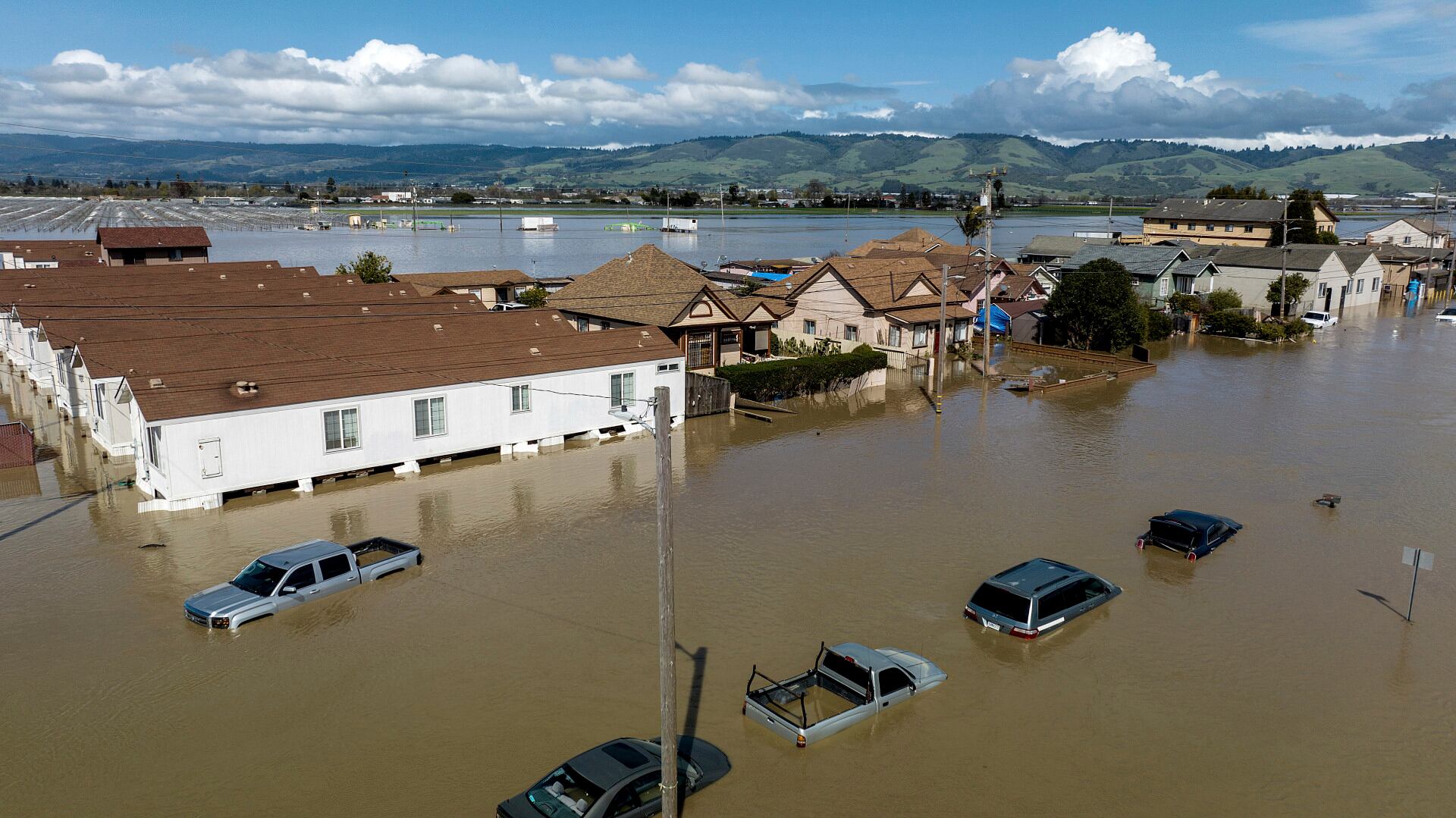
Floodwaters surround homes and vehicles in the community of Pajaro in Monterey County, Calif., on March 13, 2023. Record snowfall and rain have helped to loosen drought’s grip on parts of the western U.S. as national forecasters and climate experts warned Thursday, March 16, that some areas should expect more flooding as the snow begins to melt. (AP Photo/Noah Berger, File)
The National Oceanic and Atmospheric Administration has released its 2023 Spring outlook and the ongoing trend of unseasonable weather could be continuing.
One of the major takeaways from the report is that drought conditions in the Western U.S. are set to improve. The region that has been inundated with wet weather for much of the winter will see some reprieve when it comes to drought.
"Climate change is driving both wet and dry extremes, as illustrated by NOAA's observations and data that inform this seasonal outlook," said Rick Spinrad, Ph.D, NOAA administrator. "Under the Bipartisan Infrastructure Law and Inflation Reduction Act, and in support of the Biden Administration's priority to tackle the climate crisis, NOAA will invest significant resources to build a Climate-Ready Nation that gives communities tailored information about changing conditions so that residents and economies are protected."
In California, drought status is expected to improve even more as snowpacks that built up over the winter eventually melt. The conditions in the central Plains and in Florida are also expected to improve with Spring rainfalls.
Meanwhile, when it comes to heat and high temperatures, a swath of Southern and East Coast states will be above average. Alaska and Hawaii are also predicted to see above average temperatures between April and June.
NOAA said flooding could also significantly impact most states east of the Mississippi River.
"Approximately 44 percent of the U.S. is at risk for flooding this spring," said Ed Clark, the director of NOAA's National Water Center. "California's snowpack, coupled with spring rain, is heightening the potential for spring floods."
The crypto lobbying boom kicked off last year, sparked by a broadly-worded provision in the bipartisan infrastructure bill. Cheddar's Alex Vuocolo takes a deeper look.
U.S. stocks ended Wednesday's session mixed following the release of the minutes from the Federal Reserve’s most recent meeting, and amid ongoing tensions between Russia and Ukraine. Dan Eye, Chief Investment Officer at Fort Pitt Capital Group joined Cheddar News' Closing Bell to discuss.
Applications for U.S. unemployment benefits rose last week, but remain near historically low levels, reflecting relatively few layoffs across the economy
As we celebrate Black History Month, Cheddar is highlighting prominent Black Americans who are carving their own historic paths and trailblazing in their fields. Today we feature activist Tamika Mallory.
As more and more states end mask mandates and ease other COVID restrictions, discussions about the endemic phase of the pandemic have been growing. For weeks, scientists have warned about how contagious the omicron variant is, but now it seems the tone has shifted and governors are rolling back policies they've had in place for months. Dr. Eric Feigl-Ding, epidemiologist and senior fellow at the Federation of American Scientists, joined Cheddar's Opening Bell to discuss what the next phase of the pandemic might look like, how to act now that mask mandates are ending, and if we should be worried about another variant emerging.
Jeff Powell, Managing Partner and Chief Investment Officer at Polaris Wealth Advisory Group, joins Cheddar News' Closing Bell, where he says the market was looking for - and received - a little bit of relief when it came to the geopolitical conflict between Russia and Ukraine.