By Tom Krisher
Seven major automakers say they're joining forces to build a North American electric vehicle charging network that would rival Tesla's and nearly double the number of fast-charging plugs in the U.S. and Canada.
General Motors, BMW, Honda, Hyundai, Kia, Mercedes and Stellantis said Wednesday that they will share in a multibillion-dollar investment to build “high power” charging stations with at least 30,000 plugs in urban areas and along travel corridors by 2030.
The dramatic move is intended to speed the adoption of electric vehicles, allaying fears that chargers won't be available for long distance travel.
The companies wouldn't disclose the exact number of charging stations or financial details of the joint venture they're forming to put the network in place. They said the first of the U.S. chargers will be ready by next summer.
The automakers said in a joint statement Wednesday that they want to build the “leading network” of reliable high-powered charging stations in North America.
“The parties have agreed not to disclose specific investment numbers at this time, but the seven founding automakers intend to work as equals to ensure the success of the joint venture,” the companies said in a written statement answering questions from The Associated Press. “As you can imagine, such a high-powered charging network of this scale requires a multibillion-dollar investment.”
There are currently just under 8,700 direct-current fast-charging stations in the U.S. and Canada with nearly 36,000 charging plugs, according to the U.S. Department of Energy. Even with 30,000 more plugs, the U.S. will need far more chargers. The National Renewable Energy Laboratory estimates that 182,000 fast chargers will be needed by 2030.
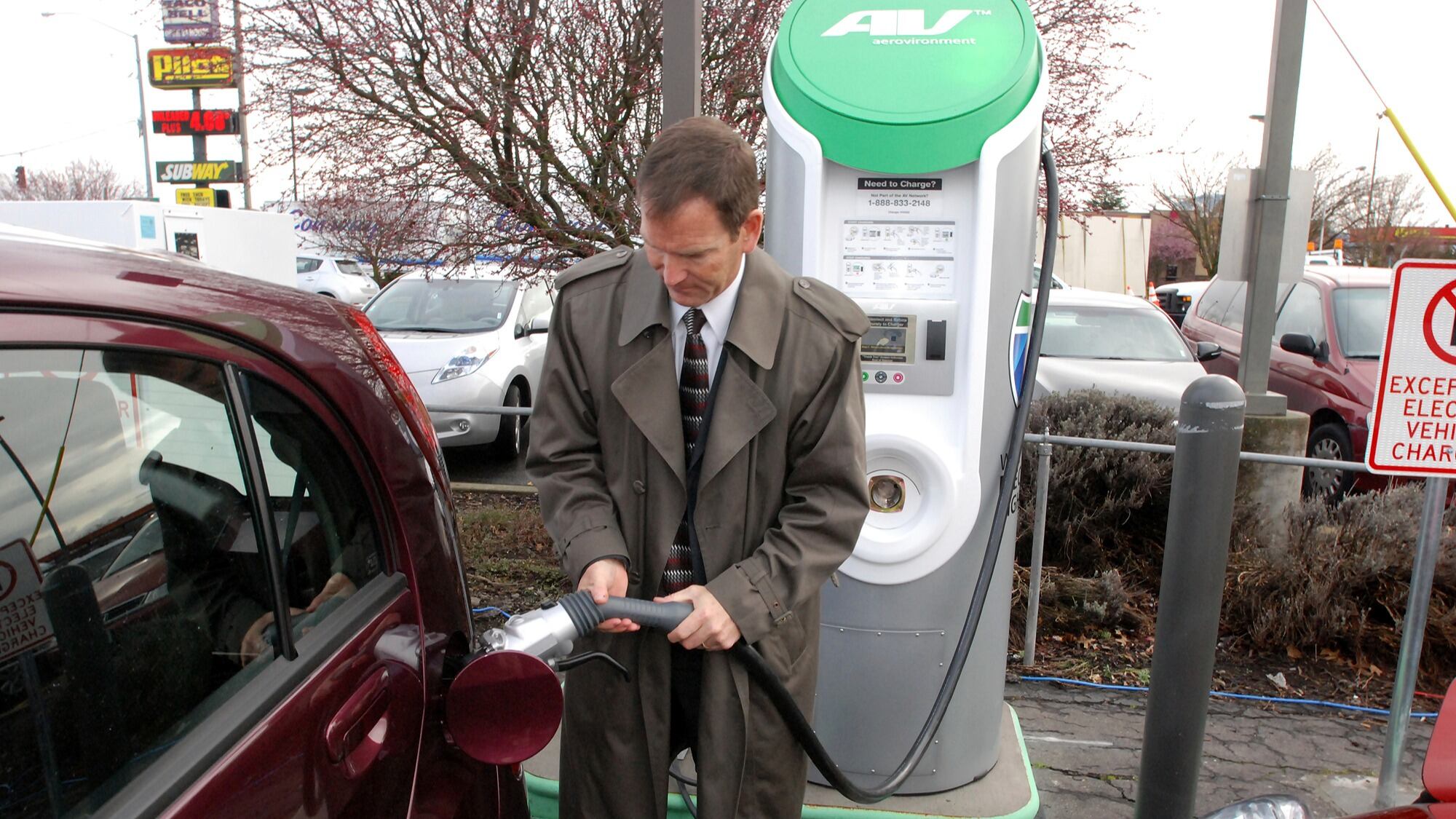
Fast chargers can get a battery to 80% of its capacity in 20 minutes to one hour, making them optimal for travel corridors and in some cases comparable to the time it takes to fill a car with gasoline. They’re much quicker than 240-volt “Level 2” chargers that can take hours to get a battery to a full charge.
The new network is expected to have 10 to 20 charging plugs per station, meaning there would be a minimum of 1,500 stations and a maximum of about 3,000.
Tesla’s network, with the largest number of fast chargers in North America, has 2,050 stations and more than 22,000 plugs in the U.S. and Canada, the DOE says.
The network formed by the seven automakers would be public and open to all electric vehicle owners. It will have connectors for both Tesla’s North American Charging Standard plugs as well as the Combined Charging System plugs used by other automakers.
The network will speed up electric vehicle sales in North America by getting people who now are reading stories about holes in the charging network that prevent long-distance travel, said Stephanie Brinley, an analyst with S&P Global Mobility.
“It's stopping them even from exploring what EV life is like,” Brinley said. The announcement of the network “is giving them confidence that this is going to work out.”
In their statement, the seven automakers said they would use renewable energy as much as possible to power the chargers, and they will be in convenient locations with canopies and amenities such as restrooms, food service and stores nearby.
Brinley said a good charging experience is key to earning the trust of potential EV buyers. “The reality is consumers want to feel comfortable when they charge,” she said.
It will take years and billions of dollars to build out the network, which will need special electrical wiring, Brinley said.
The current charging network, being built by a hodgepodge of companies, is growing but is often unreliable or in poor locations. This has prompted Ford, General Motors and others to sign agreements with Tesla to give their EVs access to its much larger network of fast chargers. Automakers also have announced they're building their own networks, but Brinley said the moves weren't enough.
She also doesn't see the automakers' announcement as a threat to Tesla. “I think the reality is this is needed, and these automakers are getting together to say ‘we need this’” she said. “Tesla can't build enough for everyone.”
The automakers will seek to use U.S. government funds from the bipartisan infrastructure law to help pay for the network.
Stellantis CEO Carlos Tavares said the network is a response to significant growth that's expected in electric vehicle sales, and the group intends to exceed customer expectations. “We believe that a charging network at scale is vital to protecting freedom of mobility for all,” he said.
In the U.S., electric vehicle sales continued to rise during the first half of the year to more than 557,000 vehicles, or 7.2% of all new vehicle sales. The EV share of the market last year was 5.8% with just over 807,000 sales. Most industry analysts predict continued growth in EV sales for the next decade or more.
But in June, EV inventories began to grow as factories started cranking out new models. Not including Tesla and Rivian, dealers had enough EV supply on hand for 103 days of sales, according to Cox Automotive. But there was only a 53-day supply of all vehicles, indicating much lower inventories of combustion engine vehicles.
Still, Cox is forecasting that EV sales will grow to over 1 million for the first time this year.
The consulting firm LMC Automotive predicts that EVs will hit 14.4% of the market in 2025, and close to 40% by 2030.
New greenhouse gas emissions standards proposed by the Environmental Protection Agency say automakers could meet the requirements in 2032 if 67% of all new vehicle sales are electric.