Twenty-six questions into day one of questioning, senators have largely directed inquiries to their own sides, assisting respective legal teams in poking holes in the opposition's case.
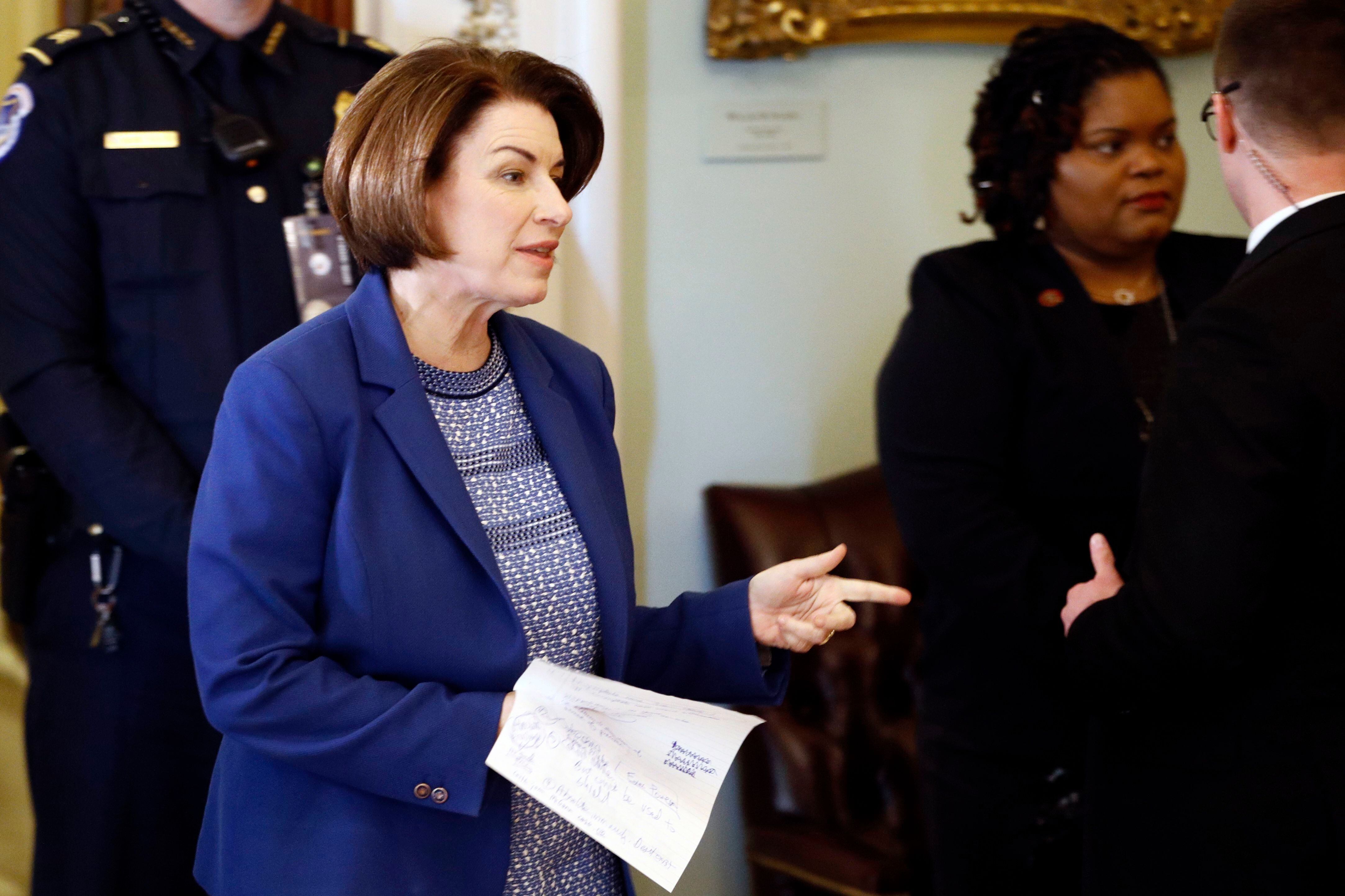
During the first break of the day, nearly three hours after questioning began, Sen. Amy Klobuchar (D-Minn.) told Cheddar she plans to ask a question about absolute immunity. The president has argued he has absolute immunity to bar testimony, though a federal judge ruled in November that former White House counsel Don McGahn must obey a subpoena compelling him to testify. The judge wrote at the time "with respect to senior-level presidential aides, absolute immunity from compelled congressional process simply does not exist."
The president's defense team has repeatedly sought to portray the president as needing the freedom to speak candidly with his advisors. However, House Managers have emphasized the president is not able to exercise blanket immunity.
"Some of the questions were planned ahead, but you can always adjust them," Klobuchar said. "I have one question that I want to focus on, on the absolute immunity issue, but if it's fully asked, maybe I'll switch to another one. You're not bound into what your question is. And then there's other questions that I have — you'll see that Senator Whitehouse is going to ask one of them. He and I shared the same question so he's asking on his behalf and my behalf."
Throughout the first portion of today's session, some senators appeared to have pre-written questions on cards while others, like Senators Lindsey Graham (R-S.C.) and Ted Cruz (R-Texas) exited the room to presumably discuss a question before posing one jointly. Others still, like Senators Martha McSally (R-Ariz.), Joni Ernst (R-Iowa), Richard Burr (R-N.C.), Jerry Moran (R-Kan.) and Kelly Loeffler (R-Ga.) seemed to have empty cards on their desks.
Senators must submit written questions to the Chief Justice and, alternating between parties, a Senator stands, asks Supreme Court Chief Justice John Roberts to hear his or her question, and a high school page carries the card to Roberts, who is facing the Senators from the elevated seat usually reserved for the Vice President. At one point Roberts paused while attempting to read a question from Republicans, as it seemed he was having trouble reading the hand-written question.
The Senate Press Gallery sits above the Republican side of the chamber, which allows better access to see the Republican Senators than the Democrat officials.
Alan Dershowitz, an attorney for the defense who came to today's session to answer questions about his testimony earlier this week, said anything a sitting president does to stay in power is in the national interest, emphasizing a very expansive view of presidential power. Lead House Manager and chairman of the House Intelligence Committee Rep. Adam Schiff (D-Calif 28th District) answered the final question of the early session pushing back against Dershowitz's argument and attempted to portray the president as believing himself to wield broad powers, accusing Trump of being a "president who identifies the state as being himself."