By Jonathan Mattise and Kimberlee Kruesi
A Tennessee judge agreed Wednesday to temporarily block a new rule advanced by state House Republicans that banned the public from holding signs during floor and committee proceedings. The ruling came after state troopers removed three people who held small signs urging gun control were kicked out of a hearing Tuesday.
The removal came at the order of a GOP subcommittee chair, who later instructed state troopers to remove the rest of the public from the committee room after deeming the crowd too unruly. That included grieving parents closely connected to a recent Nashville school shooting, who broke down in tears at the decision.
The emotional and chaotic scene sparked widespread outrage from both Republican and Democratic lawmakers, while others pointed out that while signs were banned, the public could still freely carry firearms inside the legislative office building.
Nashville Chancellor Anne Martin's ruling came within hours of the filing of a lawsuit by the American Civil Liberties Union of Tennessee on behalf of the three women who were removed because of their signs: Allison Polidor, Maryam Abolfazli and Erica Bowton.
Republicans, who have a supermajority control in the House, signed off on a new slate of strict rules this week during a special session that was called by Gov. Bill Lee in reaction to the Nashville school shooting in March. GOP leaders are not expected to take up gun control, but they have approved severely limiting the public from accessing the Senate and House galleries where people have traditionally been allowed to watch their government in action.
A hearing on the temporary injunction has been scheduled for Sept. 5. However, lawmakers are expected to adjourn by Thursday.
A spokesperson for House Speaker Cameron Sexton, who is named as a defendant, did not immediately respond to a request for comment.
“These rules are unreasonable,” Stella Yarbrough, ACLU of Tennessee legal director, said in a news release. “The Tennessee House’s ban on silently holding signs in House galleries directly undermines Tennesseans’ First Amendment right to express their opinions on issues that affect them and their families.”
On the first day of the special session Monday, House Republicans approved a new set of procedural rules that carried harsh penalties for lawmakers deemed too disruptive or distracting, and they banned visitors from carrying signs inside the Capitol and in legislative hearing rooms. While House GOP leaders have defended rules on disruptions by lawmakers, they've been largely silent on why they also went after signs.
The actions come after the Tennessee Republicans attracted national attention for expelling two young Black Democratic lawmakers this year for breaking House rules during a demonstration in support of gun control. Reps. Justin Jones and Justin Pearson have since been reinstated and reelected to their positions, but the actions sent shock waves about the Republican supermajority’s ability to hand down strict punishments to opponents.
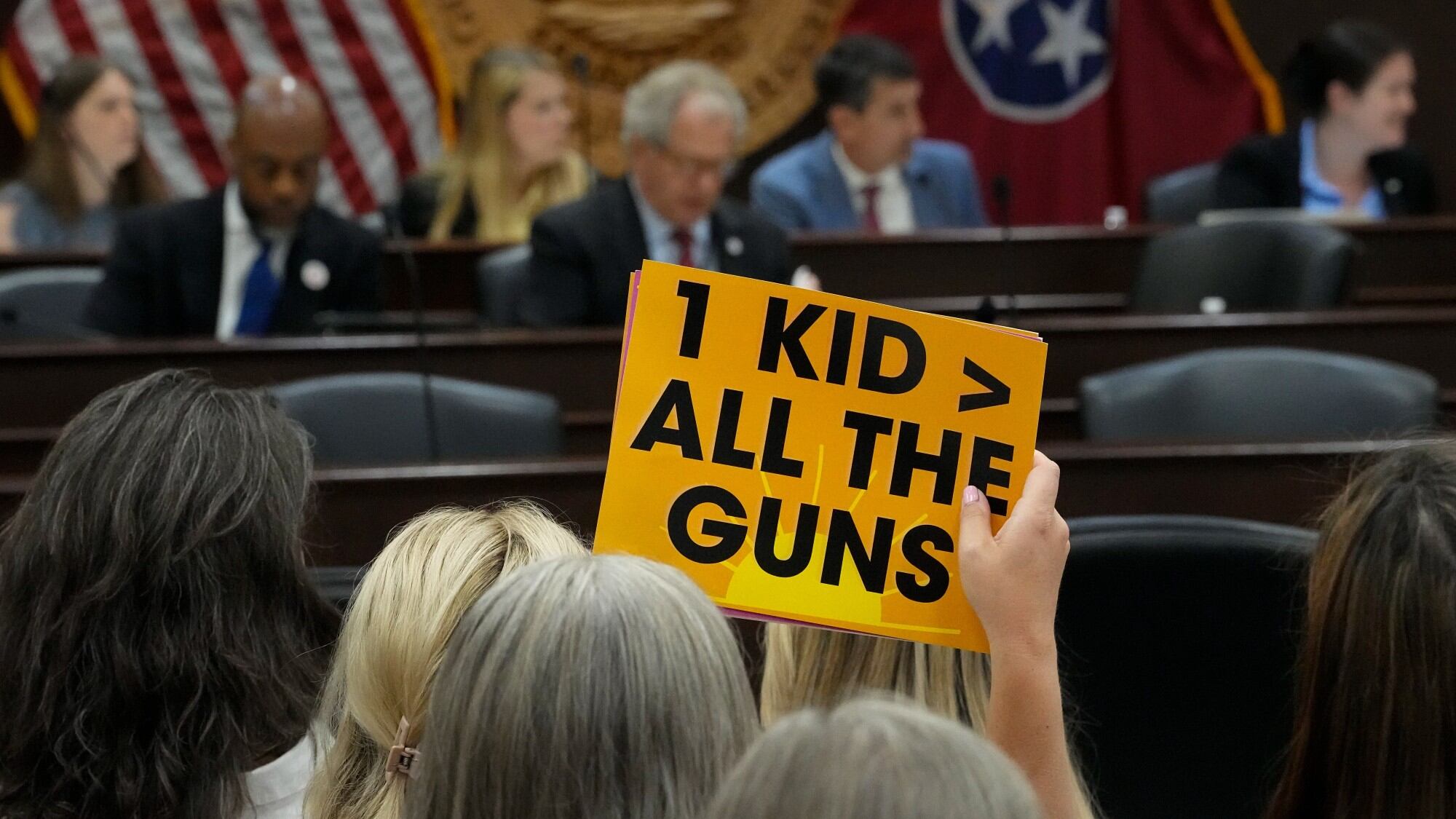
Polidor, a gun control advocate from Nashville, was escorted out of a hearing room because she was holding a sign that said, “1 KID” is greater than “ALL THE GUNS.”
“I joined with so many other moms from across Tennessee to urge our lawmakers to enact common sense gun laws,” Polidor said in the news release. "I was removed for peacefully holding a small sign, and exercising my First Amendment rights. What started as a debate on gun safety has morphed into a blatant violation of my First Amendment rights.”
While firearms have long been allowed inside Tennessee’s legislative building, hand-held signs have faced strict criticism from lawmakers as being a potential safety hazard and too distracting to proceedings.
In 2017, signs were briefly prohibited from Cordell Hull — the building that contains both legislative committee rooms and offices for lawmakers and staffers — following demonstrations over refugee resettlements, Medicaid expansion and gas taxes.
That policy was then altered to allow the public to hold small letter-size signs inside Cordell Hull, but banned any signs on sticks or poles.
In the years since, the public has repeatedly shown up with signs that reflect a wide range of policy stances.