By Lisa Mascaro
On Day 20 without a House speaker, Republicans found themselves starting over Monday — bumbling ahead with few ideas about who will lead, what they are fighting over and when they will get Congress working again.
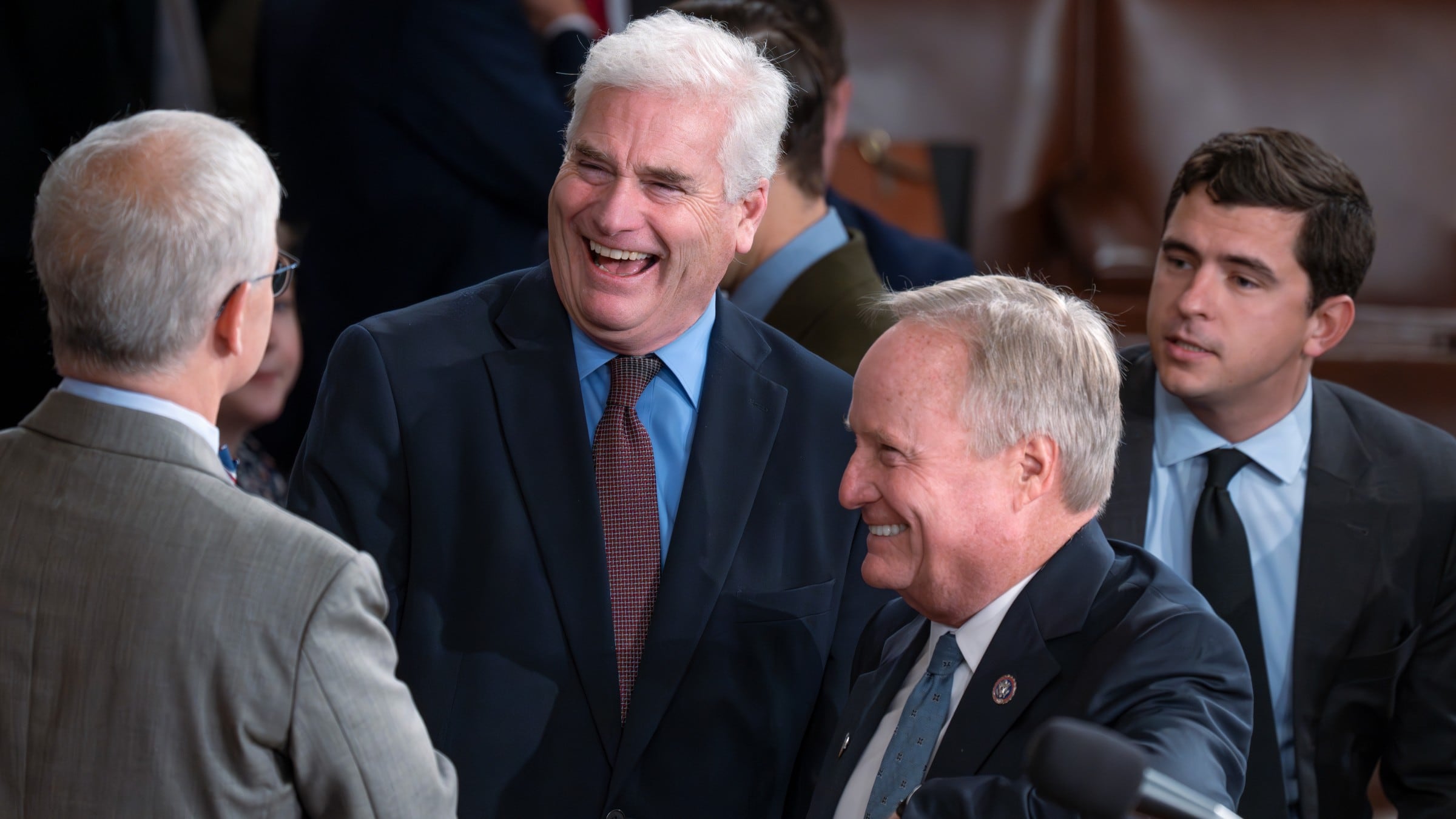
Republicans gathered late in the evening to hear quick speeches from the congressmen seeking the job, though none has a clear shot at the gavel. Eight candidates are in the running for one speaker after one dropped out. Behind closed doors, they made their elevator pitches to colleagues ahead of internal party voting.
Senior-most among the hopefuls is Rep. Tom Emmer of Minnesota, but neither he or the other lower-level Republican lawmakers are expected to quickly secure a majority. Instead he and others are reaching out to Donald Trump for backing ahead of elections to choose a nominee. One, Rep. Dan Meuser of Pennsylvania, dropped out.
“They all called asking for support,” said Trump, the Republican front-runner in the 2024 presidential race, who was in New Hampshire registering for the state’s primary ballot.
Of Emmer, Trump said, “I think he’s my biggest fan now because he called me yesterday and told me I’m your biggest fan.”
Trump downplayed, even derided, Emmer, the third-ranking House Republican with whom he has had rocky relationship, while presenting himself as a kingmaker who talks to “a lot of congressmen” seeking his stamp of approval.
“There’s only one person who can do it all the way: Jesus Christ," he declared.
The House Republicans retreated privately, as they have most days since the ouster of Kevin McCarthy, trying for several hours to find a path forward. The candidates had two minutes to make opening remarks, then take questions, then sum it up. The Republicans plan to meet Tuesday to choose the nominee.
“We’re going have to figure out how to get our act together — I mean, big boys and big girls have got to quit making excuses and we just got to get it done,” said Rep. Dusty Johnson, R-S.D., a conservative caucus leader.
What started as swaggering bravado when a contingent of hardline Republicans led by Rep, Matt Gaetz of Florida ousted McCarthy at the start of the month has morphed into a full-blown crisis of governing as dysfunction and dangerous, bitter infighting prevent the normal operations of Congress.
The federal government again risks a shutdown in a matter of weeks if Congress fails to pass funding legislation by a Nov. 17 deadline to keep services and offices running. More immediately, President Joe Biden has asked Congress to provide $105 billion in aid — to help Israel and Ukraine amid their wars and to shore up the U.S. border with Mexico. Federal aviation and farming programs face expiration without action.
As he exited the meeting, Rep. Pat Fallon, R-Texas, urged his colleagues to act quickly, saying voters want them to wrap it up. “Enough is enough. Andale! Andale!” he told reporters.
Yet factional power plays are running stronger on Capitol Hill than any sense of urgency to resolve the standoff as the House Republicans are essentially eating their own — first by ousting McCarthy just nine months on the job, then rejecting the next nominees to take his place, Majority Leader Steve Scalise and hard-edged Judiciary Committee Chairman Jim Jordan.
Launched over right-flank complaints over McCarthy's leadership in budget battles, the speakership fight is now a string of political and personal grievances over various leaders, factions and personalities.
"Is there anybody that can get there? I don’t think there is,” said Rep. Troy Nehls, R-Texas, who has repeatedly suggested Trump should be elected House speaker.
Trump himself has largely stayed in the background, but his presence is everywhere. Trump also spoke over the weekend to longshot candidate Rep. Pete Sessions, R-Texas, according to a person who insisted on anonymity to discuss the private conversation. Early on Trump helped sink Scalise's nomination by backing Jordan instead.
But when more centrist GOP conservatives in the House refused to back Jordan, worried about elevating the far-right Freedom Caucus founder as speaker, Trump was unable to salvage the Ohioan's nomination. The House Republicans dropped Jordan as their nominee Friday, after a hardball pressure campaign that resulted in some lawmakers even receiving death threats flopped.
“Most of these guys and gals can’t be bullied to do anything," said Johnson. "You’re gonna have to use persuasion.”
The House has never been here before, having ousted its own speaker for the first time in history, and now led by a nominal interim speaker pro tempore Rep. Patrick McHenry, R-N.C., the bow-tie-wearing chairman of the Financial Services Committee whose main job is now to elect a more permanent speaker.
Some Republicans — and Democrats — would like to simply give McHenry more power to reconvene the House and get on with the routine business of governing. But McHenry, the first person to be in the position that was created in the aftermath of the Sept. 11, 2001, terror attacks as an emergency measure, has brushed back those overtures.
In the Senate, Republican leader Mitch McConnell, who is trying to helm the party through a tumultuous time, has had little advice for his colleagues on the other side of the Capitol.
“Look, I’m not an expert on the House. I have my hands full here in the Senate,” McConnell said Sunday on CBS. “We’re gonna do our job and hope the House can get functional here sometime soon.”
For now, Emmer and the others will try their hand at uniting the broken Republican majority around each of their candidacies. Among those running are potential leaders, to be sure, but no singular figure who stands out as an obvious choice.
Along with Emmer and Sessions seeking the nomination are Rep. Mike Johnson, an affable lawyer from Louisiana, Rep. Kevin Hern, a former McDonald's restaurant franchise owner who now leads the conservative Republican Study Committee, the largest bloc of House conservatives, and Rep. Byron Donalds, a Florida newcomer aligned with Trump.
Also running are Reps. Austin Scott of Georgia, who had briefly challenged Jordan with a protest bid, Jack Bergman of Michigan and Gary Palmer of Alabama.
Internal party elections are set for Tuesday, but with eight candidates it could take multiple rounds to choose a nominee ahead of floor voting by the full House, possibly later this week.
Desperate to end the infighting, some GOP lawmakers are demanding that the candidates sign a pledge to back whoever is eventually nominated, as the Republican majority's rules state.
Associated Press writers Stephen Groves, Jill Colvin, Farnoush Amiri and Kevin Freking and Holly Ramer in Concord, New Hampshire, contributed to this report.
Updated Oct. 24, 2023 at 3:51 a.m. ET with latest details.