A crew member staples the carpet to the ground in preparation for Sunday's 95th Academy Awards, Wednesday, March 8, 2023, outside the Dolby Theatre in Los Angeles. (AP Photo/Chris Pizzello)
By Lindsey Bahr
Many things about the Academy Awards have changed over the years, but for the past six decades there has been at least one constant: The red carpet. The hues have varied over the years, but it has always been some shade of red. Until this year.
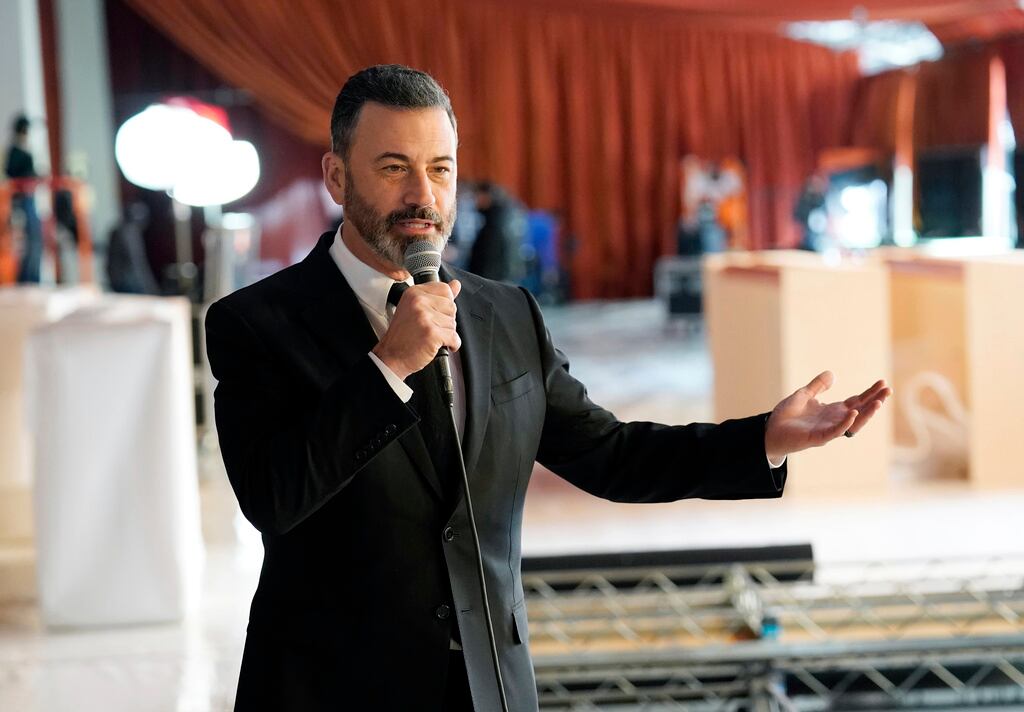
On Wednesday outside the Dolby Theatre in Hollywood, workers unspooled a champagne-colored carpet as Jimmy Kimmel, who is hosting the 95th Oscars on Sunday, presided over the occasion.
“I think the decision to go with a champagne carpet over a red carpet shows how confident we are that no blood will be shed," Kimmel said.
Jimmy Kimmel, host of Sunday's 95th Academy Awards, addresses the media before the roll out of the carpet for the show, Wednesday, March 8, 2023, outside the Dolby Theatre in Los Angeles. (AP Photo/Chris Pizzello)
The decision to change the color came from creative consultants Lisa Love, a longtime Vogue contributor, and Raúl Àvila, the creative director for the glamourous Met Gala in New York.
This year the carpet will be covered, in part to protect the stars and cameras from the weather, but also to help turn the arrivals into an evening event. For Love, there has always been a disconnect between the elegant black tie dress code and the fact that it’s mid-afternoon when people arrive to be photographed in the daylight. With a covered carpet, they could change that.
“We turned a day event into night,” Love told The Associated Press. “It’s evening, even though it’s still 3:00.”
The Oscars red carpet dates back to 1961, the 33rd Academy Awards held at the Santa Monica Civic Auditorium, when Billy Wilder’s “The Apartment” won best picture, Burt Lancaster and Elizabeth Taylor won the lead acting prizes, and there was still a “juvenile award,” which went to Hayley Mills for “Pollyanna.” It was the first televised ceremony, broadcast on ABC and hosted by Bob Hope. The general public wouldn’t see the red carpet in all its glory on television until 1966, when the Oscars were first broadcast in color.
There wasn’t any debate over the change, Love said. They just knew they had the freedom to break from tradition. They tried some other colors too but they seemed too dark with the covered tent. “We chose this beautiful sienna, saffron color that evokes the sunset, because this is the sunset before the golden hour,” Love said.
Instead they went lighter and Academy CEO Bill Kramer approved.
They weren’t especially worried about upsetting Oscars traditionalists either.
“Somebody’s always got a way to find something wrong with something,” Love said. “This is just a lightness and hopefully people like it. It doesn’t mean that it’s always going to be a champagne colored carpet.”
As for what we should call it? Love said “champagne” and “sand” are apt descriptions, but that there’s no reason to not default to “red carpet” either. It’s more metonym for the glamorous arrivals than a literal description of what everyone is walking on.
The 95th Oscars “red carpet” opens Sunday at 3:30 p.m. Eastern. The ceremony is set to begin at 8 p.m. and will be broadcast live on ABC.
The telecom giant AT&T is looking to make online learning more fun for students by engaging them with content from its partners at Warner Bros. Discovery. Mylayna Albright, the assistant vice president of corporate social responsibility for AT&T, joined Cheddar to discuss how the company came about with the free digital e-learning program that it's calling The Achievery. "We knew that once students went home as a result of the pandemic, it was very difficult for them, and we knew from research, specifically through Morning Consult, that parents and teachers realized that probably 80 percent of students felt that they would be more engaged if they had a more entertaining approach," she said.
Sourceful is an all-in-one platform for sourcing sustainable materials. The startup recently raised $20 million in a Series A round led by Index Ventures. Through its platform, Sourceful helps businesses find and design more eco-friendly packaging and reduce the carbon footprint of their supply chains. Wing Chan, Co-Founder and CEO of Sourceful, joined Cheddar News' Closing Bell to discuss.
If you did not attend Coachella and spent the weekend scrolling through Tiktok or Instagram, you probably saw a lot influencers comparing Revolve Festival to Fyre Fest.
Content creator Lars Gummer joins Cheddar News to discuss his experience at the festival.
Arthur Madrid, CEO of The Sandbox, and Steven Kolb, CEO of CFDA, join Cheddar News to discuss their partnership focused around fashion in the metaverse.
Actor Niecy Nash’s guest character Simone Clark on ABC’s "The Rookie" is getting a spinoff series of her own after a backdoor pilot arc on the hit cop show. Nash joined Cheddar News to discuss the developments for her character, who will be the oldest rookie in the FBI. "I just think her journey in the world is what's going to be delicious, watching her navigate this new career field, watching her unpack her complicated relationship with her father," she said. Nash also talked about the legacy of her other cop show, "Reno 911," which she called a "culty phenomenon."
Ever walk into a CVS to pick up some gum, maybe some Chapstick, only to get hit with a ridiculously long receipt? It’s no secret that most CVS purchases come with these comically long receipts. But what might surprise you is that these long receipts are part of a marketing plan that's paying off big time for CVS.
Bonnie Wright, who starred in the Harry Potter film series as Ginny Weasely, the youngest of the Weasely clan and Harry Potter’s love interest, is now an author and sustainability activist with her new book, "Go Gently: Actionable Steps to Nurture Yourself and the Planet," which focuses on how to change your habits to live a more sustainable lifestyle. Wright joined Cheddar News to discuss. "I wrote my book to really help to kind of bring the macro-scale system thinking down to our day-to-day life," she said. "They're actually tangible, quite resourceful, practical things that you can implement in your day-to-day life to just help you connect to these issues and just feel empowered when we feel pretty powerless within this situation."