A crew member staples the carpet to the ground in preparation for Sunday's 95th Academy Awards, Wednesday, March 8, 2023, outside the Dolby Theatre in Los Angeles. (AP Photo/Chris Pizzello)
By Lindsey Bahr
Many things about the Academy Awards have changed over the years, but for the past six decades there has been at least one constant: The red carpet. The hues have varied over the years, but it has always been some shade of red. Until this year.
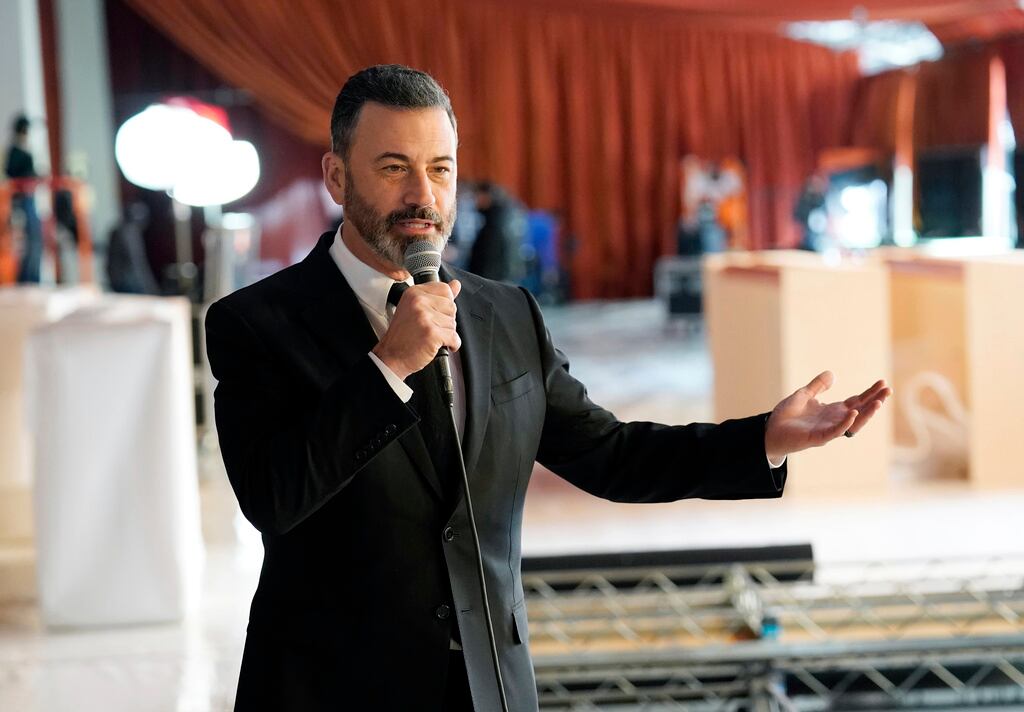
On Wednesday outside the Dolby Theatre in Hollywood, workers unspooled a champagne-colored carpet as Jimmy Kimmel, who is hosting the 95th Oscars on Sunday, presided over the occasion.
“I think the decision to go with a champagne carpet over a red carpet shows how confident we are that no blood will be shed," Kimmel said.
Jimmy Kimmel, host of Sunday's 95th Academy Awards, addresses the media before the roll out of the carpet for the show, Wednesday, March 8, 2023, outside the Dolby Theatre in Los Angeles. (AP Photo/Chris Pizzello)
The decision to change the color came from creative consultants Lisa Love, a longtime Vogue contributor, and Raúl Àvila, the creative director for the glamourous Met Gala in New York.
This year the carpet will be covered, in part to protect the stars and cameras from the weather, but also to help turn the arrivals into an evening event. For Love, there has always been a disconnect between the elegant black tie dress code and the fact that it’s mid-afternoon when people arrive to be photographed in the daylight. With a covered carpet, they could change that.
“We turned a day event into night,” Love told The Associated Press. “It’s evening, even though it’s still 3:00.”
The Oscars red carpet dates back to 1961, the 33rd Academy Awards held at the Santa Monica Civic Auditorium, when Billy Wilder’s “The Apartment” won best picture, Burt Lancaster and Elizabeth Taylor won the lead acting prizes, and there was still a “juvenile award,” which went to Hayley Mills for “Pollyanna.” It was the first televised ceremony, broadcast on ABC and hosted by Bob Hope. The general public wouldn’t see the red carpet in all its glory on television until 1966, when the Oscars were first broadcast in color.
There wasn’t any debate over the change, Love said. They just knew they had the freedom to break from tradition. They tried some other colors too but they seemed too dark with the covered tent. “We chose this beautiful sienna, saffron color that evokes the sunset, because this is the sunset before the golden hour,” Love said.
Instead they went lighter and Academy CEO Bill Kramer approved.
They weren’t especially worried about upsetting Oscars traditionalists either.
“Somebody’s always got a way to find something wrong with something,” Love said. “This is just a lightness and hopefully people like it. It doesn’t mean that it’s always going to be a champagne colored carpet.”
As for what we should call it? Love said “champagne” and “sand” are apt descriptions, but that there’s no reason to not default to “red carpet” either. It’s more metonym for the glamorous arrivals than a literal description of what everyone is walking on.
The 95th Oscars “red carpet” opens Sunday at 3:30 p.m. Eastern. The ceremony is set to begin at 8 p.m. and will be broadcast live on ABC.
Jay-Z's Roc Nation is teaming up with The Reform Alliance to host a job fair at Madison Square Garden later this week. The event is aimed at helping disadvantaged people in NYC, including single parents and the formerly incarcerated, get jobs in the city. Participating companies include Zara, Amazon, Live Nation, VICE, and a slew of others. Dania Diaz, Managing Director, Roc Nation, joined Cheddar's Opening Bell to discuss what attendees can expect.
Cases of covid-19 are climbing in the Upper Midwest, Southwest, and parts of the Northeast. The seven-day national average is sitting at roughly 82,000 new cases which is an 11 percent jump from the week before. Dr. Amesh Adalja, Infectious Disease, Specialist, Sr. Scholar at Johns Hopkins Center for Health Security joined Cheddar's Opening Bell to discuss this recent uptick ahead of the holiday season.
Jill is joined by Baker Machado to talk all things infrastructure: where will the money go and who’s in charge? Plus, Sesame Street has its first Asian-American muppet. And a trailer for the trailer for Spiderman. Huh?
New York has always been home to some of the world’s tallest towers, but in the last 10 years the city has seen an influx of super skinny buildings towering over Central Park, built exclusively for the ultra-rich. With demand for luxury high-rise vistas being higher than ever, building developers are using every zoning opportunity they can to push height limits – and there’s one loophole that’s helping make that happen.
Ignacio Meyer, Executive Vice President of Music and Non-Scripted Entertainment at Univision, joins Cheddar News to preview the 22nd Annual Latin Grammy Awards.
Even prior to the pandemic, the United States had already been seeing a shortage of qualified teachers staffing its schools, but COVID-19 stress added to the burdens educators faced leading to burnout and early retirements. Steve M. Matthews, superintendent of the Novi Community School District in Michigan, joined Cheddar to discuss the lack of available teachers to keep kids educated. "I think the pandemic just exacerbated some of the issues and kind of pushed the momentum forward for a teacher shortage," he said.
According to ValuePenguin survey, 45% of insured Americans are considering health insurance changes during open enrollment. Derrick Kinney, Host of the 'Good Money' podcast, joins Cheddar to break down everything you need to know about open enrollment, and how inflation is having an impact on health insurance.
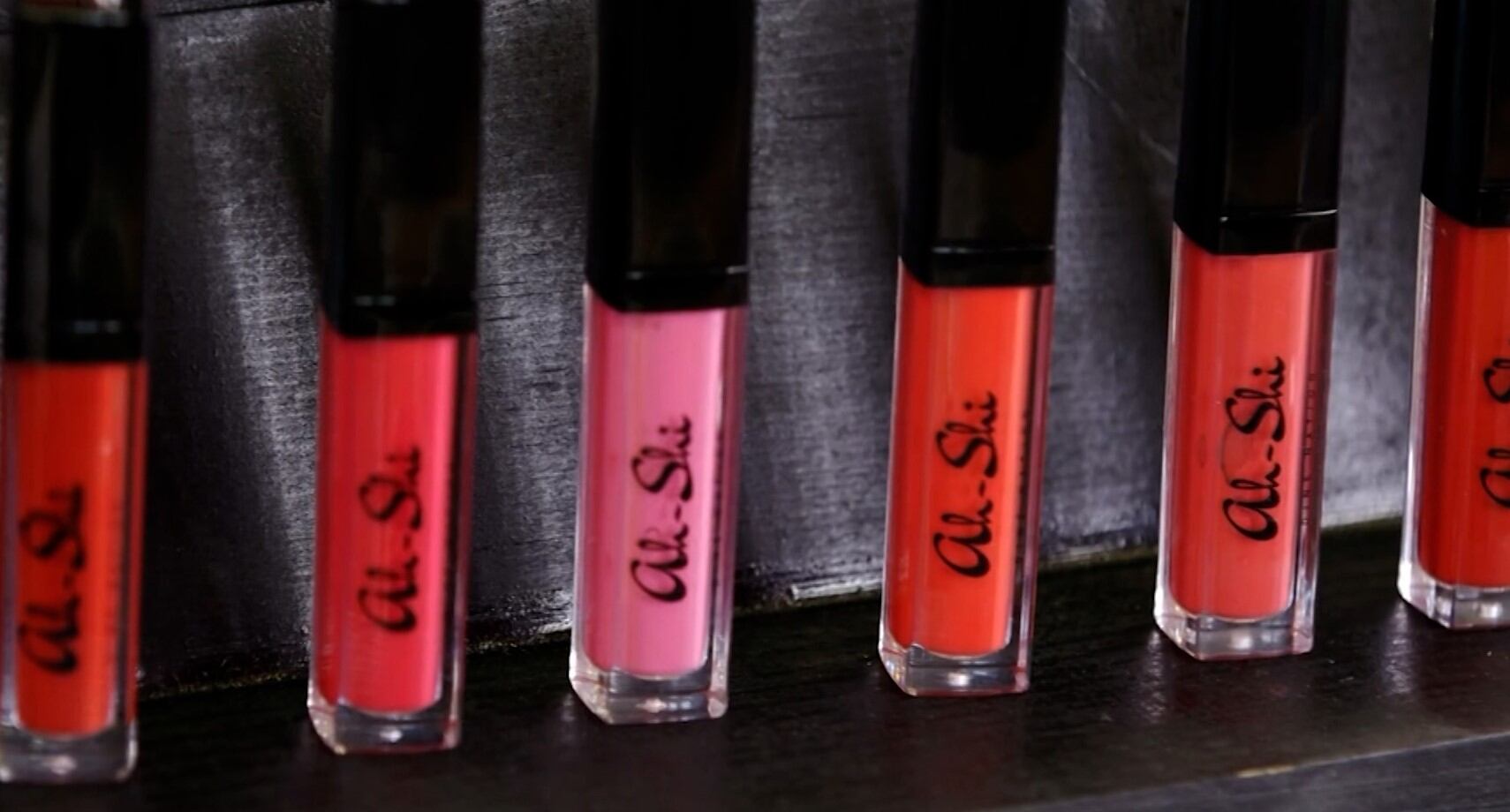
Ahsaki LaFrance-Chachere, Founder of Ah-Shí Beauty, joins Cheddar to discuss what inspired her to launch this beauty brand, how the brand is staying true to her tribe's culture and traditions, and what makes it stand out in the crowded beauty space.
All-Pro Baltimore Ravens offensive lineman Ronnie Stanley joins Cheddar News to discuss launching The Ronnie Stanley Foundation, whose mission is to improve the quality of life for rescue dogs, provide training that cultivates therapeutic properties, and match each rescue with an individual who has faced a challenge in life such as a chronic illness or emotional trauma.