By Lindsey Bahr
Many things about the Academy Awards have changed over the years, but for the past six decades there has been at least one constant: The red carpet. The hues have varied over the years, but it has always been some shade of red. Until this year.
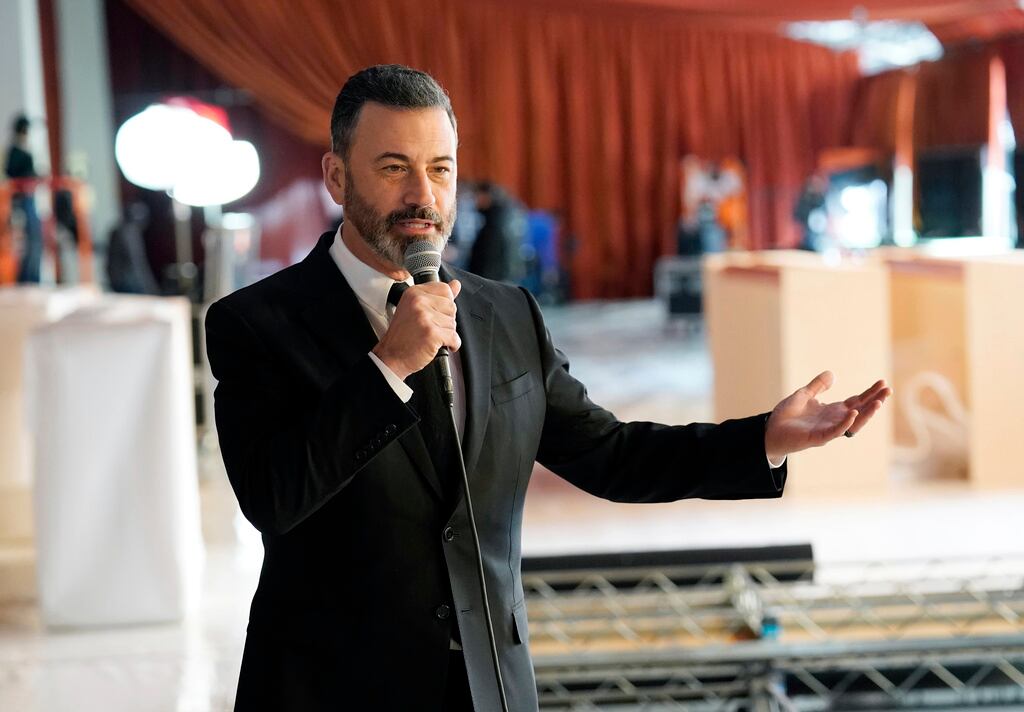
On Wednesday outside the Dolby Theatre in Hollywood, workers unspooled a champagne-colored carpet as Jimmy Kimmel, who is hosting the 95th Oscars on Sunday, presided over the occasion.
“I think the decision to go with a champagne carpet over a red carpet shows how confident we are that no blood will be shed," Kimmel said.
The decision to change the color came from creative consultants Lisa Love, a longtime Vogue contributor, and Raúl Àvila, the creative director for the glamourous Met Gala in New York.
This year the carpet will be covered, in part to protect the stars and cameras from the weather, but also to help turn the arrivals into an evening event. For Love, there has always been a disconnect between the elegant black tie dress code and the fact that it’s mid-afternoon when people arrive to be photographed in the daylight. With a covered carpet, they could change that.
“We turned a day event into night,” Love told The Associated Press. “It’s evening, even though it’s still 3:00.”
The Oscars red carpet dates back to 1961, the 33rd Academy Awards held at the Santa Monica Civic Auditorium, when Billy Wilder’s “The Apartment” won best picture, Burt Lancaster and Elizabeth Taylor won the lead acting prizes, and there was still a “juvenile award,” which went to Hayley Mills for “Pollyanna.” It was the first televised ceremony, broadcast on ABC and hosted by Bob Hope. The general public wouldn’t see the red carpet in all its glory on television until 1966, when the Oscars were first broadcast in color.
There wasn’t any debate over the change, Love said. They just knew they had the freedom to break from tradition. They tried some other colors too but they seemed too dark with the covered tent. “We chose this beautiful sienna, saffron color that evokes the sunset, because this is the sunset before the golden hour,” Love said.
Instead they went lighter and Academy CEO Bill Kramer approved.
They weren’t especially worried about upsetting Oscars traditionalists either.
“Somebody’s always got a way to find something wrong with something,” Love said. “This is just a lightness and hopefully people like it. It doesn’t mean that it’s always going to be a champagne colored carpet.”
As for what we should call it? Love said “champagne” and “sand” are apt descriptions, but that there’s no reason to not default to “red carpet” either. It’s more metonym for the glamorous arrivals than a literal description of what everyone is walking on.
The 95th Oscars “red carpet” opens Sunday at 3:30 p.m. Eastern. The ceremony is set to begin at 8 p.m. and will be broadcast live on ABC.