A crew member staples the carpet to the ground in preparation for Sunday's 95th Academy Awards, Wednesday, March 8, 2023, outside the Dolby Theatre in Los Angeles. (AP Photo/Chris Pizzello)
By Lindsey Bahr
Many things about the Academy Awards have changed over the years, but for the past six decades there has been at least one constant: The red carpet. The hues have varied over the years, but it has always been some shade of red. Until this year.
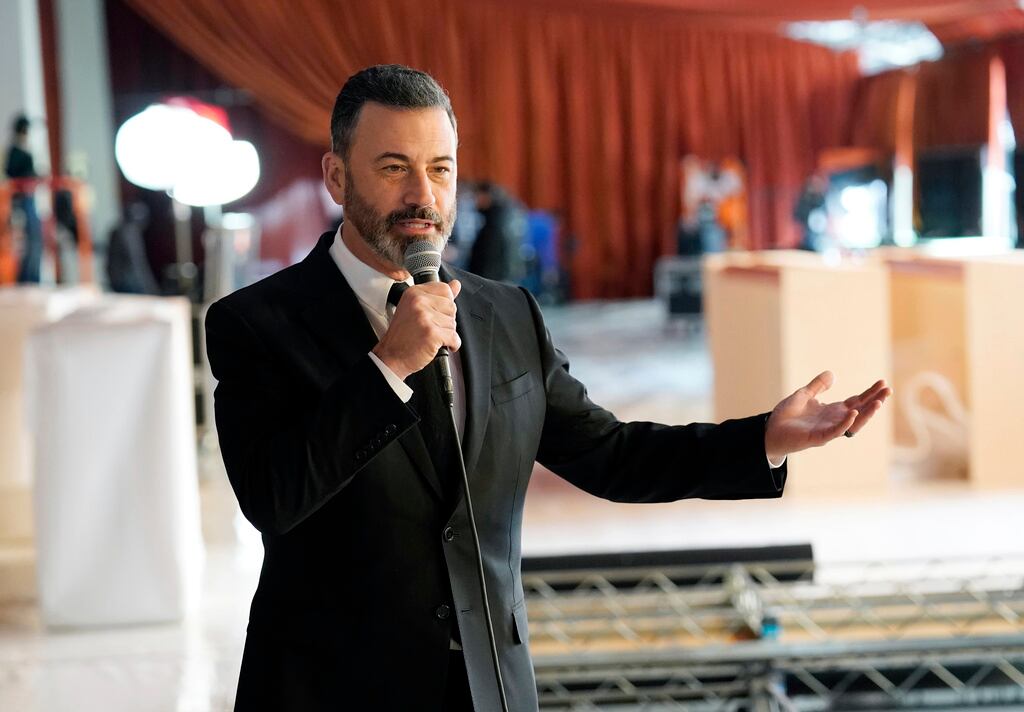
On Wednesday outside the Dolby Theatre in Hollywood, workers unspooled a champagne-colored carpet as Jimmy Kimmel, who is hosting the 95th Oscars on Sunday, presided over the occasion.
“I think the decision to go with a champagne carpet over a red carpet shows how confident we are that no blood will be shed," Kimmel said.
Jimmy Kimmel, host of Sunday's 95th Academy Awards, addresses the media before the roll out of the carpet for the show, Wednesday, March 8, 2023, outside the Dolby Theatre in Los Angeles. (AP Photo/Chris Pizzello)
The decision to change the color came from creative consultants Lisa Love, a longtime Vogue contributor, and Raúl Àvila, the creative director for the glamourous Met Gala in New York.
This year the carpet will be covered, in part to protect the stars and cameras from the weather, but also to help turn the arrivals into an evening event. For Love, there has always been a disconnect between the elegant black tie dress code and the fact that it’s mid-afternoon when people arrive to be photographed in the daylight. With a covered carpet, they could change that.
“We turned a day event into night,” Love told The Associated Press. “It’s evening, even though it’s still 3:00.”
The Oscars red carpet dates back to 1961, the 33rd Academy Awards held at the Santa Monica Civic Auditorium, when Billy Wilder’s “The Apartment” won best picture, Burt Lancaster and Elizabeth Taylor won the lead acting prizes, and there was still a “juvenile award,” which went to Hayley Mills for “Pollyanna.” It was the first televised ceremony, broadcast on ABC and hosted by Bob Hope. The general public wouldn’t see the red carpet in all its glory on television until 1966, when the Oscars were first broadcast in color.
There wasn’t any debate over the change, Love said. They just knew they had the freedom to break from tradition. They tried some other colors too but they seemed too dark with the covered tent. “We chose this beautiful sienna, saffron color that evokes the sunset, because this is the sunset before the golden hour,” Love said.
Instead they went lighter and Academy CEO Bill Kramer approved.
They weren’t especially worried about upsetting Oscars traditionalists either.
“Somebody’s always got a way to find something wrong with something,” Love said. “This is just a lightness and hopefully people like it. It doesn’t mean that it’s always going to be a champagne colored carpet.”
As for what we should call it? Love said “champagne” and “sand” are apt descriptions, but that there’s no reason to not default to “red carpet” either. It’s more metonym for the glamorous arrivals than a literal description of what everyone is walking on.
The 95th Oscars “red carpet” opens Sunday at 3:30 p.m. Eastern. The ceremony is set to begin at 8 p.m. and will be broadcast live on ABC.
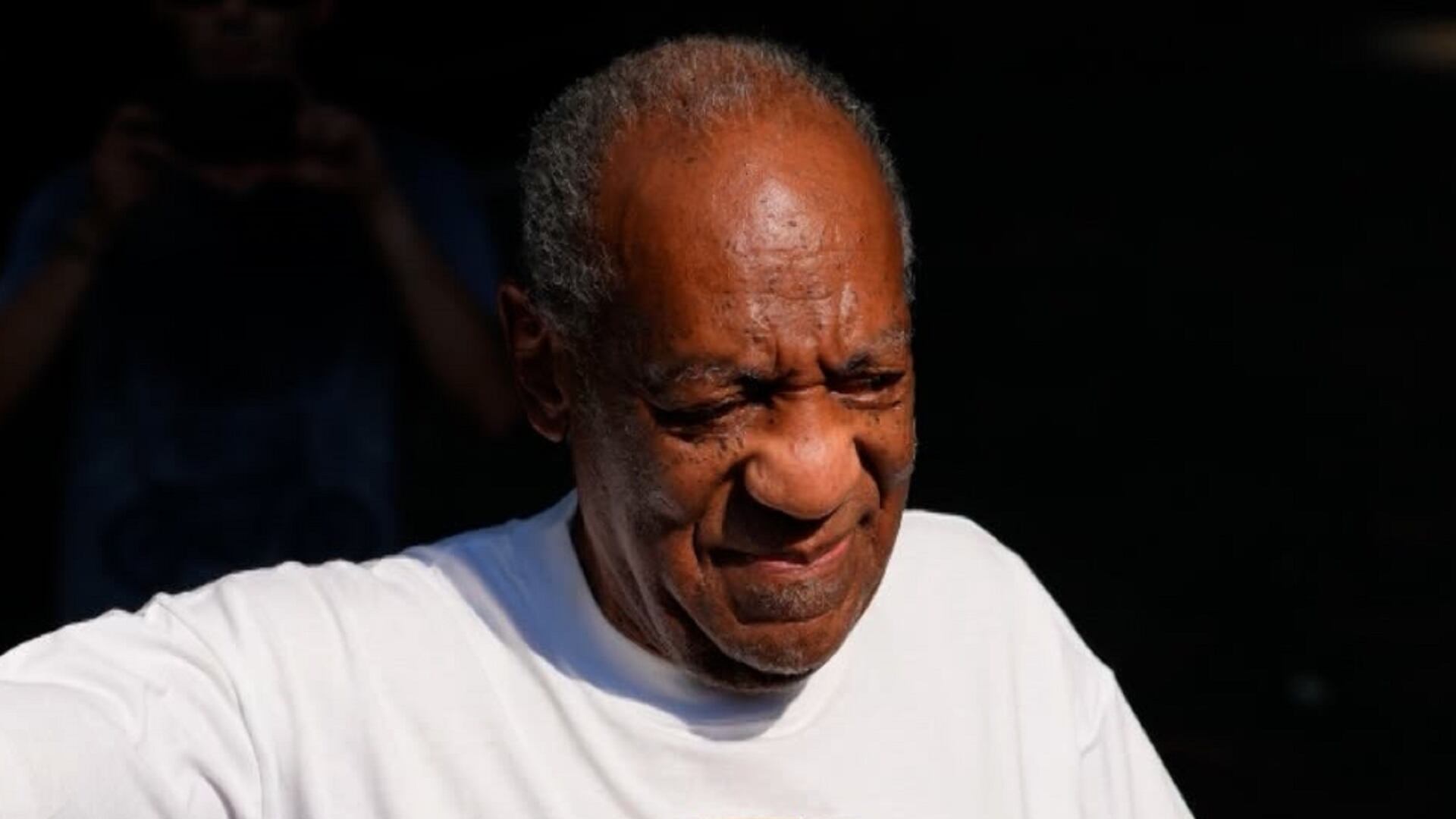
After premiering at the 2022 Sundance Festival, Showtime is slated to drop the four-part docuseries "We Need to Talk About Bill Cosby" this Sunday. Director W. Kamau Bell joined Cheddar to discuss the sensitive project and about coming to grips with the reality of who Bill Cosby is following the numerous allegations of sexual assault. Bell said the biggest takeaway from the project is that survivors are not only looking for the 84-year-old comedian to be held accountable, they also want to prevent future assaults. "Maybe the key thing to learn is how do we create a society that is more supportive and accepting particularly women in this case who are survivors of sexual assault," Bell said.
Tax season is now underway, and it's going to be a bit different than in years past. For starters, the deadline is April 18, instead of the typical April 15th, and many Americans will need to account for advance child tax credit payments, the return of the recovery rebate credit, and a special break for charitable contributions, among other things. Brent Weiss, Co-Founder and certified financial planner at Facet Wealth, tells us what we need to know about filing our taxes this year, and when we can expect to receive our returns.
College enrollment has been on a steady decline for years, and the pandemic hasn't helped. Since the start of the pandemic, there has been a 6.6% — more than 1 million students — drop in undergraduate enrollment, according to a recent report. Douglas Belkin, higher education reporter at the Wall Street Journal, joined Cheddar to discuss the long-term implications of students sitting out of college, and what institutions can do about it.
As the midterm election looms, things aren't looking too promising for President Joe Biden. One year into his term as president, Biden is facing one of the lowest approval ratings of any modern-day president, threatening his party's control of the House in 2022. Brian Bennett, Senior White House Correspondent for TIME, joined Cheddar's Opening Bell to discuss.
A full one year into his term as President of The United States, President Biden addressed the nation on Wednesday, facing questions on everything from inflation to chip shortages and covid-19. As Biden enters his second year in office, he is facing one of the lowest approval ratings of any modern-day president. Kate Davidson, Reporter, POLITICO joined Cheddar's Opening Bell to discuss.
San Diego has just implemented a new law that could set the stage for how the country deals with food waste. This new law hopes to make a dent in that. Businesses and groceries stores out in San Diego will need to put a plan in place to *donate edible food rather than toss it straight to the trash. Food Rescue Manager at Feeding San Diego, Kate Garret
The streaming giant Netflix posted its latest earnings from its fourth quarter after the close on Thursday. The company's stock plummeted shortly after the company warned that its rate of subscription additions are slowing down. Senior Reporter at MarketWatch Jon Swartz, joined Cheddar to discuss more.
Earlier this month, New York City experienced one of the deadliest fires it has seen in decades. 17 people lost their lives in the Fordham section of the Bronx. This was due to a faulty space heater which reportedly began on the lower floor of the 120 unit building. Thanks to the F. D. N. Y. And heroic neighbors, many were able to get out in time. Unfortunately, the toxic smoke surged upwards through a safety door. Now, many advocates say negligence by policymakers and landlords has led to the deaths in black and brown communities from fires that honestly could have been preventable. Legislative Director of Citizen Action of New York, Rebecca Garrard, and the Chair of Journalism and New Media Studies at St. Joseph's College Theodore Hamm, joined Cheddar to discuss more.
Revenue operations platform Clari recently raised $225 million in a Series F financing round led by Blackstone, bringing the company's valuation to more than $2.6 billion. Calri says more than 450 companies from around the world use its A.I.-powered platform to make their revenue operations more connected, efficient, and predictable. Clari CEO Andy Byrne joined Cheddar News' Closing Bell to discuss.