A crew member staples the carpet to the ground in preparation for Sunday's 95th Academy Awards, Wednesday, March 8, 2023, outside the Dolby Theatre in Los Angeles. (AP Photo/Chris Pizzello)
By Lindsey Bahr
Many things about the Academy Awards have changed over the years, but for the past six decades there has been at least one constant: The red carpet. The hues have varied over the years, but it has always been some shade of red. Until this year.
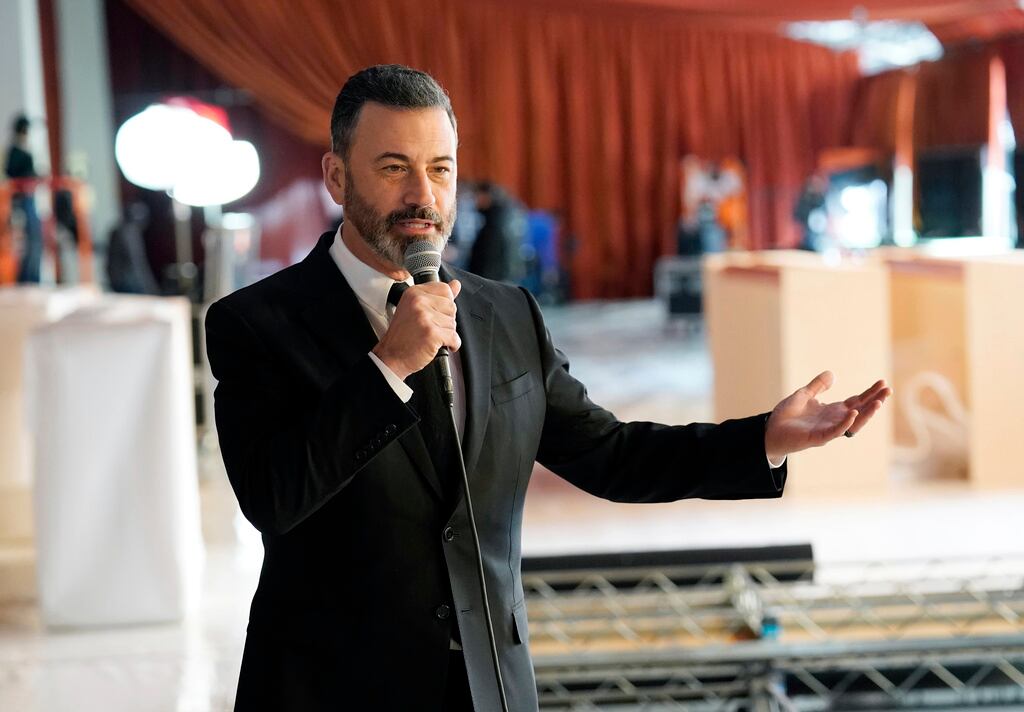
On Wednesday outside the Dolby Theatre in Hollywood, workers unspooled a champagne-colored carpet as Jimmy Kimmel, who is hosting the 95th Oscars on Sunday, presided over the occasion.
“I think the decision to go with a champagne carpet over a red carpet shows how confident we are that no blood will be shed," Kimmel said.
Jimmy Kimmel, host of Sunday's 95th Academy Awards, addresses the media before the roll out of the carpet for the show, Wednesday, March 8, 2023, outside the Dolby Theatre in Los Angeles. (AP Photo/Chris Pizzello)
The decision to change the color came from creative consultants Lisa Love, a longtime Vogue contributor, and Raúl Àvila, the creative director for the glamourous Met Gala in New York.
This year the carpet will be covered, in part to protect the stars and cameras from the weather, but also to help turn the arrivals into an evening event. For Love, there has always been a disconnect between the elegant black tie dress code and the fact that it’s mid-afternoon when people arrive to be photographed in the daylight. With a covered carpet, they could change that.
“We turned a day event into night,” Love told The Associated Press. “It’s evening, even though it’s still 3:00.”
The Oscars red carpet dates back to 1961, the 33rd Academy Awards held at the Santa Monica Civic Auditorium, when Billy Wilder’s “The Apartment” won best picture, Burt Lancaster and Elizabeth Taylor won the lead acting prizes, and there was still a “juvenile award,” which went to Hayley Mills for “Pollyanna.” It was the first televised ceremony, broadcast on ABC and hosted by Bob Hope. The general public wouldn’t see the red carpet in all its glory on television until 1966, when the Oscars were first broadcast in color.
There wasn’t any debate over the change, Love said. They just knew they had the freedom to break from tradition. They tried some other colors too but they seemed too dark with the covered tent. “We chose this beautiful sienna, saffron color that evokes the sunset, because this is the sunset before the golden hour,” Love said.
Instead they went lighter and Academy CEO Bill Kramer approved.
They weren’t especially worried about upsetting Oscars traditionalists either.
“Somebody’s always got a way to find something wrong with something,” Love said. “This is just a lightness and hopefully people like it. It doesn’t mean that it’s always going to be a champagne colored carpet.”
As for what we should call it? Love said “champagne” and “sand” are apt descriptions, but that there’s no reason to not default to “red carpet” either. It’s more metonym for the glamorous arrivals than a literal description of what everyone is walking on.
The 95th Oscars “red carpet” opens Sunday at 3:30 p.m. Eastern. The ceremony is set to begin at 8 p.m. and will be broadcast live on ABC.
Sheila Goffe, VP of Government Relations of the American Kennel Club, joins Cheddar Reveals to discuss the efficacy of police, military, and other working dogs, and how they're trained.
On this episode of Cheddar Reveals, Sheila Goffe, VP of Government Relations of the American Kennel Club, discusses the efficacy of police, military, and other working dogs, and how they're trained. Paul Mundell, Executive Director of the American Service Dog Access Coalition, breaks down why emotional support, therapy, and service dogs are important; Cheddar gets a look at Curiosity Stream's 'Secrets of a Dog's Nose.'
On this episode of ChedHER; Amanda Carlson Phillips, Senior Vice President of Exos' performance team, breaks down how wellness programs can fight burnout; Deena LaMarque Piquion, Chief Marketing Officer at Xerox, explains why and how women should stop saying 'sorry' so often;
Marylyn Harris, President of Harrland Healthcare Consulting, talks about how her experience in the military prepared her for a cybersecurity career, and how she's paving the way for women of color in the industry.
On this episode of Cheddar Innovates: Atom Limbs CEO breaks down how the Atom Touch prosthetic is different from other prosthetics on the market; CEO & Chief Scientific Officer of MyMD explains how the MYMD-1 is on track to be the first FDA-approved drug to treat aging and age-related diseases; A look at Curiosity Stream's 'The Future of Warfare.'
On this episode of Cheddar Reveals Clay Routledge, Professor of Business and author of "Nostalgia: A Psychological Resource", discusses the psychology of nostalgia: why we have it, and why it may be good for our mental health; Patrick Metzger, Writer and Technologist, breaks down how nostalgia has influenced pop culture, why it remains in a trend loop for every generation, and why that trend is likely never going to end; Cheddar gets a look at Curiosity Stream's 'The Year That Rocked the World.'
On this episode of ChedHER: CEO of The Lactation Network breaks down how they are expanding access to lactation support for families nationwide; CEO of Vanta explains the importance of a security team for startups; Midwest Divison Area Manager at JPMorgan Chase discusses the perks of having a business mentor.
On this episode of ChedHER we hear from the CEO of Incredible Health on how she's breaking the bias this women's history month, a bestselling author gives us tips on how to create new post-pandemic habits, and we learn just how critical a business consultant can be.
On this episode of 'Cheddar Innovates': Creator of Animal Flow discusses the benefits to this unique type of workout that's rising in popularity; CEO of Vinylly breaks down how the app takes your streaming music data and some personal questions to find your next love match; A look at Curiosity Stream's 'Secrets of the Universe.'
Activism is growing around the country in response to school boards banning books from shelves that focus on sexuality, gender, identity, or race. Jen Cousins, co-founder of The Florida Freedom to Read Project, joins Cheddar News to discuss.