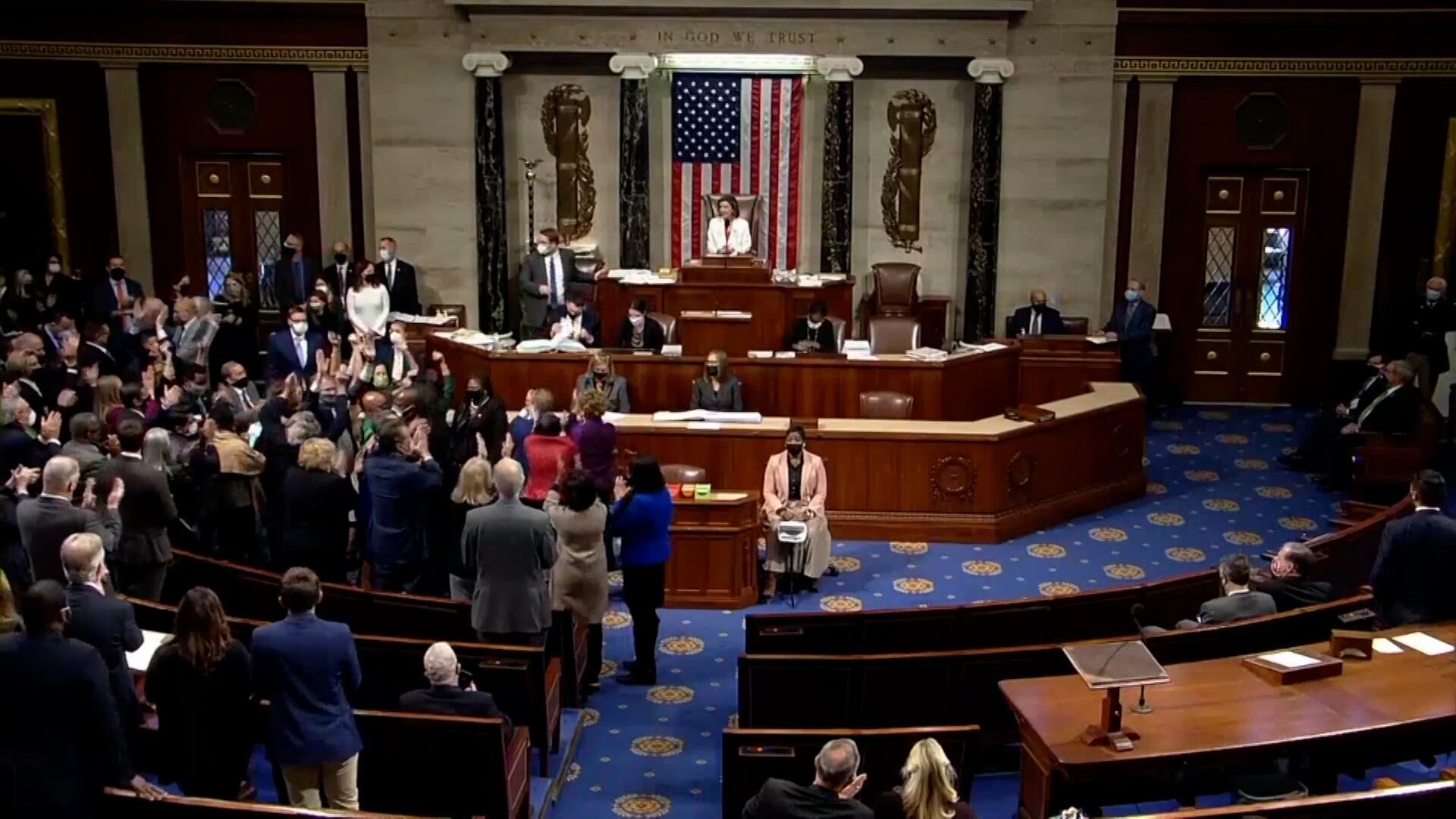
The House approved a resolution on Thursday to force the president to halt military action against Iran without Congressional authorization, restarting conversations on the role of Congress in war. Lawmakers voted largely along party lines, with the final vote tallied 224-194. Eight Democrats voted against the resolution and three Republicans voted in favor.
The bill, introduced by Michigan Democrat Elissa Slotkin, limits the president’s war-making power by requiring the president to seek an Authorization for Use of Military Force (AUMF) before possibly taking the U.S. into a war with Iran.
An aide to the congresswoman told Cheddar the bill aims to limit the president’s ability to wage such a conflict without consulting Congress.
“If our loved ones are going to be sent to fight in any protracted war, the President owes the American people a public conversation about why and for what ends,” Slotkin said in a press release.
House Speaker Nancy Pelosi said in a press conference earlier Thursday, before the vote, that the justification the White House used to justify the strike against Iran’s top military leader Gen. Qassem Soleimani was “foggy.” Slotkin noted Soleimani “was the architect of some of the worst destabilizing activities in the Middle East. But his behavior does not mean that the Administration can disregard the Constitution by engaging in a wider war, without consulting first with Congress.”
Democrats and at least two Republican senators have been publically skeptical of the administration’s justification for the drone strike, which has rotated between the contention the administration was preventing an “imminent threat,” that Iran was “looking to blow up our embassy,” and that Soleimani’s actions in the past were rationalization enough for the strike. The Trump administration has not explicitly offered a public legal justification but seems to indicate the rationale is based in the 2001 or 2002 AUMF measures that supported the War on Terror and the war in Iraq, respectively.
Under the War Powers Act of 1973, the president is supposed to brief Congress within 48 hours of an unauthorized executive military action. Lawmakers were not satisfied with the White House’s decision not to speak with Congress before the attack.
After Senators were finally briefed by Secretary of State Mike Pompeo, Defense Secretary Mark Esper, and CIA Director Gina Haspel five days after the attack, Senators Rand Paul (R-Ky.) and Mike Lee (R-Utah) joined Democrats in questioning the administration's strategy and raising concerns about its justifications. Both Republicans have indicated they would back a Senate version of the House resolution, with Lee saying the briefing was “insulting and demeaning to the Constitution of the United States.”
According to the resolution, a version of which was introduced to the GOP-controlled Senate by Democratic Senator Tim Kaine of Virginia, the president must end the use of U.S. armed forces to engage in hostilities in or against Iran unless formally authorized by Congress or if there is an “imminent armed attack upon the United States.” Lee’s press secretary confirmed he would vote for Kaine’s resolution but also supported the strike against Soleimani. Senator Mitt Romney confirmed he spoke to Kaine about the resolution, but did not yet support it. If Lee and Paul indeed voted for the resolution, Democrats would still need two more Republican votes to pass it in the Senate.
House Democrats voted using a concurrent resolution rather than a joint resolution, as the president is never presented with a concurrent resolution to sign. A concurrent resolution is simply enacted once the House and the Senate vote to approve it.