By Lisa Mascaro
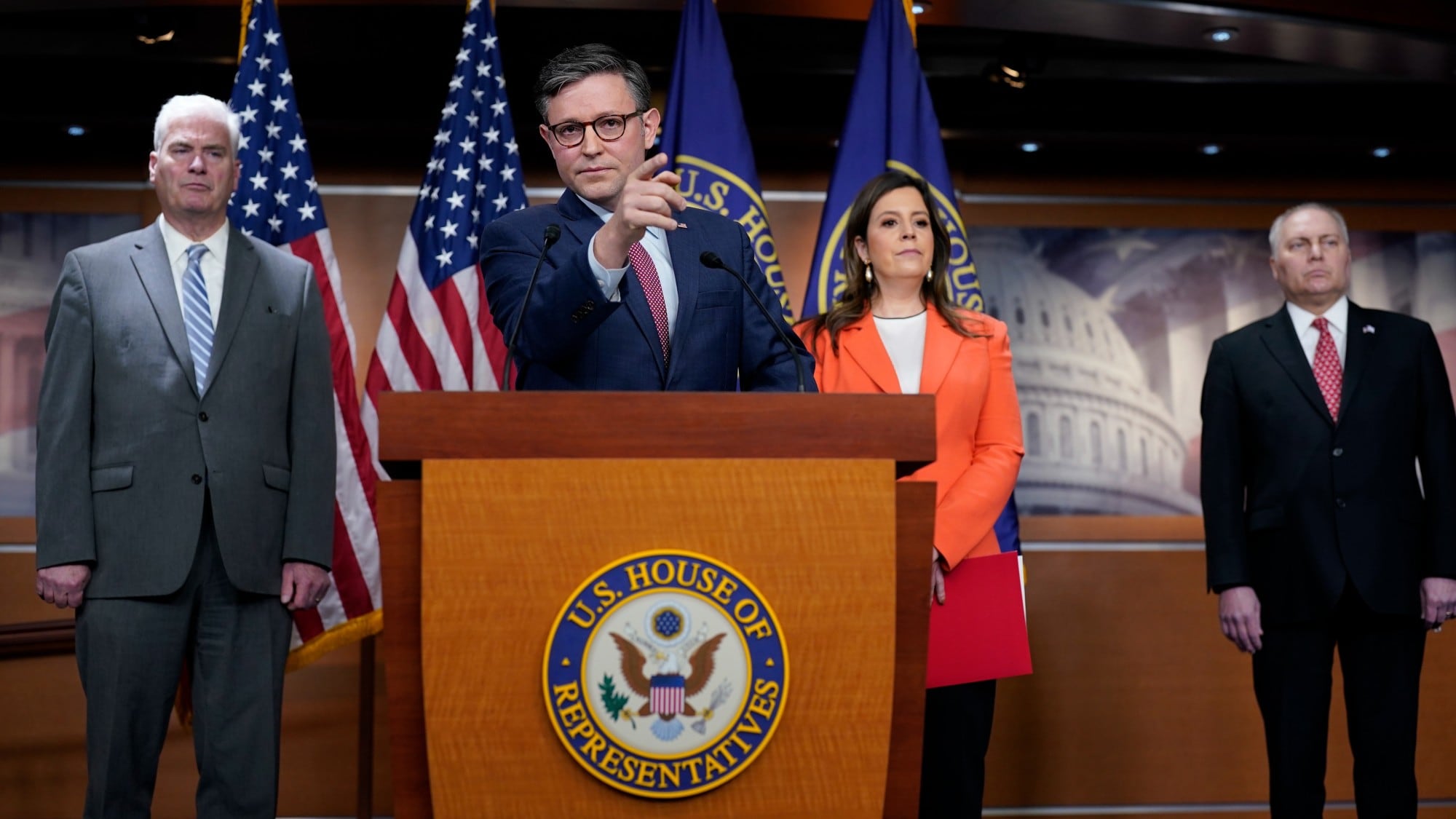
The House approved a nearly $14.5 billion military aid package Thursday for Israel, a muscular U.S. response to the war with Hamas but also a partisan approach by new Speaker Mike Johnson that poses a direct challenge to Democrats and President Joe Biden.
In a departure from norms, Johnson's package required that the emergency aid be offset with cuts in government spending elsewhere. That tack established the new House GOP's conservative leadership, but it also turned what would typically be a bipartisan vote into one dividing Democrats and Republicans. Biden has said he would veto the bill, which was approved 226-196, with 12 Democrats joining most Republicans on a largely party-line vote.
Johnson, R-La., said the Republican package would provide Israel with the assistance needed to defend itself, free hostages held by Hamas and eradicate the militant Palestinian group, accomplishing "all of this while we also work to ensure responsible spending and reduce the size of the federal government.”
Democrats said that approach would only delay help for Israel. Senate Majority Leader Chuck Schumer, D-N.Y., has warned that the “stunningly unserious” bill has no chances in the Senate.
The first substantial legislative effort in Congress to support Israel in the war falls far short of Biden's request for nearly $106 billion that would also back Ukraine as it fights Russia, along with U.S. efforts to counter China and address security at the border with Mexico.
It is also Johnson's first big test as House speaker as the Republican majority tries to get back to work after the month of turmoil since ousting Rep. Kevin McCarthy, R-Calif., as speaker. Johnson has said he will turn next to aid for Ukraine along with U.S. border security, preferring to address Biden's requests separately as GOP lawmakers increasingly oppose aiding Kyiv.
The White House's veto warning said Johnson's approach “fails to meet the urgency of the moment” and would set a dangerous precedent by requiring emergency funds to come from cuts elsewhere.
While the amount for Israel in the House bill is similar to what Biden sought, the White House said the Republican plan's failure to include humanitarian assistance for Gaza is a “grave mistake” as the crisis deepens.
Biden on Wednesday called for a pause in the war to allow for relief efforts.
"This bill would break with the normal, bipartisan approach to providing emergency national security assistance," the White House wrote in its statement of administration policy on the legislation. It said the GOP stance "would have devastating implications for our safety and alliances in the years ahead."
It was unclear before voting Thursday how many Democrats would join with Republicans. The White House had been directly appealing to lawmakers, particularly calling Jewish Democrats, urging them to reject the bill.
White House chief of staff Jeff Zients, counselor to the president Steve Ricchetti and other senior White House staff have been engaging House Democrats, said a person familiar with the situation and granted anonymity to discuss it.
But the vote was difficult for some lawmakers, particularly Democrats who wanted to support Israel and may have trouble explaining the trade-off to constituents, especially as the large AIPAC lobby and other groups encouraged passage. In all, two Republicans opposed the bill.
Rep. Brad Schneider, D-Ill, who voted against the package, said: “It was one of the hardest things I've had to do.”
To pay for the bill, House Republicans have attached provisions that would cut billions from the IRS that Democrats approved last year and Biden signed into law as a way to go after tax cheats. The nonpartisan Congressional Budget Office says doing that would end up costing the federal government a net $12.5 billion because of lost revenue from tax collections. Taken together, the cost of the aid package and revenue reduction adds up to more than $26 billion.
Republicans scoffed at that assessment, but the independent budget office is historically seen as a trusted referee.
Backers said the package would provide support for Israel’s Iron Dome missile defense system, procurement of advanced weaponry and other military needs, and help with protection and evacuations of U.S. citizens. CBO pegged the overall package at about $14.3 billion for Israel.
As the floor debate got underway, Democrats pleaded for Republicans to restore the humanitarian aid Biden requested and decried the politicization of typically widely bipartisan Israel support.
“Republicans are leveraging the excruciating pain of an international crisis to help rich people who cheat on their taxes and big corporations who regularly dodge their taxes,” said Rep. Jim McGovern of Massachusetts, the top Democrat on the House Rules Committee.
Rep. Dan Goldman of New York described hiding in a stairwell with his wife and children while visiting Israel as rockets fired in what he called the most horrific attack on Jews since the Holocaust.
Nevertheless, Goldman said he opposed the Republican-led bill as a “shameful effort” to turn the situation in Israel and the Jewish people into a political weapon.
“Support for Israel may be a political game for my colleagues on the other side of the aisle," the Democrat said. "But this is personal for us Jews and it is existential for the one Jewish nation in the world that is a safe haven from the rising tide of antisemitism around the globe.”
The Republicans have been attacking Democrats who raise questions about Israel's war tactics as antisemitic. The House tried to censure the only Palestinian-American lawmaker in Congress, Rep. Rashida Tlaib, D-Mich., over remarks she made. The censure measure failed.
Rep. Andrew Clyde, R-Ga., said he was "so thankful there is no humanitarian aid," which he argued could fall into the hands of Hamas.
In the Democratic-controlled Senate, Schumer made clear that the House bill would be rejected.
“The Senate will not take up the House GOP's deeply flawed proposal, and instead we'll work on our own bipartisan emergency aid package" that includes money for Israel and Ukraine, as well as humanitarian assistance for Gaza and efforts to confront China.
Senate Republican leader Mitch McConnell of Kentucky is balancing the need to support his GOP allies in the House while also fighting to keep the aid package more in line with Biden's broader request, believing all the issues are linked and demand U.S. attention.
McConnell said the aid for Ukraine was “not charity” but was necessary to bolster a Western ally against Russia.
In other action Thursday, the House overwhelmingly approved a Republican-led resolution that focused on college campus activism over the Israel-Hamas war. The nonbinding resolution would condemn support of Hamas, Hezbollah and terrorist organizations at institutions of higher education.
Associated Press writers Stephen Groves, Farnoush Amiri, Mary Clare Jalonick and Seung Min Kim contributed to this report.