Burdened by over five months of civil unrest, Hong Kong has fallen into a recession, the city's financial secretary said Sunday.
"The economy has entered a technical recession, and the negative growth rate has significantly expanded," Secretary Paul Chan wrote in a blog post. "The blow to our economy is comprehensive."
Chan added that official quarterly GDP figures would be released Thursday, but that preliminary analysis shows consecutive economic contractions. It will be "extremely difficult," he wrote, for Hong Kong to reach its previously forecasted growth rate.
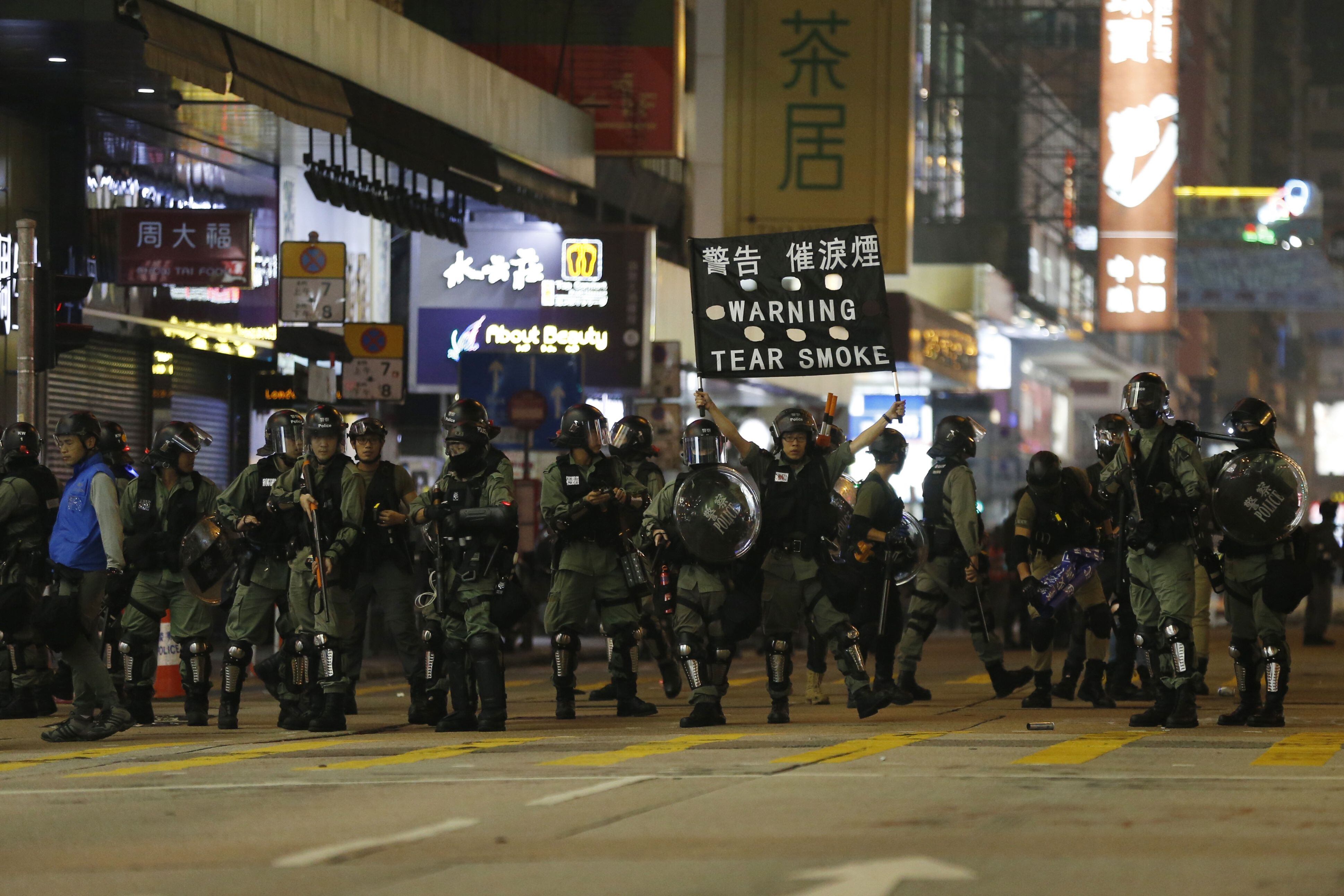
The bleak report coincided with chaotic demonstrations over the weekend that saw shops set ablaze and petrol bombs thrown at police, who responded heavily with water cannons and tear gas. In a statement Monday, police said that protesters overstepped the "bottom line of any civilized society." Unrest in Hong Kong, which first broke in June in opposition to a proposed extradition bill, has escalated significantly in recent months as residents continue to protest China's growing influence over the city and call for more democratic rights.
Chan on Sunday called on demonstrators to keep order and allow industry and commerce to operate freely. "Our society and the economy need to take a breather and need to get back on the road," he wrote.
<i>Police and protesters in Hong Kong on Sunday. Photo Credit: JEROME FAVRE/EPA-EFE/Shutterstock</i>
As a Chinese special administrative region since 1997, Hong Kong has enjoyed relative autonomy from Beijing in recent decades and has grown into one of the world's most significant financial and commercial hubs. In 2018, Hong Kong was home to the highest number of ultrawealthy ($30 million or more net worth) residents of any city in the world, according to Wealth-X's annual report. New York surpassed Hong Kong just slightly in 2019.
Earlier this month, Hong Kong's richest resident, Li Ka-shing, donated 1 billion Hong Kong dollars ($128 million) to support local business affected by the city's "unprecedented challenges."
"I hope that HK$1 billion donation will spark more support for the embattled [Small and Medium Enterprises]," Li said in a statement. "All suggestions are welcome and let's work together during these difficult times."
The Hong Kong government has also implemented a series of measures to help alleviate financial pains. Secretary Chan announced earlier this month a 19 billion Hong Kong dollar ($2.4 billion) relief package, which included significant rent reductions.
In announcing the recession Sunday, Chan cited plummeting tourism and retail sales figures. The number of visitors to Hong Kong fell by 37 percent in August and September, and by 50 percent in the first half of October. Tourism's decline constitutes an "emergency," Chan wrote. The decline of retail sales volume fell by 13.1 percent in July to 25.3 percent in August.
"We will continue to closely monitor the external economic situation and the political and economic situation in Hong Kong and try our best to further study the relief measures," Chan added in his Sunday blog post.
Investors, however, seem to be sticking with Hong Kong. The Hong Kong Stock Exchange's Hang Seng Index remains up more than 4 percent year-to-date.
Scott Helfstein, executive director of thematic investing at ProShares, joined Wake Up With Cheddar to break down the early data on Black Friday. Americans were ready to return to in-person shopping after the pandemic fueled a surge in online sales last year. Online sales dipped this year and in-store foot traffic topped 2020 but has yet to reach pre-pandemic levels. "It might not get much better than this for brick and mortar as we wrap up this year, whereas, the online has been in a long-term secular growth trend," he said.
The holidays are here, which means many will raise a glass. In fact, data shows the average American doubles their booze intake between Thanksgiving and New Years, with about 45% of those drinkers choosing vodka as their liquor of choice. Tony Latham, Bacardi's CFO, tells Cheddar what he anticipates will be the most popular spirit or cocktail this holiday season, as well as other trends going into the new year.
This holiday season, e-commerce sales are expected to hit 207 billion dollars, with17 percent of that chunk will occuring between the days of the deals - black friday and cyber monday. Deren Baker, CEO of edge by ascential, joins Cheddar News to give a Cyber Monday preview.
With Black Friday right around the corner, Trae Bodge, Smart Shopping Expert at TrueTrae.com joined Cheddar's Opening Bell to discuss holiday shopping tips ahead of the annual event.
Zoom reported solid third quarter earnings, with a beat on revenue and EPS, but did warn of slowed growth as the pandemic wanes. For more on the company’s third quarter earnings and their innovation plans post-pandemic, Kelly Steckelberg, CFO, Zoom joined Cheddar’s Opening Bell to discuss.
As Black Friday and Cyber Monday shopping continues, Shopify is tracking sales across the more than 1 million independent and direct-to-consumer brands it powers globally. The e-commerce giant's live map captures data in real time with metrics such as sales per minute and orders per minute, demonstrating the impact independent business have around the world. Ritu Khanna, Shopify's managing director for North America, gives insight into the trends the company is seeing this year.
A federal jury has found CVS, Walmart, and Walgreens responsible for distributing millions of painkillers in two Ohio counties, which as a result fueled the opioid crisis there. The verdict could set the tone for cities and counties across the country that want to hold pharmacies accountable for their role in the opioid epidemic. Barak Lurie, partner and principal attorney at Lurie and Kramer, joined Cheddar to discuss why he thinks the verdict will be overruled.
Natalie Fertig, Federal Cannabis Policy Reporter for Politico Pro, joined Cheddar to discuss the shift among republicans to support federally legalizing marijuana.
Bitcoin has officially entered bear market territory. The cryptocurrency is down 20% from an all-time high of nearly $69,000 dollars, which it hit earlier this month. Experts mark the new potentially vaccine-resistant coronavirus variant as the reason for the dip. Patrick McConlogue, CEO of Overlin, joins Cheddar News to discuss.