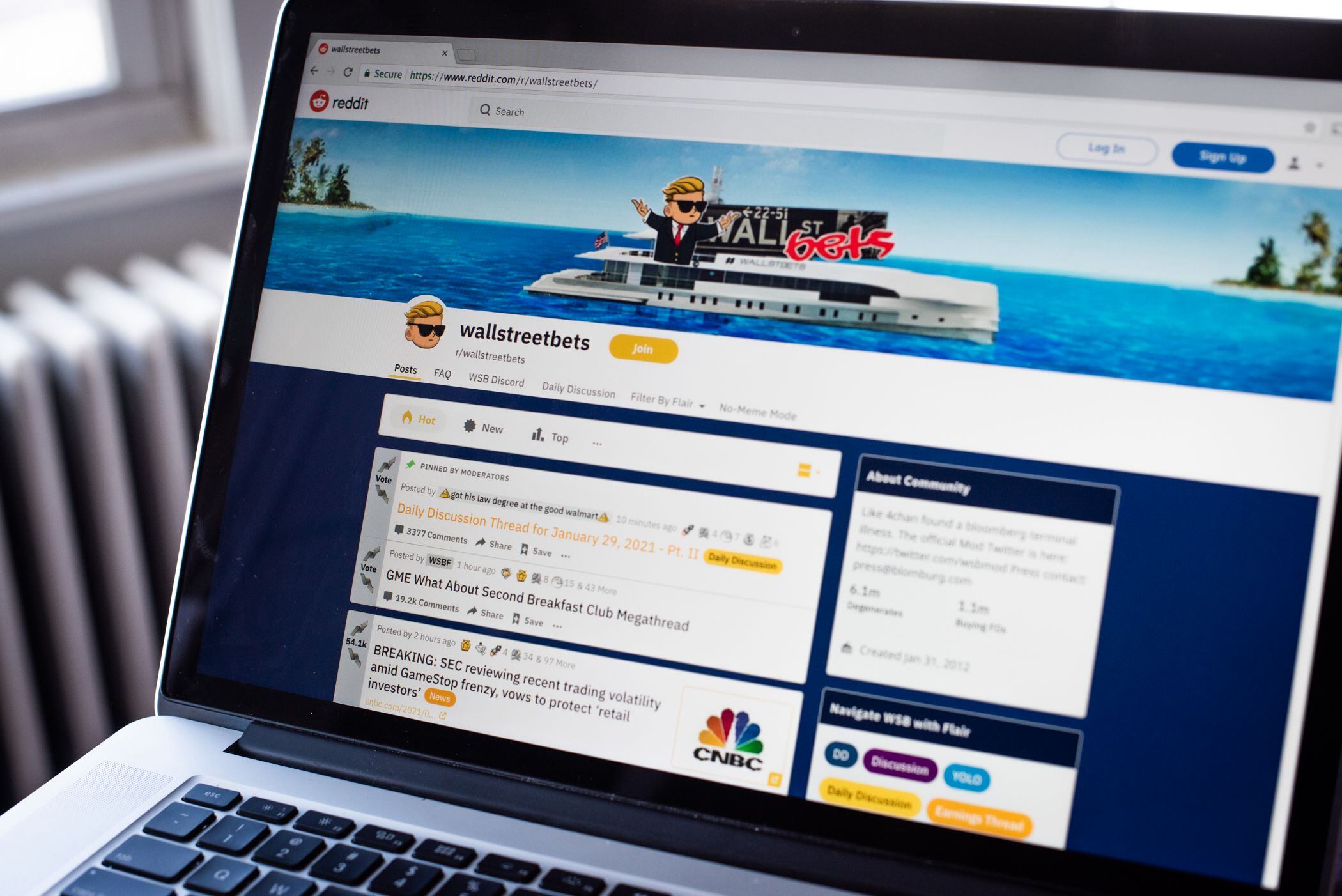
The WallStreetBets forum on the Reddit Inc. website on a laptop computer arranged in Hastings-On-Hudson, New York, U.S., on Friday, Jan. 29, 2021. Photographer: Tiffany Hagler-Geard/Bloomberg via Getty Images
The race is on for hedge funds to better understand how social media is moving markets or risk the same fate as the short-sellers who were clobbered by the rally in GameStop shares.
One way to get ahead of these trends is to more closely track subreddits such as /WallStreetBets, which sparked off the recent buying frenzy and is keeping it rolling with a steady stream of messages telling members to "hold the line" on their investment.
But reading every Reddit post is a tough sell for a hedge fund or institutional investor engaged in high-speed, high-volume trading. That's why brothers Christopher and James Kardatzke, founders of Quiver Quantitative, are suddenly getting a lot of interest from Wall Street.
Over the past few days, the Wisconsin-based startup has gotten a steady stream of inquiries from hedge funds asking about how their technology can help them track social media.
"We've been getting a lot of emails from different hedge funds interested in using our data API to basically get data from /WallStreetBets," Christopher Kardatzke, the chief technology officer for Quiver Quantitative, told cheddar. "They want to make sure there isn't this retail investor interest in what they're taking short positions in."
The company, which provides both free and custom application programming interfaces (API), tracks or "scrapes" alternative data sources such as subreddits, Twitter, and Facebook channels — basically any non-financial source that could be relevant to markets.
Fortunately for the startup, it had been scraping the popular subreddit since early 2020.
Technically, that means it was tracking the number of times certain stocks or ticker symbols were mentioned and whether there was a positive or negative sentiment around those stocks.
Looking at the whole year, Quiver found that the "WallStreetBets Portfolio," a breakdown of the top stocks mentioned positively on the subreddit, was up more than 61 percent, was more volatile than the S&P 500, but outperformed it even through the downturn at the start of the year.
Right now, this data is aggregated on a daily basis, but the startup is working on rolling out a real-time feed within the next few weeks.
"It's pretty basic stuff, but we're in the process right now of expanding that into a live feed to get the most recent comments within seconds," the CTO said.
Kardatzke noted that this will be particularly useful to hedge funds, and will fit well with /WallStreetBets, which features daily posts outlining where members plan to invest the following day.
Soon, he added, Quiver will start looking at language more specific to the subreddit, including option trading terms such as puts and calls.
And while Quiver will likely develop some of these inquiries from hedge funds into client relationships, the company plans to maintain its free platform, which Kardatzke said was originally built to help retail rather than institutional investors.
"It's so relevant to retail investors," he said. "It's data you see in your everyday life. You don't need a finance degree to be able to analyze it or get insights from it."
Kardatzke said that he's conscious that the company could soon be straddling both sides of what appears to be a growing rift in the financial world. The way to remedy that is by making sure both sides are catered to. Retail investors, for instance, want more visualizations and analysis, while institutions want APIs to use for their own analysis, he said.
He said that typically data providers only offer the latter, "but we’d like to do everything we can to make insights from our data available to the public, while keeping afloat."
Earlier this week, New York's gaming commission approved nine mobile sports platforms to operate in the market, but each respective sportsbooks' revenue will be taxed at 51%, tied for the steepest rate in the country. Eben Novy-Williams, sports business reporter for Sportico, joins Cheddar News' Closing Bell where he breaks down the challenge sportsbooks face to be profitable in the region.
Rich Rosenblum, Co-Founder and President of crypto trading firm GSR, joins Cheddar News' Closing Bell, where he explains why investors are rushing to Ethereum and breaks down the advantages it holds over other digital assets.
Earnings season continues in the week of November 15-19, with results on tap from Walmart, Home Depot, Lowe's, Target, and more. New economic data on Tuesday will provide a deeper look at the retail space when the Commerce Department releases October retail sales numbers, following this week's hot inflation data. Plus, President Biden is set to visit GM's electric vehicle factory in Michigan, where he is expected to formally introduce the plant's grand opening.
On this episode of 'Your Future Home', Chip Wade, Emmy Award-winning HGTV Host, breaks down all the ways you can avoid breaking the bank on energy costs this holiday season, especially when it comes to outfitting your home with smart tech; Dr. Wendy Osefo, Entrepreneur, Professor & Cast Member of Bravo's 'Real Housewives of Potomac', discusses her popular new Onyi Home Essentials line and how ideas of family and legacy helped shape it; Cheddar breaks down everything you need to know about how to determine your non-negotiables when purchasing a house.
One NFL team says it is using data to help it win off the field. The Seattle Seahawks say they want to be a source of inspiration for other organizations that want to reap the rewards of a data-driven culture and aim to show the unlikely role data can play in professional sports operations. Seattle Seahawks Director of Business Strategy and Analytics Paimon Jaberi joins Cheddar News' Closing Bell to discuss.
Aurora Cannabis CEO Miguel Martin joins Cheddar News' Closing Bell to discuss the company's latest earnings results, how it will achieve positive EBITDA by 2023, and the state of the cannabis industry amid potential U.S. federal legalization.
Disney saw misses on both its top and bottom lines for its fourth quarter. The entertainment giant also fell just short of Wall Street expectations for new Disney+ subscribers. CFRA Research media and entertainment analyst Tuna Amobi joined Cheddar News' Closing Bell to break down what this means for the future of Disney.
Johnson & Johnson is the latest company to announce this week it is splitting into two companies, separating its consumer operations from its pharmaceutical and medical devices unit. Electronics firm Toshiba also made a similar announcement today, and General Electric earlier this week also said it would be spinning off its aviation, healthcare, and power businesses. What does this mean for investors - and will this become a trend among conglomerates? Barron's Senior Writer Al Root joins Cheddar News' Closing Bell to discuss why Johnson & Johnson is splitting up, what this strategy means for conglomerates, and why they might pursue a break-up.
Business is booming for the used car marketplace Shift while the automotive industry as a whole struggles with demand and supply chain issues stemming from the global semiconductor shortage. Co-CEO and co-founder George Arison joined Cheddar's "Closing Bell" to talk about the company's stellar Q3 earnings and how it was able to meet demand.