By Lisa Mascaro, Farnoush Amiri, Stephen Groves and Kevin Freking
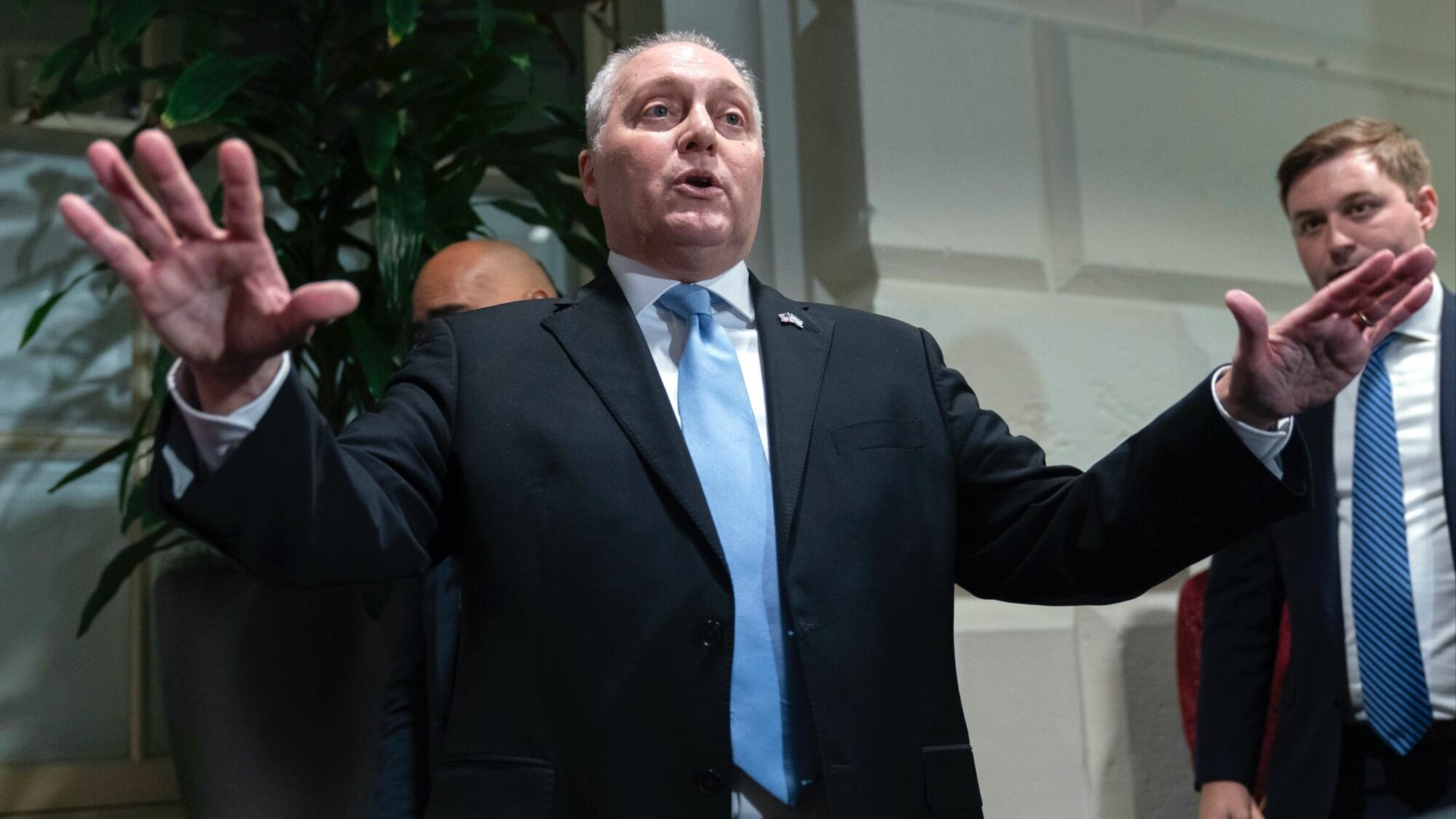
Republican Steve Scalise ended his bid to become House speaker late Thursday after hardline holdouts refused to back the party’s nominee, throwing the GOP majority into deeper chaos and leaving the chamber still unable to function.
Scalise told GOP colleagues at a closed-door evening meeting of his decision and pointedly declined to announce backing for anyone else, including his chief rival, Rep. Jim Jordan, the far-right Judiciary Committee chairman backed by Donald Trump who had already told colleagues he no longer would seek the job.
Next steps are uncertain as the House is essentially closed while the Republican majority tries to elect a speaker after ousting Kevin McCarthy from the job.
“I just shared with my colleagues that I’m withdrawing my name as a candidate for speaker-designee,” Scalise, the House majority leader, said as he emerged from the closed-door meeting at the Capitol.
Scalise, R-La., said the Republican majority still has to come together and "open up the House again. But clearly not everybody is there.”
He had been working furiously to secure the votes after being nominated by a majority of his colleagues, but after hours of private meetings over two days and late into the evening it was clear many other Republican lawmakers were not budging from their refusal to support him.
Asked if he would throw his support behind Jordan, Scalise said, "It’s got to be people that aren’t doing it for themselves and their own personal interest.”
Scalise spoke candidly of the perspective on life he said he has gained from surviving being shot in 2017 and said he would push quickly for a resolution. “But it wasn’t going to happen. It wasn’t going to happen today. It wasn’t going to happen tomorrow. It needs to happen soon, but I’ve withdrawn my name,” he said.
Frustrations were boiling over and some lawmakers simply walked away as the political crisis spiraled and now threatens to leave the Republican majority in turmoil for the foreseeable future.
Scalise had been laboring to peel off more than 100 votes, mostly from those who backed Jordan. But many hard-liners taking their cues from Trump have dug in for a prolonged fight to replace McCarthy after his historic ouster from the job.
The hold-outs argued that as majority leader, Scalise was no better choice, that he should be focusing on his health as he battles cancer and that he was not the leader they would support. The House closed late in the night, with lawmakers vowing to meet again early Friday.
McCarthy said afterward that Scalise would remain as majority leader but had no other advice for his colleagues. The California Republican had briefly floated a comeback bid but that seems uncertain.
“I just think the conference as a whole has to figure out their problems, solve it and select the leader,” he said.
The House is entering its second week without a speaker and is essentially unable to function during a time of turmoil in the U.S. and wars overseas, and the political pressure increasingly is on Republicans to reverse course, reassert majority control and govern in Congress.
The situation is not fully different from the start of the year, when McCarthy faced a similar backlash from a different group of far-right holdouts who ultimately gave their votes to elect him speaker, then engineered his historic downfall.
But the math this time is even more daunting, and the problematic political dynamic only worsening.
Scalise — who is seen by some colleagues as hero for having survived the 2017 shooting, when a gunman opened fire on lawmakers at a congressional baseball game practice — won the closed-door Republican vote 113-99.
But with the House narrowly split 221-212, with two vacancies, Scalise could lose just a few Republicans to reach the 217 majority needed in the face of opposition from Democrats who will most certainly back their own leader, New York Rep. Hakeem Jeffries. Absences heading into the weekend could lower the majority threshold needed.
“We will come together and we will move forward for the good of the country,” Jordan said afterward.
Attention now focuses on Jordan and his backers instantly revived calls for party members to get behind the Ohio Republican, who is a founding leader of the hard-right House Freedom Caucus.
“Make him the speaker. Do it tonight,” said Rep. Jim Banks, R-Ind. “He’s the only one who can unite our party.”
But the firebrand Jordan has a long list of detractors who started making their opposition known. Other potential speaker choices were also being floated.
Some Republicans proposed simply giving Rep. Patrick McHenry, R-N.C., who was appointed interim speaker pro tempore, greater authority to lead the House for some time.
Rank-and-file Republicans left Thursday night's meeting angry, overwhelmed and with their heads spinning about what to do next.
“I’m a freshman caught up in this maelstrom,” said Rep. Mark Alford, R-Mo. “We’re a ship without a rudder right now. And I’m thoroughly disappointed in the process. And I just pray to God that we find something.”
Exasperated Democrats, who have been watching and waiting for the Republican majority to recover from McCarthy’s ouster, urged them to figure it out, warning the world is watching.
“The House Republicans need to end the GOP Civil War, now,” Jeffries said.
“The House Democrats have continued to make clear that we are ready, willing and able to find a bipartisan path forward,” he said, including doing away with the rule that allows a single lawmaker to force a vote against the speaker. “But we need traditional Republicans to break from the extremists and partner with us.”
As Congress sat idle, the Republicans spent a second day behind closed doors, arguing and airing grievances but failing to follow their own party rules and unite behind the nominee.
Rep. Dan Crenshaw, R-Texas, said the meetings had been marked by “emotional” objections to voting for Scalise.
Some Republicans simply took their Chick-fil-A lunches to go.
Earlier in the day, Jordan had given his most vocal endorsement yet to Scalise and announced he did not plan to continue running for the leadership position. But it was not enough to sway the holdouts.
Handfuls of Republicans announced they were sticking with Jordan, McCarthy or someone other than Scalise.
Rep. Troy Nehls, R-Texas, reaffirmed his support for Trump as speaker; the position does not need to go to a member of Congress.
Trump, the front-runner for the 2024 GOP presidential nomination, repeatedly discussed Scalise's health during a radio interview that aired Thursday.
“Well, I like Steve. I like both of them very much. But the problem, you know, Steve is a man that is in serious trouble, from the standpoint of his cancer,” Trump said on Fox News host Brian Kilmeade’s radio show.
Scalise has been diagnosed with a form of blood cancer known as multiple myeloma and is being treated.
“I think it’s going to be very hard, maybe in either case, for somebody to get,” Trump said. "And then you end up in one of these crazy stalemates. It’s a very interesting situation.”
Many Republicans want to prevent the spectacle of a messy House floor fight like the grueling January brawl when McCarthy became speaker.
But others said it was time for Republicans to get out from behind closed doors and vote.
“Stop dragging it out,” said Rep. Marjorie Taylor Greene, R-Ga., on social media. “If Kevin McCarthy had to go 15 rounds then the next Speaker should be able to do the same or more if they have to.”
Associated Press writer Jill Colvin in New York contributed to this report.