By Mary Claire Jalonick

A congressional hearing devolved into an angry confrontation between a senator and a witness on Tuesday after Republican Sen. Markwayne Mullin of Oklahoma challenged Sean O’Brien, the president of the International Brotherhood of Teamsters, to “stand your butt up” and settle longstanding differences right there in the room.

Vermont Sen. Bernie Sanders, the chairman of the Senate panel that was holding the hearing, yelled at Mullin to sit down after he challenged O’Brien to a fight. Mullin had stood up from his seat at the dais and appeared to start taking his ring off.

“This is the time, this is the place,” Mullin told O’Brien after reading a series of critical tweets O’Brien had sent about him in the past. “If you want to run your mouth, we can be two consenting adults. We can finish it here.”

The two men never came face to face in the hearing room. But they hurled insults at each other for around six minutes as Sanders repeatedly banged his gavel and tried to cut them off. Sanders, a longtime union ally, pleaded with them to focus on the economic issues that were the focus of the Senate Health, Education, Labor and Pensions Committee hearing, which Sanders was holding to review how unions help working families.

“You are a United States senator!” Sanders yelled at Mullin at one point.

Mullin, a frequent critic of union leadership, has sparred before with the union head. Earlier this year, O’Brien posted repeatedly about Mullin on X, formerly known as Twitter, calling him a “moron” and “full of s---” after Mullin criticized O'Brien at a hearing for what Mullin said were intimidation tactics.

In another social media post, which Mullin read aloud at Tuesday’s hearing, O’Brien appeared to challenge Mullin to a fight. “You know where to find me. Anyplace, Anytime cowboy,” O’Brien had posted.

The exchange escalated from there, with Mullin telling O’Brien that “this is the place” and asking if he wanted to do it right now.

“I’d love to do it right now,” O’Brien said.

Mullin replied: “Well, stand your butt up then.”

“You stand your butt up,” O’Brien shot back.

When Mullin got up from his chair, appearing ready for a fight, Sanders yelled at him to sit down, banged his gavel several times and told both of them to stop talking.

“This is a hearing, and God knows the American people have enough contempt for Congress, let’s not make it worse,” Sanders said.

As Mullin persisted, O’Brien retorted: “You challenged me to a cage match, acting like a twelve year old schoolyard bully."

The two traded angry insults for several more minutes — each called the other a “thug” — with Mullin at one point suggesting they fight for charity at an event next spring, repeating an offer he made earlier this year on social media.

O’Brien declined, instead suggesting they meet for coffee and work out their differences. Mullin accepted, but the two kept shouting at each other until the next senator, Democratic Sen. Maggie Hassan of New Hampshire, started her questioning by talking over them.

After the hearing, Sanders called the exchange “absurd.”

“We were there to be talking about, and did talk about, the crisis facing working families in this country, the growing gap between the very rich and everybody else and the role that unions are playing in improving the standard of living of the American people,” Sanders said. “We’re not there to talk about cage fighting.”

Asked later about the skirmish, Senate Republican Leader Mitch McConnell demurred. “It’s very difficult to control the behavior of everybody who is in the building,” McConnell said. “I don’t view that as my responsibility.”

Republican Sen. Kevin Cramer of North Dakota said that references were made to the back-and-forth in a GOP conference meeting after the hearing. But he said that no one should take it too seriously.

“It’s a dynamic place," Cramer said of the Senate. "We don’t wear the white wigs anymore.”

Associated Press writer Kevin Freking contributed to this report.
Share:
More In Politics
U.S. Back to Negotiating Iran Nuclear Deal After Trump Withdrew in 2018
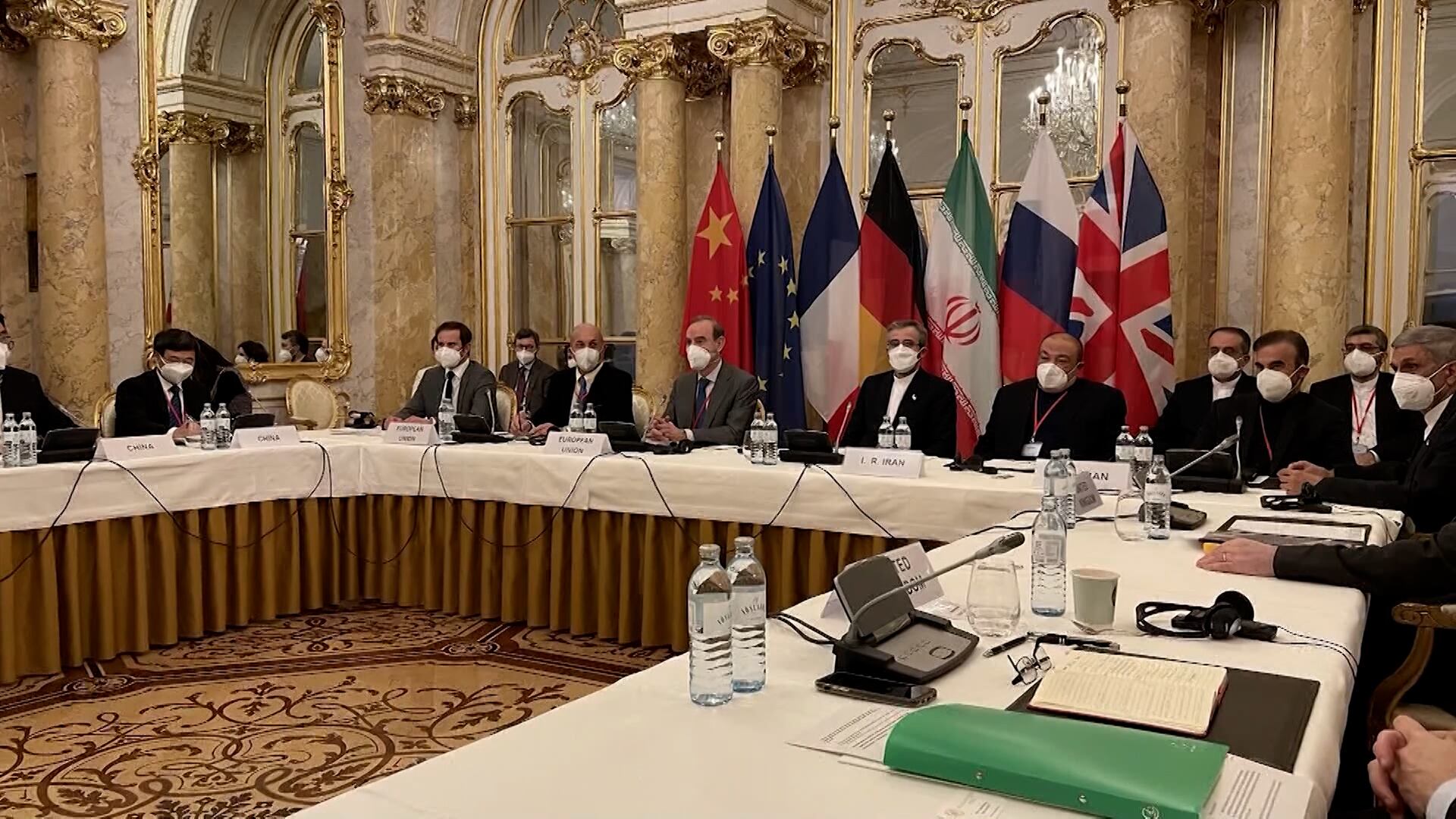
The U.S. is back in negotiations for a nuclear deal with Iran, years after former President Donald Trump withdrew the country from the Joint Comprehensive Plan of Action (JCPOA), which had been meant to curtail the Middle Eastern nation's nuclear ambitions. Former State Department senior advisor to the George W. Bush and Trump administrations, Christian Whiton, joined Cheddar News Wrap to discuss. “It appears to be very similar to the original JCPOA, which does put some constraints on Iran's nuclear program, but also has sunset provisions, including some that in the original plan were expected to take effect in 2025," he said. "And so, if we just reenter that plan, really it just buys perhaps a few years of slowing down, stopping, whatever you want to say, Iran's nuclear program."
Russia Orders Troops Into Two Ukrainian Regions, White House Calls the Conflict an Invasion
The U.S. has announced the first of what could be multiple levels of sanctions against Russia after Moscow recognized two regions of Ukraine as independent. This comes as Britain imposes sanctions on five Russian banks and two oligarchs, and Germany freezes the Nord Stream gas pipeline. Terrell Star, a foreign affairs reporter at The Atlantic Council, joins from Kyiv to discuss.
Price at the Pump Expected to Rise as Fear of Russian Invasion of Ukraine Grows
Growing tensions in Ukraine might soon be impacting consumers in the United States. With Russia on an invasion footing in the region, gas prices are predicted to go up 10 to 15 cents a gallon in the next coming weeks, according to Robert Sinclair, spokesperson for AAA. Sinclair joined Cheddar to break down what could happen even further. "We've been seeing prices go up, and there's been nothing that's happened to affect supplies," he said. "But it's something known as the fear tax where just the talk of something that might interfere with supplies leads to prices going up speculatively."
End of 3G Networks Expected to Impact Millions of Car Owners
The end of 3G is upon us. On Tuesday, AT&T became the first major provider to disable its 3G services, and T-Mobile and Verizon plan to follow suit later this year. The shutdowns are expected to impact millions of vehicles that use 3G networks for updates, remote connection, and certain emergency and convenience features. Lance Ulanoff, the U.S. Editor-in-Chief of TechRadar, joined Cheddar's Closing Bell to discuss the ramifications of the changeover.
Biden Imposes Economic Sanctions On Russia
President Biden unveiled new economic sanctions on Russia for what he called "the beginning of a Russian invasion". This came one day after Putin sent troops into two breakaway regions of eastern Ukraine. Alex Ward, national security reporter for POLITICO, explains what these sanctions might do to the global economy.
Stocks Close Sharply Lower Amid Russia-Ukraine Tensions
U.S. stocks ended today's session sharply lower on the heels of rising geopolitical tensions between Russia and Ukraine. Melissa Brown, Managing Director of Applied Research at Qontigo, joins Cheddar News' Closing Bell to discuss.
U.S. Will Impose Sanctions on Russia After Troops Entered Ukraine for Alleged Peacekeeping
President Joe Biden said Tuesday that the U.S. will begin to impose sanctions on Russia, calling recent troop movement into Ukraine an 'invasion.' Biden and other government officials including from the State Department have begun to classify the Russian troop movement as an invasion after Russian President Vladimir Putin ordered troops to two independent Ukrainian areas in an alleged "peacekeeping" mission — which the West considers an act of aggression. Biden said Russia will continue to pay 'an even steeper price' if it continues sending troops into Ukraine. What happens next? Will Putin find a way around these sanctions? Ariel Cohen, senior fellow at the Atlantic Council, joins Closing Bell to discuss Biden's remarks, how the West will protect Ukraine since it doesn't belong to NATO, and more.
Load More