By Michael Kunzelman, Lindsay Whitehurst and Alanna Durkin Richer
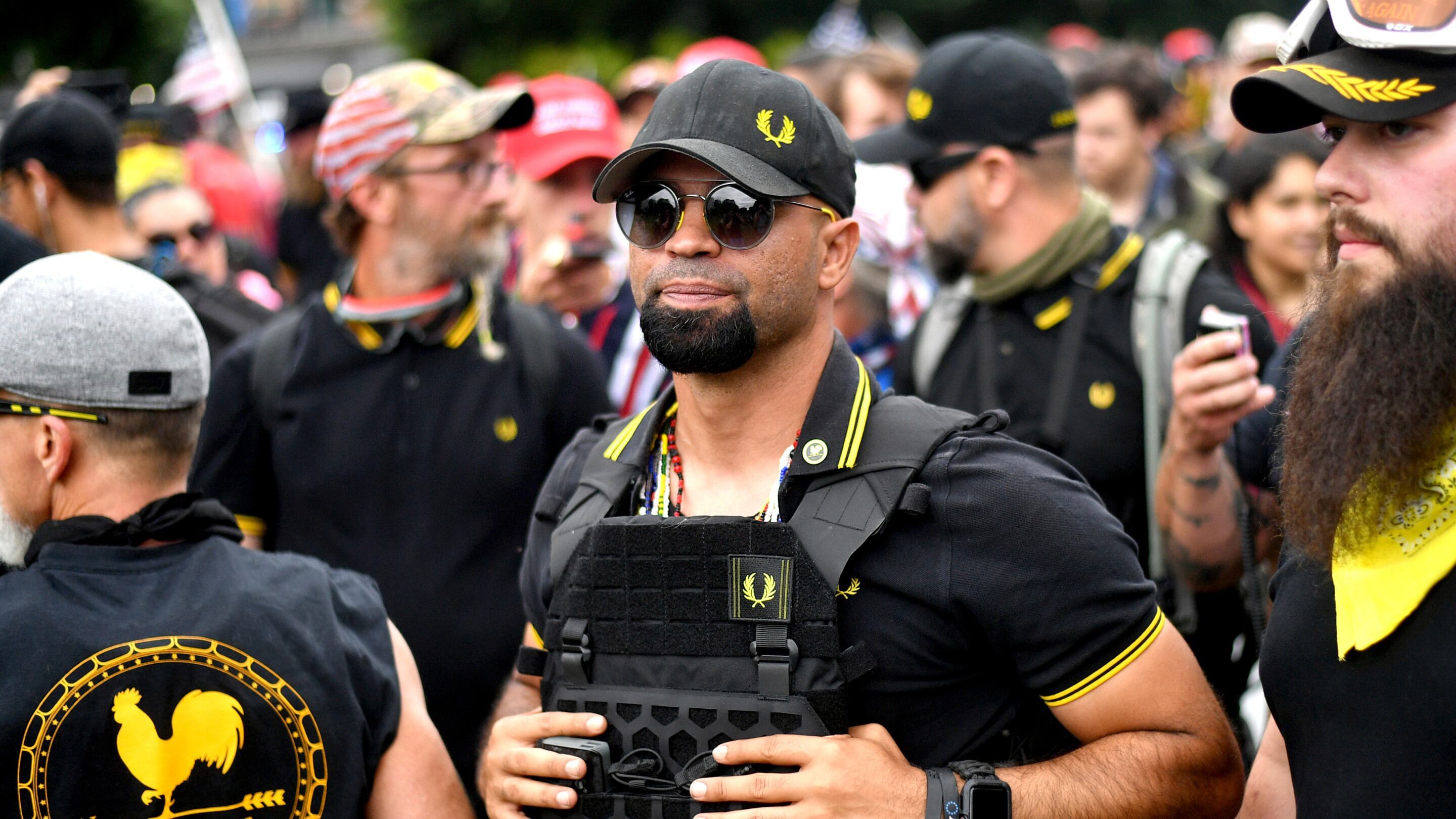
Former Proud Boys leader Enrique Tarrio was sentenced Tuesday to 22 years in prison for orchestrating a failed plot to keep Donald Trump in power after the Republican lost the 2020 election, capping the case with the stiffest punishment that has been handed down yet for the U.S. Capitol attack.
Tarrio, 39, pleaded for leniency before the judge imposed the prison term topping the 18-year sentences given to Oath Keepers founder Stewart Rhodes and one-time Proud Boys leader Ethan Nordean for seditious conspiracy and other convictions stemming from the Jan. 6, 2021, riot.
Tarrio, who led the neofacist group as it became a force in mainstream Republican circles, lowered his head after the sentence was imposed, then squared his shoulders. He raised his hand and made a “V” gesture with his fingers as he was led out of the courtroom in orange jail garb.
His sentencing comes as the Justice Department prepares to put Trump on trial at the same courthouse in Washington on charges that the then-president illegally schemed to cling to power that he knew had been stripped away by voters.
Rising to speak before the sentence was handed down, Tarrio called Jan. 6 a “national embarrassment,” and apologized to the police officers who defended the Capitol and the lawmakers who fled in fear. His voice cracked as he said he let down his family and vowed that he is done with politics.
“I am not a political zealot. Inflicting harm or changing the results of the election was not my goal,” Tarrio said. “Please show me mercy,” he said, adding, “I ask you that you not take my 40s from me.”
U.S. District Judge Timothy Kelly, who was appointed to the bench by Trump, said Tarrio was motivated by "revolutionary zeal" to lead the conspiracy that resulted in “200 men, amped up for battle, encircling the Capitol.” Noting that Tarrio had not previously shown any remorse publicly for his crimes, the judge said a stiff punishment was necessary to deter future political violence.
"It can't happen again. It can’t happen again,” the judge repeated.
Tarrio and three lieutenants were convicted in May of seditious conspiracy and other crimes after a months-long trial that served as a vivid reminder of the violent chaos fueled by Trump’s lies about the election that helped inspire right-wing extremists like the Proud Boys and the Oath Keepers.
Prosecutors had sought 33 years behind bars for Tarrio, describing him as the ringleader of a plot to use violence to shatter the cornerstone of American democracy and overturn the election victory by Joe Biden, a Democrat, over Trump, the Republican incumbent.
Prosecutor Conor Mulroe told the judge that the Proud Boys came dangerously close to succeeding in their plot — and noted that “it didn’t take rifles or explosives.”
“There was a very real possibility we were going to wake up on Jan. 7 in a full-blown constitutional crisis,” Mulroe said, with “300 million Americans having no idea who the next president would be or how it would be decided.”
Tarrio wasn’t in Washington, D.C, when Proud Boys members joined thousands of Trump supporters, who smashed windows, beat police officers and poured into the House and Senate chambers as lawmakers met to certify Biden’s victory. But prosecutors say the Miami resident organized and led the Proud Boys’ assault from afar, inspiring followers with his charisma and penchant for propaganda.
Tarrio’s lawyers denied the Proud Boys had any plan to attack the Capitol or stop the certification of Biden’s victory. They argued that prosecutors used Tarrio as a scapegoat for Trump, who spoke at the “Stop the Steal” rally near the White House on Jan. 6 and urged his supporters to “fight like hell.”
Tarrio’s younger sister, fiancé and mother tearfully urged the judge to show mercy before the sentence was imposed. Tarrio took off his glasses and wiped his eyes as he listened to his mother speak.
The defense asked for no more than 15 years in prison, arguing that their client should not be punished as harshly as the Oath Keepers’ Rhodes, who was present on Capitol grounds on Jan. 6.
Defense attorney Nayib Hassan told reporters after the hearing that they will appeal.
Tarrio’s lawyers described him as a “keyboard ninja,” who was prone to “talk trash,” but had no intentions of overthrowing the government. The Proud Boys’ only plans that day were to protest the election and confront left-wing antifa activists, attorney Sabino Jauregui told the judge.
“My client is no terrorist,” Jauregui said. “My client is a misguided patriot.”
Tarrio had been arrested two days before the Capitol riot on charges that he defaced a Black Lives Matter banner during an earlier rally in the nation’s capital, and he had complied with a judge’s order to leave the city after his arrest.
The judge agreed with prosecutors that the Proud Boys’ crimes could be punished as “terrorism” — increasing the recommended sentence under federal guidelines. But he ultimately sentenced the Proud Boys to shorter prison terms than those sought by prosecutors.
The backbone of the government’s case was hundreds of messages exchanged by Proud Boys in the days leading up to Jan. 6 that prosecutors say showed how the extremists saw themselves as revolutionaries and celebrated the Capitol attack, which sent lawmakers running into hiding.
The judge pointed to Tarrio's messages cheering on the Capitol attack and the Proud Boys' role in it.
“Make no mistake,” Tarrio wrote in one message. “We did this.” In another post as the Proud Boys swarmed the Capitol, Tarrio commanded: “Do what must be done.” In a Proud Boys encrypted group chat later that day someone asked what they should do next. Tarrio responded, “Do it again.”
He is the final Proud Boys leader convicted of seditious conspiracy to receive his punishment. Three fellow Proud Boys found guilty by a Washington jury of the rarely used sedition charge were sentenced to prison terms ranging from 15 to 18 years.
The Justice Department is appealing the 18-year prison sentence of Rhodes, the Oath Keepers founder, who was convicted of seditious conspiracy in a separate case, as well as the sentences of other members of his antigovernment militia group that were lighter than what prosecutors had sought. Prosecutors had requested 25 years in prison for Rhodes.
Richer reported from Boston.