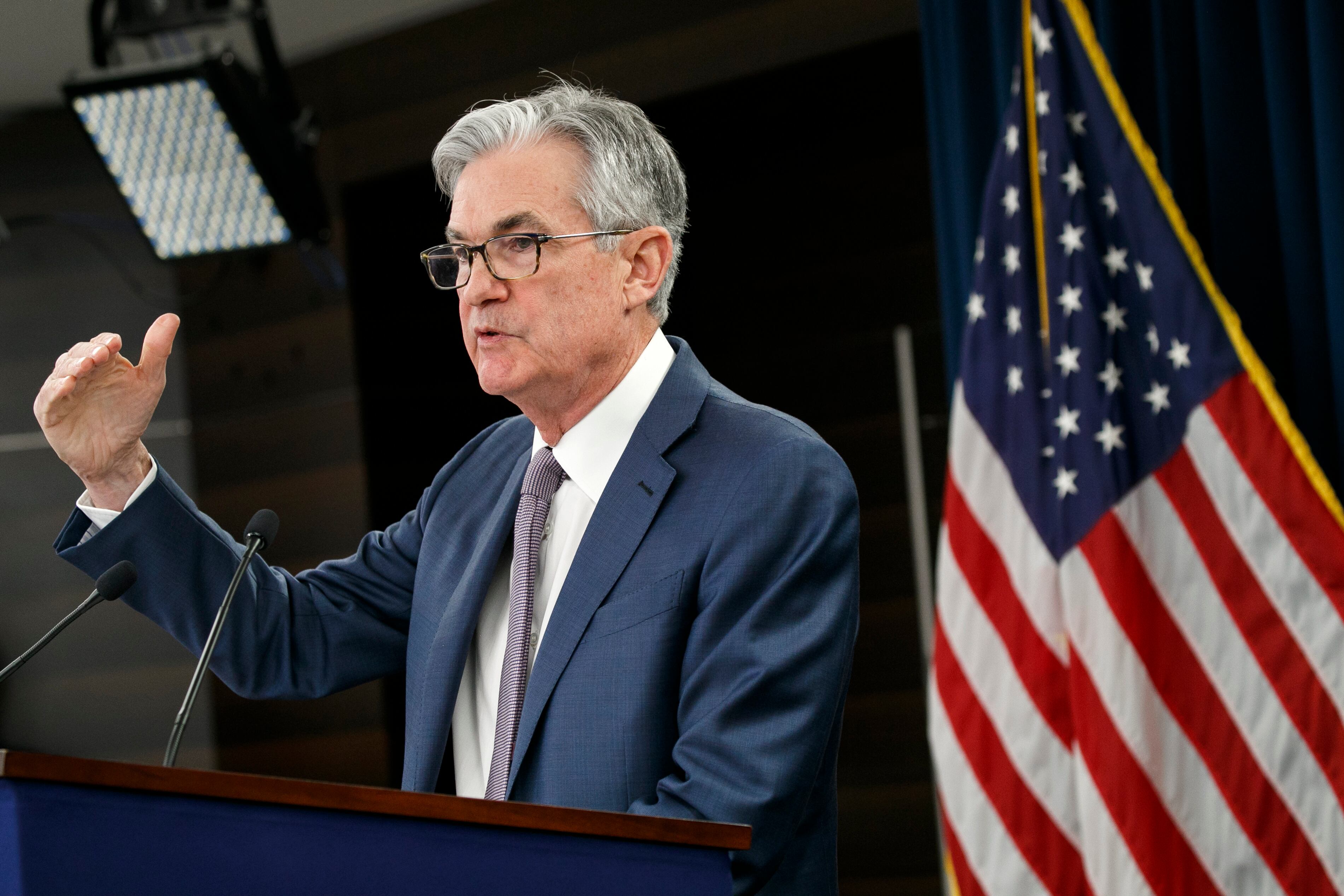
In this March 3, 2020 file photo, Federal Reserve Chair Jerome Powell speaks during a news conference to discuss an announcement from the Federal Open Market Committee, in Washington. (AP Photo/Jacquelyn Martin, File)
By Martin Crutsinger
The Federal Reserve announced a significant change Thursday in how it manages interest rates by saying it plans to keep rates near zero even after inflation has exceeded the Fed’s 2% target level.
The change signifies that the Fed is prepared to tolerate a higher level of inflation than it generally has in the past. And it means that borrowing rates for households and businesses — for everything from auto loans and home mortgages to corporate expansion — will likely remain ultra-low for years to come.
The new goal says that “following periods when inflation has been running persistently below 2%, appropriate monetary policy will likely aim to achieve inflation moderately above 2% for some time.”
The new Fed policy sought to underscore its belief that a low jobless rate was good for the economy by saying it would seek to assess the “shortfalls” in employment from the maximum level.
In a speech detailing the changes, Chairman Jerome Powell made clear that the policy change reflects the reality that high inflation — once the biggest threat to the economy — no longer appears to pose a serious danger, even when unemployment is low and the economy is growing strongly. Rather, Powell said, the economy has evolved in a way that allows the Fed to keep rates much lower than it otherwise would without igniting price pressures.
“The economy is always evolving,” Powell said. “Our revised statement reflects our appreciation for the benefits of a strong labor market, particularly for many in low- and moderate-income communities and that a robust job market can be sustained without causing an unwelcome increase in inflation."
In his speech, Powell said that the Fed's decision to allow unemployment to fall to a 50-year low before the pandemic had played an important role in lifting the fortunes of low-income workers.
On Monday, Peloton CEO John Foley stepped down, 2,800 layoffs were announced, and its stock price skyrocketed. Lydia Moynihan, business reporter for the New York Post joined Cheddar News to talk about why investors are excited about this shift in power, while thousands of its workers were let go in a less than ideal manner. "One of the headlines that emerged was that even as they were being fired, Foley sort of couched it as, 'well, you know what, you're still gonna get a year's login to a Peloton subscription', as if somehow if that would make things better," Moynihan said of the soon-to-be ex-CEO. "So, even in that, it was seen as a very sort of tone-deaf move as people were being axed."
Low-cost airlines Frontier and Spirit have agreed to merge in a deal worth $6.6 billion. The new company name and other terms of the deal have not been disclosed. If approved, the merger would be the fifth-largest airline in the United States. Jonathan Root, senior vice president at Moody's, joins Closing Bell to discuss the impact this deal could have on the broader airline industry, as well as why it makes sense for both discount airlines to combine.
Jet Tila, Food Network star and author of '101 Thai Dishes You Need to Cook Before You Die,' joins Cheddar News to talk about his new cookbook that's helping people cook authentic Thai recipes.
Crypto is increasingly becoming a hotspot for criminals and fraud with cryptocurrency crime reaching a record-breaking high. reports show scammers took $14 billion worth of crypto in 2021 alone. The latest crypto scam is aimed at investors in Binance. Ben Armstrong, the founder of Bitboy Crypto, joins Cheddar News to discuss.
In 2022, the FAA has received 323 reports of unruly passengers so far. Soon, flying could soon be limited to cooperative passengers only. Delta Airlines has asked the Department of Justice to put unruly travelers on a 'no-fly' list. Bryan Del Monte, president of the Aviation Agency, joins Cheddar News to discuss.
New York City’s tourism industry has seen a bumpy recovery from the pandemic, as the omicron surge delivers yet another blow to one of the world’s top tourist destinations. The arts and entertainment sector has been one of the hardest hit, with Broadway shows canceling performances once again after an industry-wide shutdown. Chris Heywood, executive vice president of global communications at NYC & Company, joined Cheddar's Fast Forward to talk about why he's confident the theater district - and the rest of the city - will eventually return to its pre-pandemic glory.