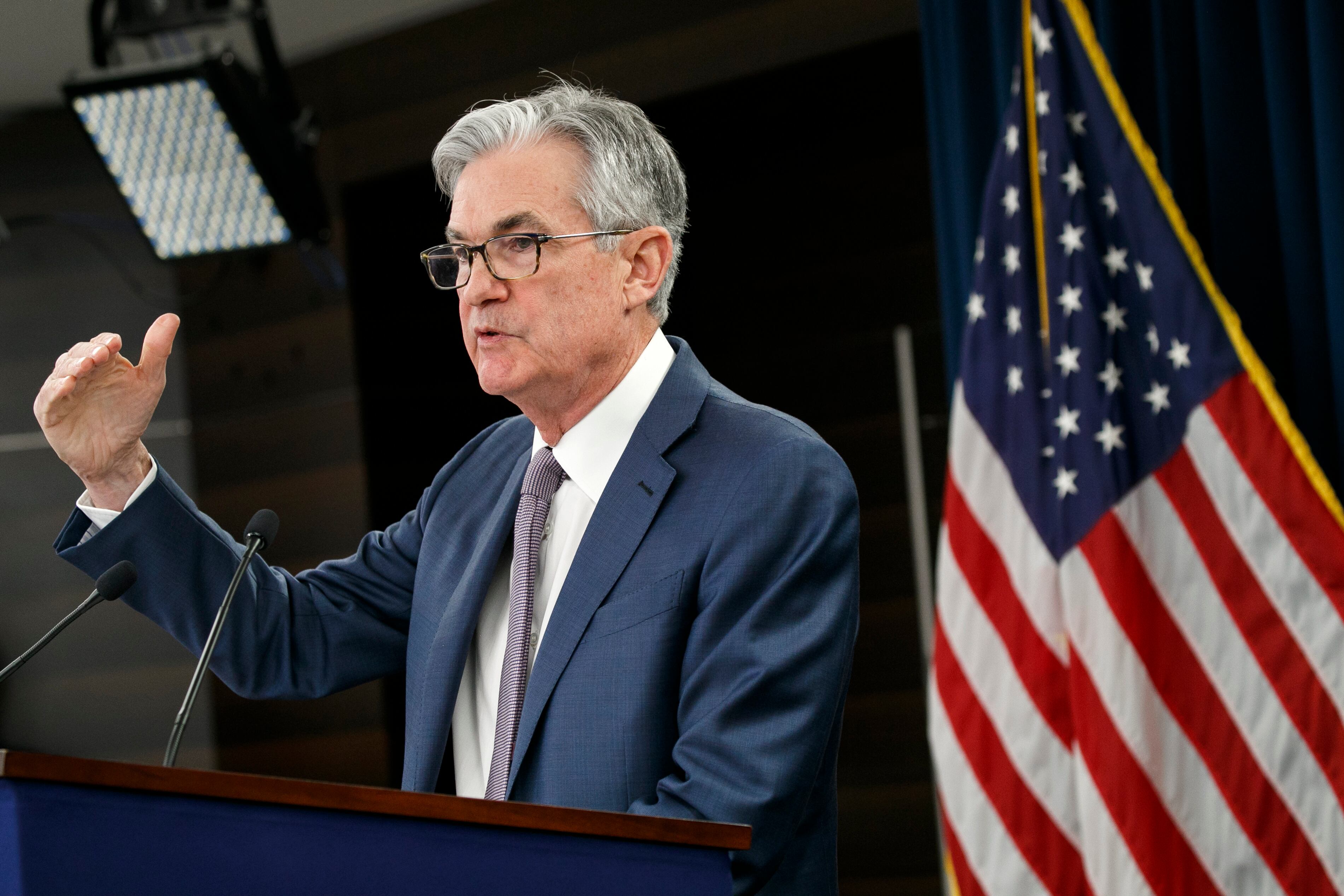
In this March 3, 2020 file photo, Federal Reserve Chair Jerome Powell speaks during a news conference to discuss an announcement from the Federal Open Market Committee, in Washington. (AP Photo/Jacquelyn Martin, File)
By Martin Crutsinger
The Federal Reserve announced a significant change Thursday in how it manages interest rates by saying it plans to keep rates near zero even after inflation has exceeded the Fed’s 2% target level.
The change signifies that the Fed is prepared to tolerate a higher level of inflation than it generally has in the past. And it means that borrowing rates for households and businesses — for everything from auto loans and home mortgages to corporate expansion — will likely remain ultra-low for years to come.
The new goal says that “following periods when inflation has been running persistently below 2%, appropriate monetary policy will likely aim to achieve inflation moderately above 2% for some time.”
The new Fed policy sought to underscore its belief that a low jobless rate was good for the economy by saying it would seek to assess the “shortfalls” in employment from the maximum level.
In a speech detailing the changes, Chairman Jerome Powell made clear that the policy change reflects the reality that high inflation — once the biggest threat to the economy — no longer appears to pose a serious danger, even when unemployment is low and the economy is growing strongly. Rather, Powell said, the economy has evolved in a way that allows the Fed to keep rates much lower than it otherwise would without igniting price pressures.
“The economy is always evolving,” Powell said. “Our revised statement reflects our appreciation for the benefits of a strong labor market, particularly for many in low- and moderate-income communities and that a robust job market can be sustained without causing an unwelcome increase in inflation."
In his speech, Powell said that the Fed's decision to allow unemployment to fall to a 50-year low before the pandemic had played an important role in lifting the fortunes of low-income workers.
Commercial property ownership platform withco recently raised $32 million across a seed and Series A funding round. The company purchases properties and then rents them back to small business owners and works to transition them into full ownership. Founder and CEO Kevin Song says withco was inspired by his family's experience of operating a Brooklyn grocery store for two decades and being forced to shutter the business due to a doubling in rent by a new landlord. Now, Song says his mission is to help small business owners become commercial property owners, in a way that's simple and affordable. Song joined Cheddar News' Closing Bell to discuss.
David Nelson, Chief Strategist at Belpointe, joins Cheddar News' Closing Bell, where he says that Wednesday's market movement shows a rotation back into the industries that were hit hard in January, but says his eyes are firmly fixed on the January CPI data set to be released Thursday.
Earlier this week, Peloton announced a change in its C-suite, with new chief executive Barry McCarthy telling the company's remaining staff in an email that he’s, 'here for the comeback story.' Greg Martin, Co-Founder of Rainmaker Securities, joins Cheddar's Closing Bell where he discusses how difficult are Peloton's challenges will be to overcome, especially after the company recently laid off approximately 20% of its staff.
Ben McMillan, Founder and CIO at IDX Digital Assets, joins Cheddar News' Closing Bell, where he discusses the significance of CFTC Chairman Rostin Behnam testifying at Wednesday's Senate Agriculture Committee hearing, and when we could expect to see more regulation in place following the second straight day of congressional hearings on the crypto industry.
Truckers in Canada have blockaded the Ambassador Bridge, the busiest border crossing between Canada and the U.S. protesting a COVID-19 vaccine mandate. Cheddar News spoke with Samir Kapadia, head of trade practice at the Vogal Group, about how this impacts trade between the two countries.