By Mark Sherman
The Electoral College gave Joe Biden a majority of its votes Monday, confirming his victory in last month's election in state-by-state voting that took on added importance this year because of President Donald Trump’s refusal to concede he lost.
California's 55 electoral votes put Biden over the top, clearing the 270-vote mark that affirmed he will be the nation's next president.
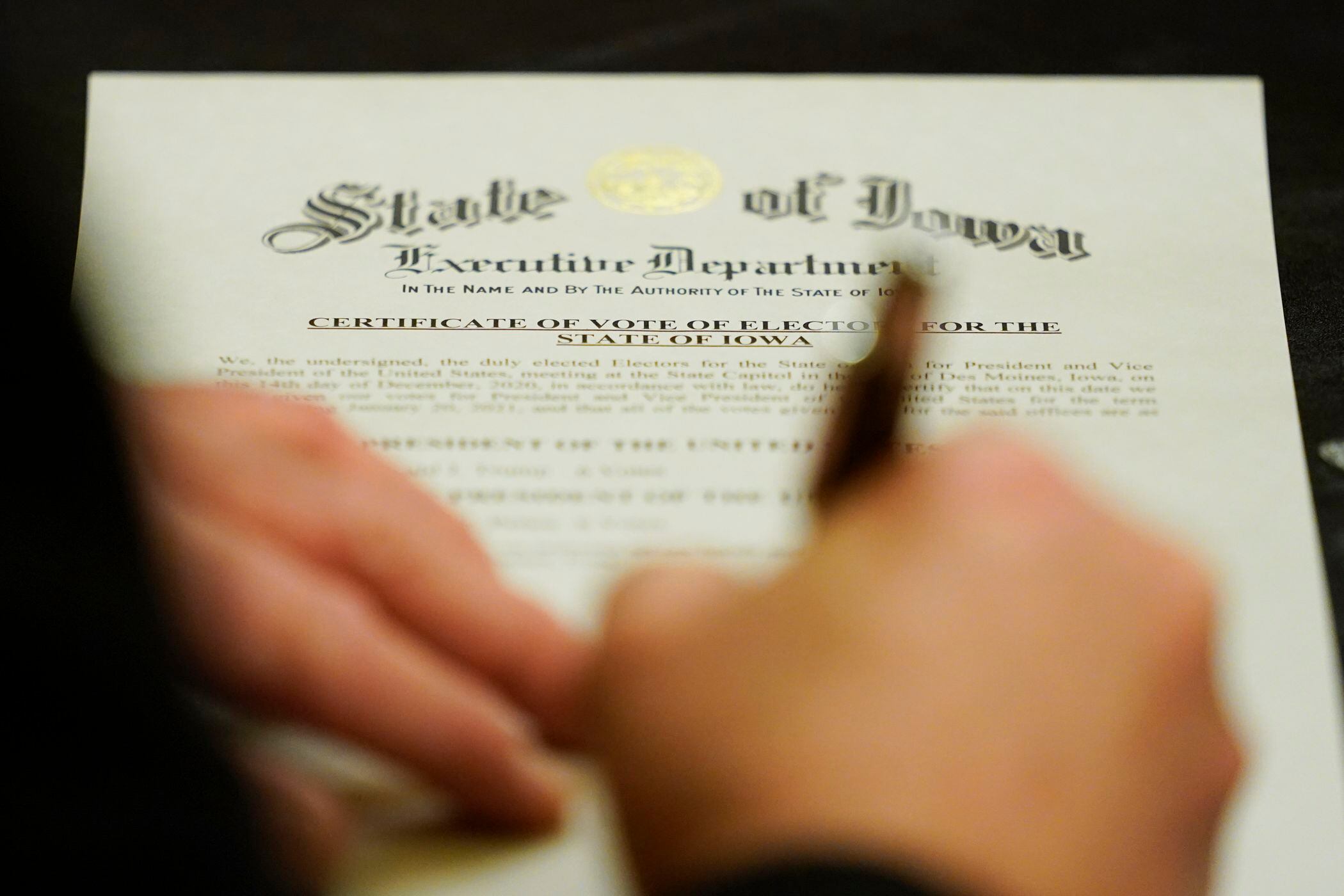
Heightened security was in place in some states as electors met on the day by federal law. Electors cast paper ballots in gatherings that took place in all 50 states and the District of Columbia, with masks, social distancing and other virus precautions the order of the day. The results will be sent to Washington and tallied in a Jan. 6 joint session of Congress over which Vice President Mike Pence will preside.
There was little suspense and no surprises as all the electoral votes allocated to Biden and Trump in last month's popular vote went to each man.
In Arizona, Georgia, Michigan, Nevada, Pennsylvania and Wisconsin — the six battleground states that Biden won and Trump contested — electors gave Biden and Vice President-elect Kamala Harris their votes Monday in low-key proceedings. Nevada’s electors met via Zoom because of the coronavirus pandemic.
When all the votes are in, Biden was expected to have 306 electoral votes to 232 for Trump. Hawaii was the only state that had yet to vote. Biden topped Trump by more than 7 million votes nationwide.
“In this battle for the soul of America, democracy prevailed,” Biden said in remarks prepared for an evening speech. “We the people voted. Faith in our institutions held. The integrity of our elections remains intact. And so, now it is time to turn the page. To unite. To heal.”
Biden renewed his campaign promise to be a president for all Americans, whether they voted for him or not, and said the country has hard work ahead on the virus and economy.
Former Maryland state Sen. Gloria Lawlah, in a state Biden won easily, said the votes for the Democratic ticket were “a repudiation of hate, a repudiation of divisiveness."
But not everyone was ready to say the election was over, even with the casting of electoral votes. Trump has refused to concede and continues to make unsupported allegations of fraud.
There have been concerns about safety for the electors, virtually unheard of in previous years. In Michigan, lawmakers from both parties reported receiving threats, and legislative offices were closed over threats of violence. Biden won the state by 154,000 votes, or 2.8 percentage points, over Trump.
Georgia state police were out in force at the state Capitol in Atlanta before Democratic electors pledged to Biden met. There were no protesters seen.
Even with the Electoral College's confirmation of Biden’s victory, some Republicans continued to refuse to acknowledge that reality. Yet their opposition to Biden had no practical effect on the electoral process, with the Democrat to be sworn in on Jan. 20.
Despite Biden’s wins in Georgia, Michigan, Pennsylvania and Wisconsin, Republicans who would have been Trump electors met anyway. Pennsylvania Republicans said they cast a “procedural vote” for Trump and Pence in case courts that have repeatedly rejected challenges to Biden’s victory were to somehow still determine that Trump had won.
In North Carolina, Utah and other states across the country where Trump won, his electors turned out to duly cast their ballots for him. Electors in North Carolina had their temperatures checked before being allowed to enter the Capitol to vote. Utah Attorney General Sean Reyes withdrew as a Trump elector and was in quarantine because he was exposed to someone with COVID-19.
Former President Bill Clinton and former Secretary of State Hillary Clinton, whom Trump defeated four years ago, were among New York's 29 electors for Biden and Harris.
In New Hampshire, before the state’s four electors voted for Biden at the State House in Concord, 13-year-old Brayden Harrington led the group in the Pledge of Allegiance. He had delivered a moving speech at the Democratic National Convention in August about the struggle with stuttering he shares with Biden.
Vermont’s electors were the first in the nation to vote Monday and they chose Biden and Harris.
Biden will address the nation Monday night after the electors have voted. Trump, meanwhile, is clinging to his false claims that he won the election, and trying to undermine Biden’s presidency before it begins.
“No, I worry about the country having an illegitimate president, that’s what I worry about. A president that lost and lost badly,” Trump said in a Fox News interview that was taped Saturday.
Following weeks of Republican legal challenges that were easily dismissed by judges, Trump and Republican allies tried to persuade the Supreme Court last week to set aside 62 electoral votes for Biden in four states, which might have thrown the outcome into doubt.
The justices rejected the effort on Friday.
In 32 states and the District of Columbia, laws require electors to vote for the popular-vote winner. The Supreme Court unanimously upheld this arrangement in July.
Electors almost always vote for the state winner anyway because they generally are devoted to their political parties. There was no reason to expect any defections this year.
The Electoral College was the product of compromise during the drafting of the Constitution between those who favored electing the president by popular vote and those who opposed giving the people the power to directly choose their leader.
Each state gets a number of electors equal to its total number of seats in Congress: two senators plus however many members the state has in the House of Representatives. Washington, D.C., has three votes, under a constitutional amendment that was ratified in 1961. With the exception of Maine and Nebraska, states award all their Electoral College votes to the winner of the popular vote in their state.
The bargain struck by the nation's founders has produced five elections in which the president did not win the popular vote. Trump was the most recent example in 2016.
Associated Press writers across the United States contributed to this report.
Updated on December 14, 2020, at 6:00 p.m. ET with the latest information.