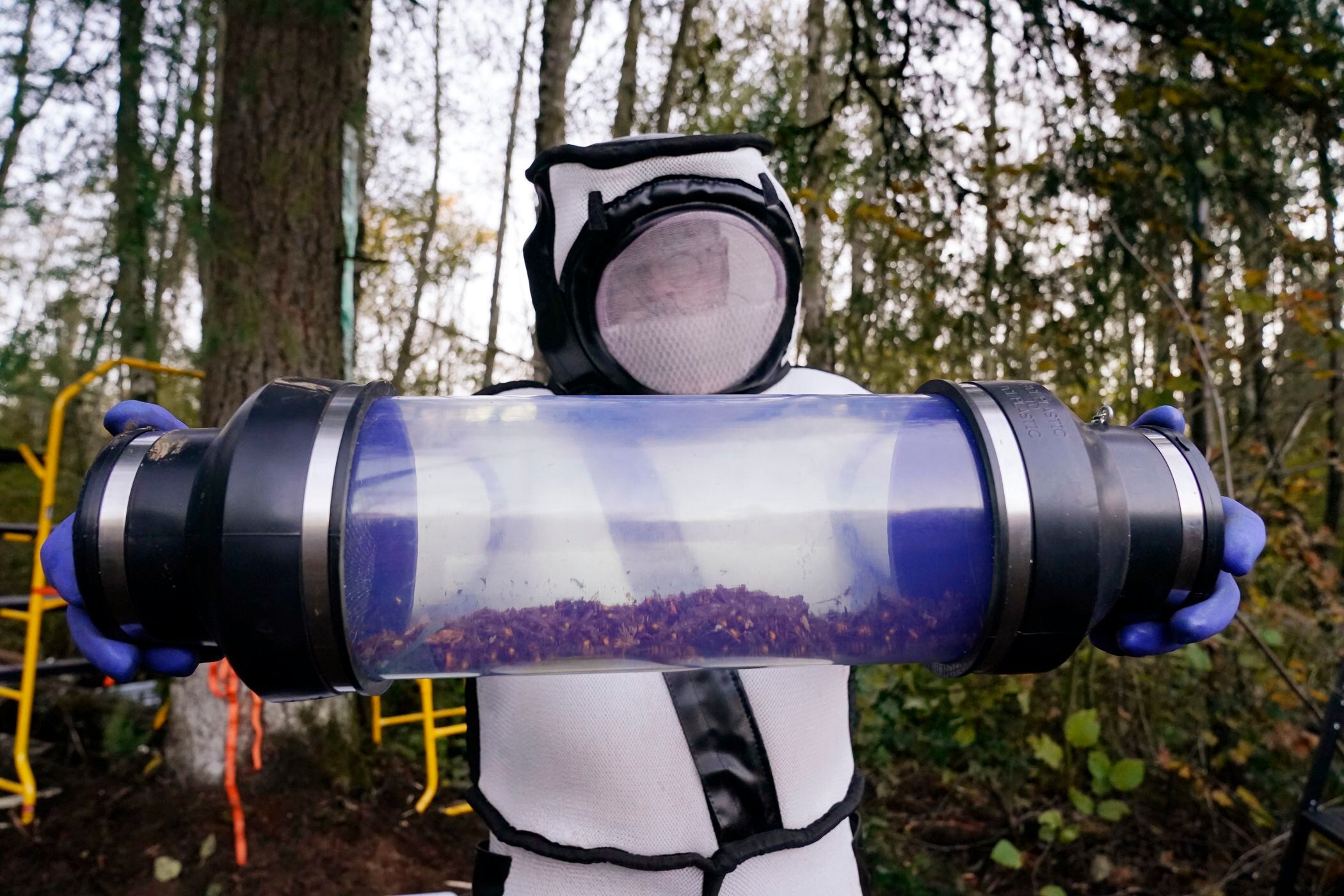
Heavily protected crews in Washington state worked Saturday to destroy the first nest of so-called murder hornets discovered in the United States.
The state Agriculture Department had spent weeks searching, trapping, and using dental floss to tie tracking devices to Asian giant hornets, which can deliver painful stings to people and spit venom but are the biggest threat to honeybees that farmers depend on to pollinate crops.
The nest found in the city of Blaine near the Canadian border is about the size of a basketball and contained an estimated 100 to 200 hornets, according to scientists who announced the find Friday.
Crews wearing thick protective suits vacuumed the invasive insects from the cavity of a tree into large canisters Saturday. The suits prevent the hornets' 6-millimeter-long stingers from hurting workers, who also wore face shields because the trapped hornets can spit a painful venom into their eyes.
The tree will be cut down to extract newborn hornets and learn if any queens have left the hive already, scientists said. Officials suspect more nests may be in the area and will keep searching. A news briefing was planned Monday on the status of the nest.
Despite their nickname and the hype that has stirred fears in an already bleak year, the world’s largest hornets kill at most a few dozen people a year in Asian countries, and experts say it is probably far less. Meanwhile, hornets, wasps, and bees typically found in the United States kill an average of 62 people a year, the Centers for Disease Control and Prevention has said.
The real threat from Asian giant hornets — which are 2 inches (5 centimeters) long — is their devastating attacks on honeybees, which are already under siege from problems like mites, diseases, pesticides, and loss of food.
The invasive insect is normally found in China, Japan, Thailand, South Korea, Vietnam, and other Asian countries. Washington state and the Canadian province of British Columbia are the only places the hornets have been found on the continent.
The nest was found after the state Agriculture Department trapped some hornets this week and used dental floss to attach radio trackers to some of them.
The time has come! SpaceX has finally revealed images of the Falcon Heavy. Will Goodman, Managing Editor at Rockets are Cool, joins Cheddar to discuss what January looks like for the aerospace company.
Rae Paoletta from Inverse talks about the secret UFO program that ran from 2007 to 2012 and received $22 million in funding. What do you think this video is showing?
Using organic and chemical-free body products should not come at a price. Or at least that's what the team behind Eclair Naturals believes. Éclair Naturals is non-GMO, cruelty-free, vegan, soy-free, and organic.
The Consumer Electronics Show is less than 3 weeks away and there is already a lot of hype around the products and innovations. Lexy Savvides is a senior editor at CNET and she joins Cheddar to preview this biggest show in electronics of the year.
From natural disasters to sexual harassment scandals, 2017 has been a year for stressful news. A new survey shows that stress is affecting women's health in surprising ways. Lisa Kennedy, Executive Vice President & GM of Everyday Health Inc., creators of the Women's Wellness Special Report., and Dr. Mike Varshavski, Board Certified Family Physician, join us discuss the state of women's wellness in 2017.
Dina Fine Maron, Editor of Health & Medicine at Scientific American, joins Cheddar to discuss some of the biggest changes to science regulations we'll see in 2018. From food labels to nonaddictive cigarettes, people need to be aware of what might affect their everyday lives.
Between Bells has the latest politics, entertainment, and business news.
Stitch Fix shares plunged after the company's first earnings report and the Senate passes tax reform. We also look a new interstellar object and what Patagonia's move in defiance of the president has meant for sales. Plus our weekly personal finance show "Your Cheddar," presented by Ally.
Sarah Lewin, Associate Editor for Space.com, discusses the latest scientific discovery found in our solar system, which has astronomers scratching their heads. Oumuamua first left scientists thinking it might have held alien life.
This Changes Things provides advice for the executives and leaders of tomorrow, powered by American Express OPEN. Between Bells has the latest tech, culture, and business news.