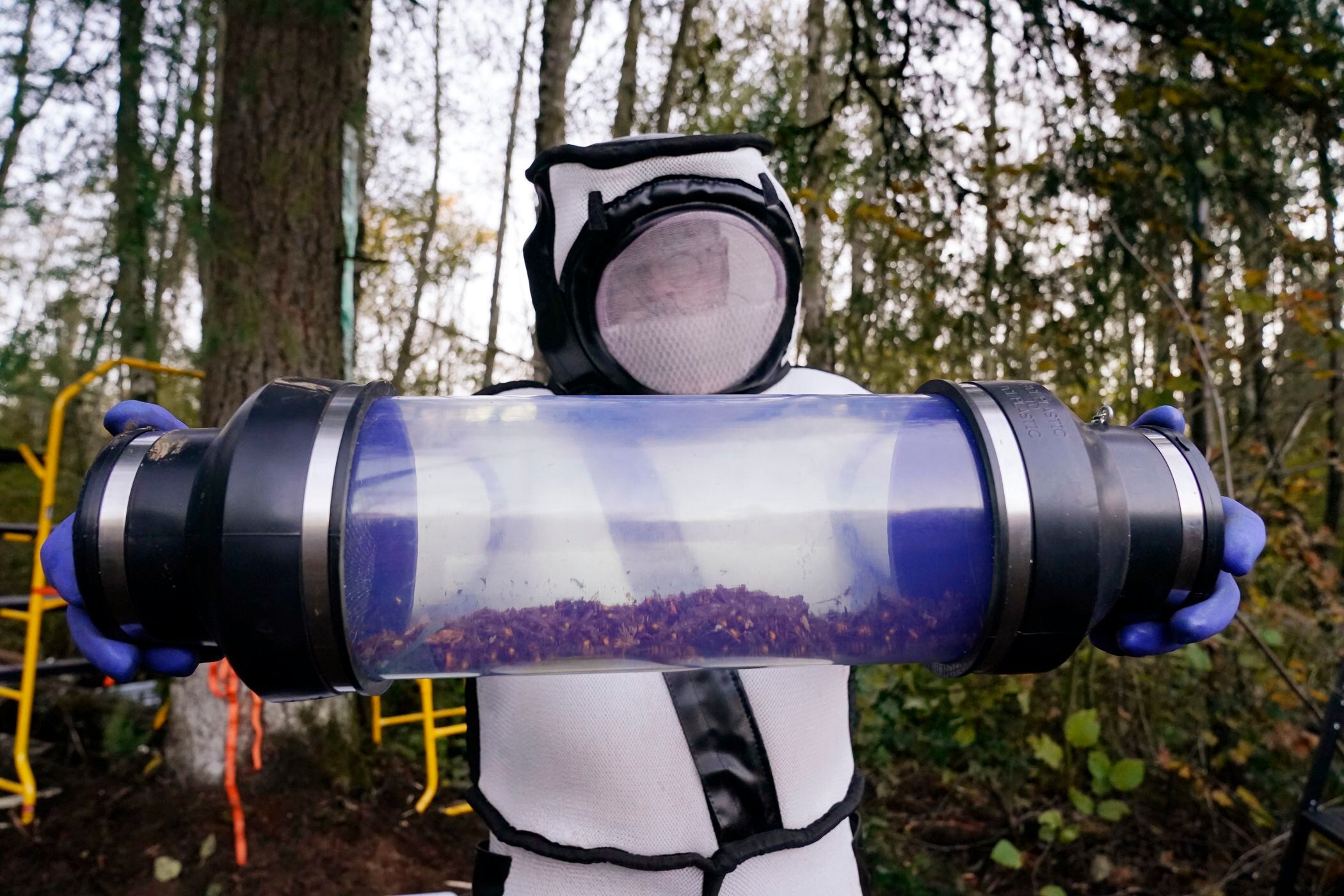
Heavily protected crews in Washington state worked Saturday to destroy the first nest of so-called murder hornets discovered in the United States.
The state Agriculture Department had spent weeks searching, trapping, and using dental floss to tie tracking devices to Asian giant hornets, which can deliver painful stings to people and spit venom but are the biggest threat to honeybees that farmers depend on to pollinate crops.
The nest found in the city of Blaine near the Canadian border is about the size of a basketball and contained an estimated 100 to 200 hornets, according to scientists who announced the find Friday.
Crews wearing thick protective suits vacuumed the invasive insects from the cavity of a tree into large canisters Saturday. The suits prevent the hornets' 6-millimeter-long stingers from hurting workers, who also wore face shields because the trapped hornets can spit a painful venom into their eyes.
The tree will be cut down to extract newborn hornets and learn if any queens have left the hive already, scientists said. Officials suspect more nests may be in the area and will keep searching. A news briefing was planned Monday on the status of the nest.
Despite their nickname and the hype that has stirred fears in an already bleak year, the world’s largest hornets kill at most a few dozen people a year in Asian countries, and experts say it is probably far less. Meanwhile, hornets, wasps, and bees typically found in the United States kill an average of 62 people a year, the Centers for Disease Control and Prevention has said.
The real threat from Asian giant hornets — which are 2 inches (5 centimeters) long — is their devastating attacks on honeybees, which are already under siege from problems like mites, diseases, pesticides, and loss of food.
The invasive insect is normally found in China, Japan, Thailand, South Korea, Vietnam, and other Asian countries. Washington state and the Canadian province of British Columbia are the only places the hornets have been found on the continent.
The nest was found after the state Agriculture Department trapped some hornets this week and used dental floss to attach radio trackers to some of them.
Sara Fischer, Media reporter for Axios, discusses how data effects foreign investments in U.S. Technology. Ripple Partners With MoneyGram to Lower Remittance Cost. Turner CEO John Martin gives his take on future of media and TV. Walmart announce it is closing 63 Sam's Club stores across the country. Former White House Chief Strategist Steve Bannon is set to appear next week before the House Intelligence Committee.
"Blue Planet" is the Emmy-Award winning series that looks at life under the deep blue sea. It's back for a new season 17 years after the original aired in 2001. The producers sit down with Alyssa Julya Smith in Los Angeles to talk about the four-year production of the latest installment.
In 1935 L'Oreal developed the first commercial sunscreen product. Now, the beauty company is out with the first battery-free wearable that help will with UV protection. UV Sense could usher in a new wave of preventative sun skincare.
Space Mysteries: the search for Zuma. How DJ Khaled will change Weight Watchers, we're cruising with Volvo Cars at CES. With YourTango, Scientific American, and more.
Conspiracy theories are flying around after reports that a secret government satellite went missing during the most recent SpaceX launch. The Zuma satellite is rumored to be lost in space, but not everyone is convinced that's true.
As officials struggle to fight the opioid epidemic that is plaguing the country, some big cities are considering creating "safe injection" sites. No city has submitted a formal plan, but the idea is already stirring up controversy.
Associate editor at Space.com Sarah Lewin sheds some light on SpaceX's mysterious Sunday night launch and breaks down the fascinating new photos we just got of Jupiter.
The next time you walk into a Sprint store you could be greeted by their newest employee, the humanoid robot "Pepper." Pepper uses machine learning and artificial intelligence to greet customers and work with them throughout their Sprint store experience. Pepper is already in some stores across America.
Divi Coins wants to make their cryptocurrency as convenient and accessible as possible. The Divi Project is a new crypto company that closed their initial coin sale in November. The new crypto is looking to replace exchanges like Paypal or Venmo.
This Changes Things: Advice for the executives and leaders of tomorrow, sponsored by American Express OPEN. On Between Bells: the latest from the Consumer Electronics Show, net neutrality's last stand, and more. With Petco, Curiosity, Daily Kos, Popular Science, and more.