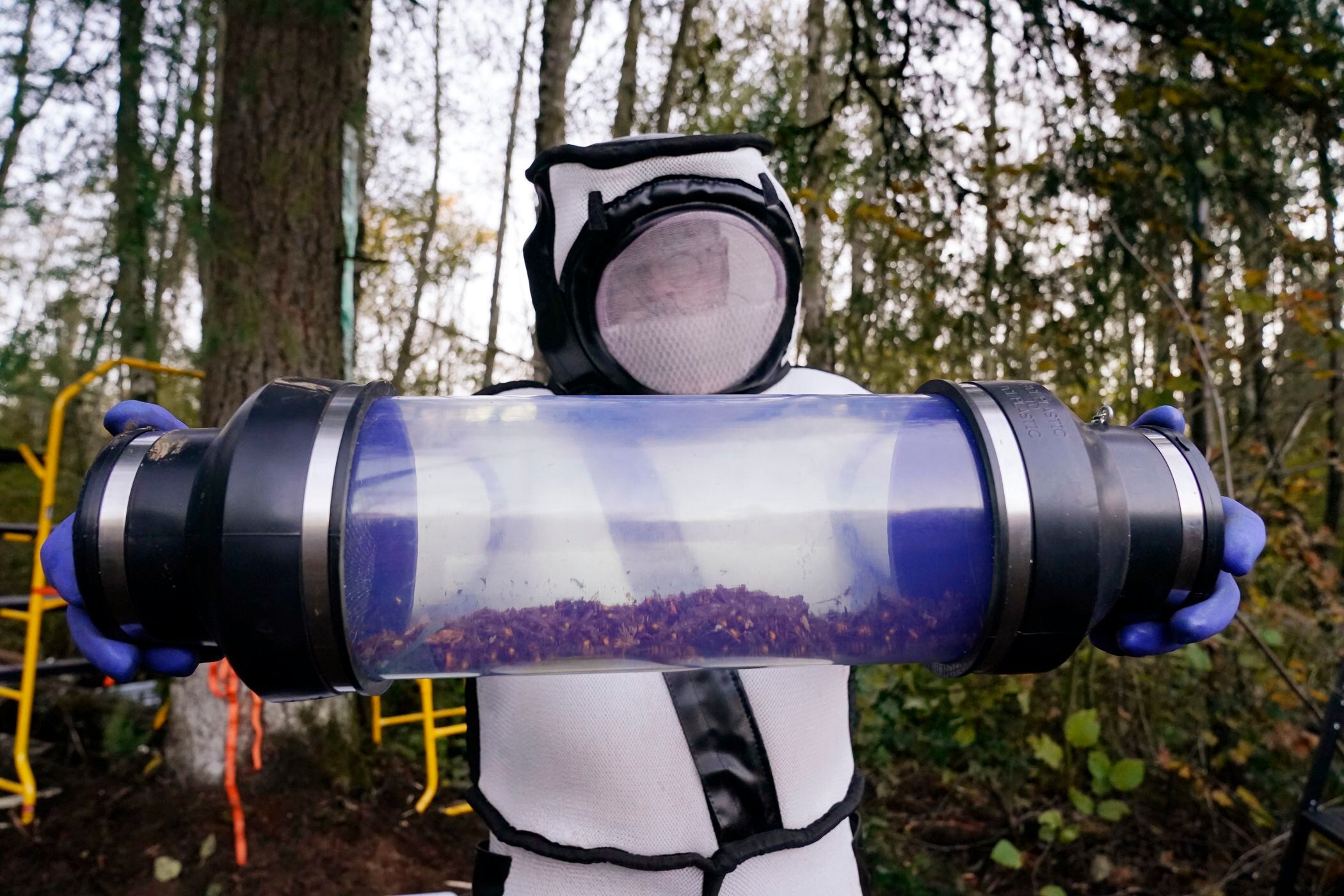
Heavily protected crews in Washington state worked Saturday to destroy the first nest of so-called murder hornets discovered in the United States.
The state Agriculture Department had spent weeks searching, trapping, and using dental floss to tie tracking devices to Asian giant hornets, which can deliver painful stings to people and spit venom but are the biggest threat to honeybees that farmers depend on to pollinate crops.
The nest found in the city of Blaine near the Canadian border is about the size of a basketball and contained an estimated 100 to 200 hornets, according to scientists who announced the find Friday.
Crews wearing thick protective suits vacuumed the invasive insects from the cavity of a tree into large canisters Saturday. The suits prevent the hornets' 6-millimeter-long stingers from hurting workers, who also wore face shields because the trapped hornets can spit a painful venom into their eyes.
The tree will be cut down to extract newborn hornets and learn if any queens have left the hive already, scientists said. Officials suspect more nests may be in the area and will keep searching. A news briefing was planned Monday on the status of the nest.
Despite their nickname and the hype that has stirred fears in an already bleak year, the world’s largest hornets kill at most a few dozen people a year in Asian countries, and experts say it is probably far less. Meanwhile, hornets, wasps, and bees typically found in the United States kill an average of 62 people a year, the Centers for Disease Control and Prevention has said.
The real threat from Asian giant hornets — which are 2 inches (5 centimeters) long — is their devastating attacks on honeybees, which are already under siege from problems like mites, diseases, pesticides, and loss of food.
The invasive insect is normally found in China, Japan, Thailand, South Korea, Vietnam, and other Asian countries. Washington state and the Canadian province of British Columbia are the only places the hornets have been found on the continent.
The nest was found after the state Agriculture Department trapped some hornets this week and used dental floss to attach radio trackers to some of them.
If someone told you that asthma would help you win gold at the Olympics, would you believe them? Well according to a new study, athletes with asthma are more likely to win at the Winter Games than those without these breathing problems. Popular Science's Claire Maldarelli explains why.
Amazon launches health products line, Chipotle adds quinoa to the menu, and Tinder reveals the most-swiped athletes in the Olympic Village.
Will Goodman, managing editor at Rockets are Cool, discusses The Boring Company securing a preliminary permit for its proposed New York to DC hyperloop.
Jason Brown, CEO of Vitamin Packs, discusses how his company can deliver improved health right to your door. Vitamin Packs is a start-up subscription service that delivers personalized vitamins to consumers once a month.
Clayton Banks, CEO of tech incubator Silicon Harlem, and Jessica O. Matthews, CEO of Uncharted Power, discuss their combined effort to make New York City's Harlem neighborhood the Silicon Valley of the East Coast.
Clayton Banks, CEO of Silicon Harlem, and Jessica Matthews, CEO of Uncharted Power, are teaching the community how to build, grow, and scale their businesses.
If you are addicted to emotional shows like "This Is Us," you are not alone. And now, there is research to show why we love to cry and watch emotional TV.
Billionaire Tom Steyer is putting his personal fortune behind an effort to get President Trump out of office. Special counsel Robert Mueller has indicted 13 Russian nationals and three Russian entities for allegedly meddling in the 2016 presidential election. Coinbase users took to social media and Reddit to complain about glitches on the platform. Coinbase says the root of the problem is credit card processing managed by Visa. But, Visa says they didn't cause the problem.
"Girls" star and director Lena Dunham is sparking a national dialogue on women's health after revealing she had a hysterectomy. LiveScience's Sara Miller and SELF's Casey Gueren join Cheddar to reveal why the star elected to have the procedure.
Snap CEO Evan Spiegel is doubling down on the app redesign. Shake Shack plans to open 32-35 new locations this year. Miso Robotics, the firm behind automated burger-flipper, "Flippy," The company behind a patty-flipping robot just got a major influx of cash.