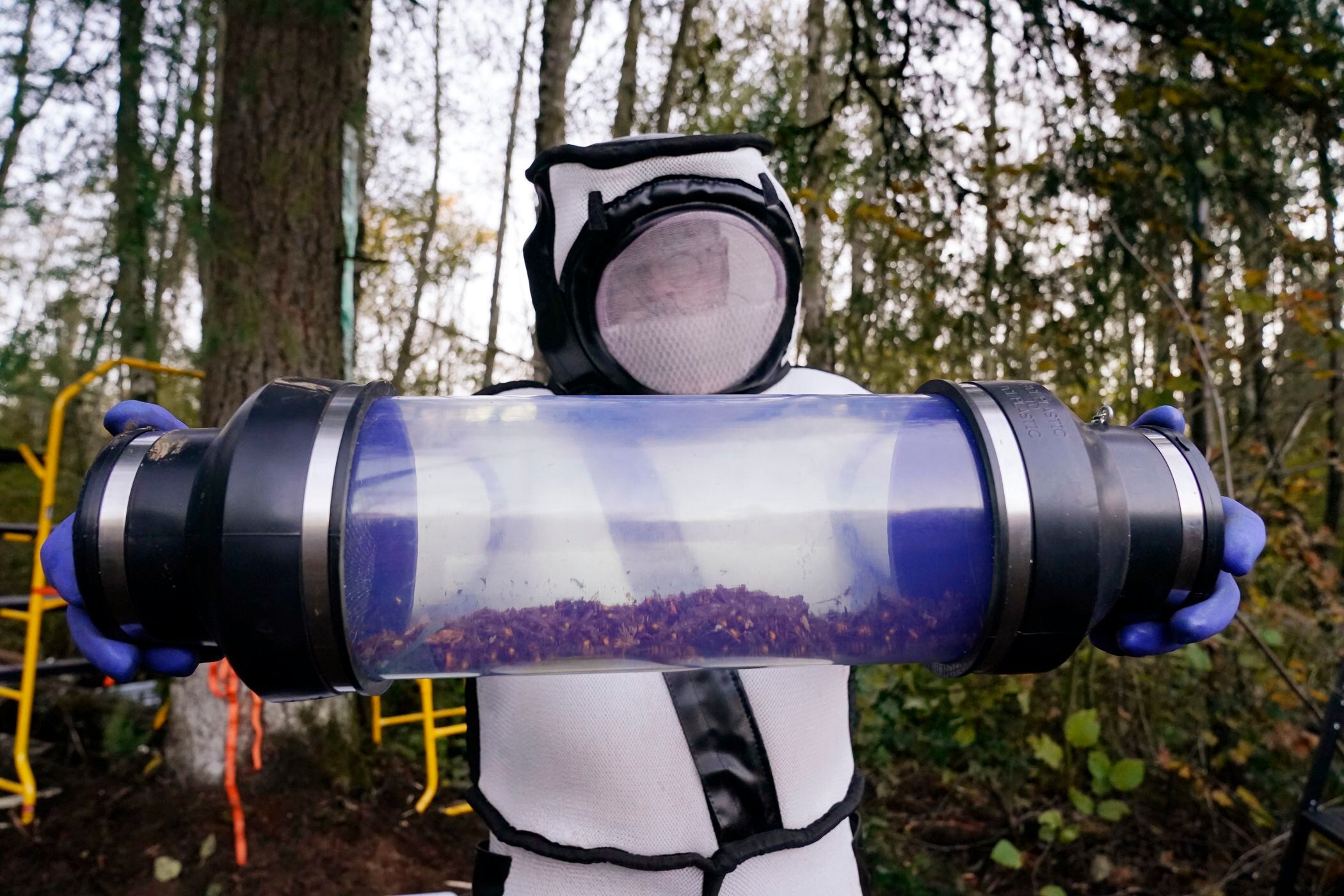
Heavily protected crews in Washington state worked Saturday to destroy the first nest of so-called murder hornets discovered in the United States.
The state Agriculture Department had spent weeks searching, trapping, and using dental floss to tie tracking devices to Asian giant hornets, which can deliver painful stings to people and spit venom but are the biggest threat to honeybees that farmers depend on to pollinate crops.
The nest found in the city of Blaine near the Canadian border is about the size of a basketball and contained an estimated 100 to 200 hornets, according to scientists who announced the find Friday.
Crews wearing thick protective suits vacuumed the invasive insects from the cavity of a tree into large canisters Saturday. The suits prevent the hornets' 6-millimeter-long stingers from hurting workers, who also wore face shields because the trapped hornets can spit a painful venom into their eyes.
The tree will be cut down to extract newborn hornets and learn if any queens have left the hive already, scientists said. Officials suspect more nests may be in the area and will keep searching. A news briefing was planned Monday on the status of the nest.
Despite their nickname and the hype that has stirred fears in an already bleak year, the world’s largest hornets kill at most a few dozen people a year in Asian countries, and experts say it is probably far less. Meanwhile, hornets, wasps, and bees typically found in the United States kill an average of 62 people a year, the Centers for Disease Control and Prevention has said.
The real threat from Asian giant hornets — which are 2 inches (5 centimeters) long — is their devastating attacks on honeybees, which are already under siege from problems like mites, diseases, pesticides, and loss of food.
The invasive insect is normally found in China, Japan, Thailand, South Korea, Vietnam, and other Asian countries. Washington state and the Canadian province of British Columbia are the only places the hornets have been found on the continent.
The nest was found after the state Agriculture Department trapped some hornets this week and used dental floss to attach radio trackers to some of them.
This week's episode of Cheddar's Crypto Craze tackles the latest news and trends in this emerging market. Dropbox files to go public. The dow closes the week up more than 300 points. TV personality Kelly Killoren Bensimon is out with a fur slipper line.
Hanneke Weitering, staff writer at Space.com, discusses SpaceX's launch of the Falcon 9 rocket that carried a Spanish imaging satellite and two demo Starlink broadband test satellites. With this technology, SpaceX hopes to provide high speed, low cost energy across the globe.
Weight Watchers is getting slammed after offering a free membership promotion for teenagers. Project Heal's Kristina Saffran joins Cheddar to discuss the effects early dieting can have on young people's health and wellness.
Cody Gough, podcast host at Curiosity.com, discusses new studies that reveal why we may not want to be around people when we're sick. He also describes the physical characteristics that tell people when we're feeling under the weather.
I-han Chou, senior editor at Nature, discusses a new study about adolescence and how that period of your life influences adulthood.
Concerns over electronics' batteries overheating and potentially exploding have been circling for some time, reaching a head with Samsung's massive recall of its Note Seven phones. That is why KULR Technologies has created technology that protects batteries and material for everything from electric cars to NASA spaceships.
Facebook is back under the microscope for failing to stop the spread of fake news. Sara Fischer, media reporter for AXIOS, joins to explain how the big tech companies are, or are not, addressing the problem.
Extreme weather across the nation this week. New York City, Philadelphia, and Washington, D.C. experiencing record high temperatures. Meanwhile, parts of Washington state and Denver are seeing record lows. Mashable's Andrew Freedman explains how the polar vortex split is causing wild weather coast to coast.
Temperatures in Washington, D.C., hit 82 degrees on Wednesday, while the West Coast braced for record lows. Andrew Freedman, senior science editor at Mashable, says a "polar vortex split" is partly to blame.
On Between Bells: Talking to kids about gun violence, Dallas Mavericks under fire, restaurant servers fight tip-pooling laws, and more. With Eater, Parents Magazine, and Popular Science.