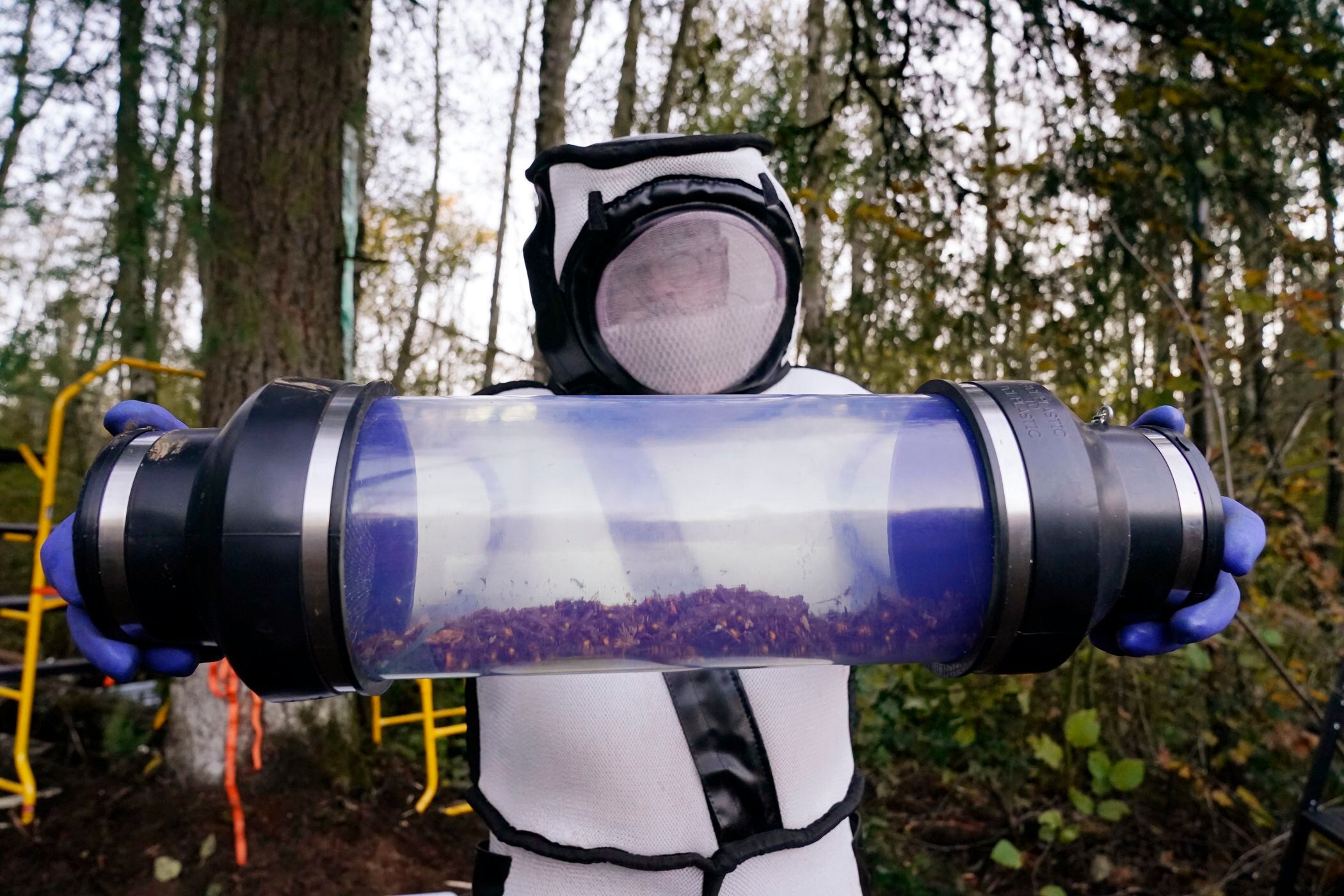
Heavily protected crews in Washington state worked Saturday to destroy the first nest of so-called murder hornets discovered in the United States.
The state Agriculture Department had spent weeks searching, trapping, and using dental floss to tie tracking devices to Asian giant hornets, which can deliver painful stings to people and spit venom but are the biggest threat to honeybees that farmers depend on to pollinate crops.
The nest found in the city of Blaine near the Canadian border is about the size of a basketball and contained an estimated 100 to 200 hornets, according to scientists who announced the find Friday.
Crews wearing thick protective suits vacuumed the invasive insects from the cavity of a tree into large canisters Saturday. The suits prevent the hornets' 6-millimeter-long stingers from hurting workers, who also wore face shields because the trapped hornets can spit a painful venom into their eyes.
The tree will be cut down to extract newborn hornets and learn if any queens have left the hive already, scientists said. Officials suspect more nests may be in the area and will keep searching. A news briefing was planned Monday on the status of the nest.
Despite their nickname and the hype that has stirred fears in an already bleak year, the world’s largest hornets kill at most a few dozen people a year in Asian countries, and experts say it is probably far less. Meanwhile, hornets, wasps, and bees typically found in the United States kill an average of 62 people a year, the Centers for Disease Control and Prevention has said.
The real threat from Asian giant hornets — which are 2 inches (5 centimeters) long — is their devastating attacks on honeybees, which are already under siege from problems like mites, diseases, pesticides, and loss of food.
The invasive insect is normally found in China, Japan, Thailand, South Korea, Vietnam, and other Asian countries. Washington state and the Canadian province of British Columbia are the only places the hornets have been found on the continent.
The nest was found after the state Agriculture Department trapped some hornets this week and used dental floss to attach radio trackers to some of them.
Netflix stock is surging after the company reported first-quarter earnings, disclosing that the company added 7.4 million subscribers in the first three months of this year. Netflix now has 125 million subscribers globally. This year, Netflix plans to spend $8 billion on developing original content.
Goldman Sachs reported earnings on Tuesday, soaring past Wall Street estimates. The firm said its quarterly revenue hit $10 billion, an increase of 27%. Goldman's successful first quarter is due in large part to the recent surge in trading and market volatility.
Plus, we talk artificial intelligence with Sam Mantle, managing director of digital enterprise at Luxoft. The company recently announced a partnership with Softbank Robotics America to improve technology in "Pepper" the robot. Mantle digs into how Pepper can be used across industries from travel, to retail, to hospitality, noting that developers are just starting to learn how expansive and beneficial artificial intelligence can be.
The fallout from Facebook's latest data scandal continues to intensify. The Weinstein Co. officially files for bankruptcy protection after many attempts to sell the company failed. Josh Sternberg, tech editor for AdWeek, joins us to discusses how Uber moves forward after one of its driverless cars killed a pedestrian in Tempe, Arizona. And Bri Bauer from Dairy Queen brings ice cream cones to the trading floor to celebrate the company's National Cone Day. On the first day of spring, Dairy Queen gives customers free vanilla ice cream cones.
One of Nike's top executives is stepping down over misconduct allegations. Airbnb is making it easier for people with disabilities to find rentals on its platform. We dive into the Theranos fraud scandal with the Wall Street Journal reporter who initially reported that something was off with the start-up blood testing company. And Tim Stenovec chats with Neil Patrick Harris about season two of his Netflix show "A Series of Unfortunate Events."
For now, the disgraced founder and CEO of Theranos says she plans to stay on in that role at the company. But a criminal investigation is still ongoing, and indictments could follow, says John Carreyrou, the investigative reporter at The Wall Street Journal who saw through the hype early.
A lot of the media hyped up the technology of Theranos. But when they asked probing questions, they were given "convoluted or confusing" statements.
In celebration of "Pi Day", Curiosity.com editor and podcast host Ashley Hamer looked at the history of the geometric ratio. She told Cheddar that back in 1897, one amateur mathematician almost convinced the Indiana state legislature to pass a law saying 𝜋 is actually equal to 3.2!
"Weed the People" seeks to raise awareness of the impact cannabis has on cancer patients and to depict how the chemicals in the plant can be life-saving.
Sara Chodosh, assistant editor at Popular Science, discusses how Daylight Saving Time affects your health. We talk about the rise in fatal car accidents due to sleep deprivation, as well as the negative effects to your health like an increased rate of heart attacks.
Sangita Patel, CEO at LeVar Burton Kids, says that as an Indian child she didn't see herself represented on TV, and she wants to change that for the upcoming generation.
A new study finds fakes news travels 6 times faster on Twitter than real news. The head of Goldman Sachs responds to reports he is leaving his post. Florida Governor Rick Scott signs a gun safety bill. The bull market celebrates its 9th birthday. The Nasdaq hits a record high.