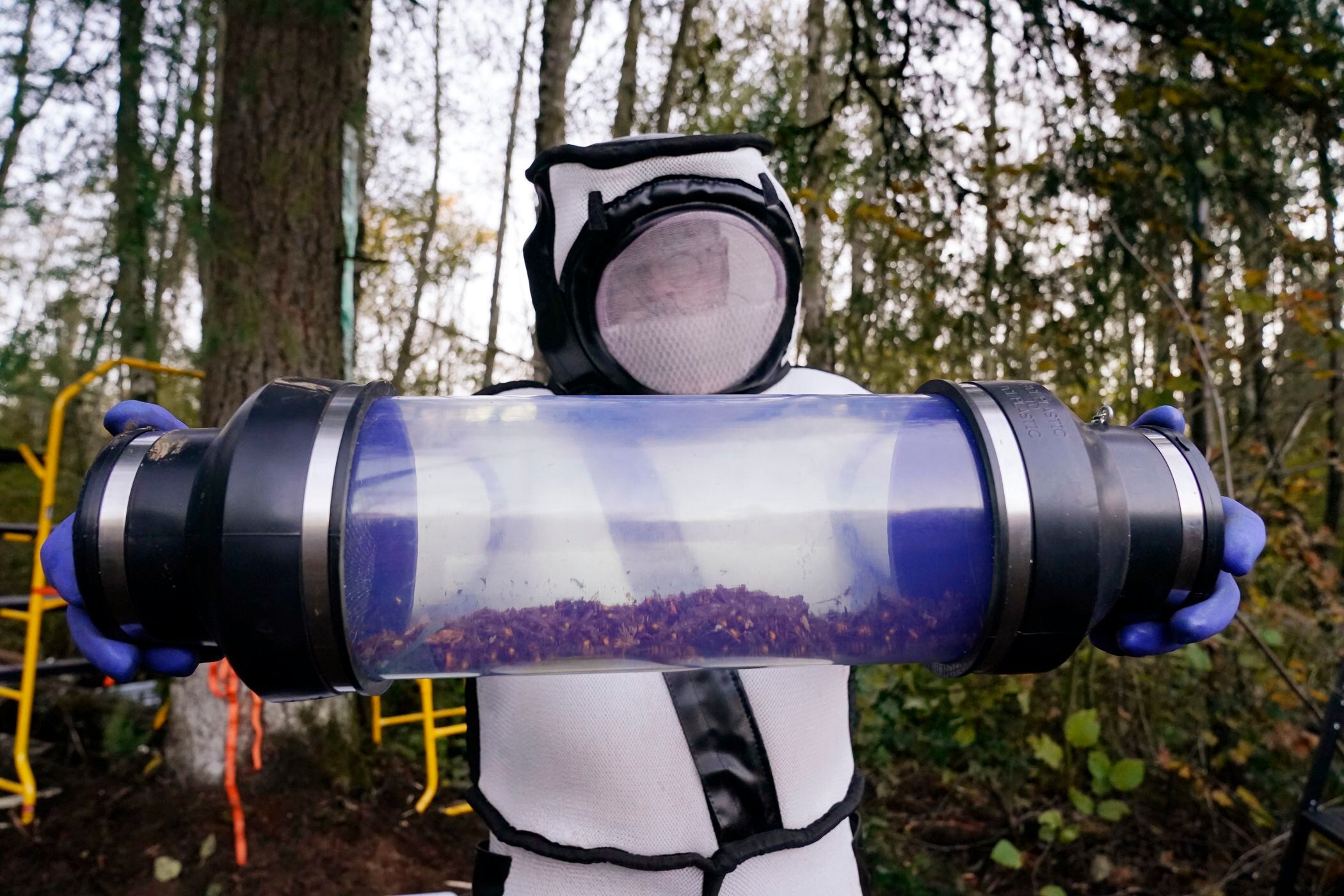
Heavily protected crews in Washington state worked Saturday to destroy the first nest of so-called murder hornets discovered in the United States.
The state Agriculture Department had spent weeks searching, trapping, and using dental floss to tie tracking devices to Asian giant hornets, which can deliver painful stings to people and spit venom but are the biggest threat to honeybees that farmers depend on to pollinate crops.
The nest found in the city of Blaine near the Canadian border is about the size of a basketball and contained an estimated 100 to 200 hornets, according to scientists who announced the find Friday.
Crews wearing thick protective suits vacuumed the invasive insects from the cavity of a tree into large canisters Saturday. The suits prevent the hornets' 6-millimeter-long stingers from hurting workers, who also wore face shields because the trapped hornets can spit a painful venom into their eyes.
The tree will be cut down to extract newborn hornets and learn if any queens have left the hive already, scientists said. Officials suspect more nests may be in the area and will keep searching. A news briefing was planned Monday on the status of the nest.
Despite their nickname and the hype that has stirred fears in an already bleak year, the world’s largest hornets kill at most a few dozen people a year in Asian countries, and experts say it is probably far less. Meanwhile, hornets, wasps, and bees typically found in the United States kill an average of 62 people a year, the Centers for Disease Control and Prevention has said.
The real threat from Asian giant hornets — which are 2 inches (5 centimeters) long — is their devastating attacks on honeybees, which are already under siege from problems like mites, diseases, pesticides, and loss of food.
The invasive insect is normally found in China, Japan, Thailand, South Korea, Vietnam, and other Asian countries. Washington state and the Canadian province of British Columbia are the only places the hornets have been found on the continent.
The nest was found after the state Agriculture Department trapped some hornets this week and used dental floss to attach radio trackers to some of them.
The 'Block 5' rocket is the first Falcon 9 rocket that can theoretically be reused 10 times without any maintenance, and up to 100 times with just minor servicing. If SpaceX can pull off seven successful 'Block 5' launches, the company could get clearance from NASA to do manned missions, says Will Goodman, managing editor of Rockets Are Cool.
Mark Kaufman, science reporter at Mashable, discusses California's history-making decision to mandate solar panels on all new homes and low-rise apartment buildings. [We talk what this means for the solar panel companies and the rest of the U.S.](https://mashable.com/2018/05/09/california-becomes-first-state-to-mandate-solar-panels-on-new-homes)
Rob Marvin, associate features editor for PCMag, discusses the biggest announcements from Microsoft's Build conference. Marvin weighs in on Microsoft introducing AI for Accessibility, an integration between its digital assistant Cortana and Amazon Alexa.
Zachariah Reitano's Roman Health is using the treatment of erectile dysfunction to save lives by helping men discover the sometimes very serious underlying causes of the condition.
Emily Manor-Chapman, a NASA engineer on the 'InSight' lander, explains what the new mission to Mars hopes to accomplish.
The on-demand app that connects patients with doctors has seen rapid growth in the past few years, particularly in mental health services, and recently raised an additional $74 million in funding. "Not only does it make access to a doctor much, much easier, it also addresses a lot of the stigma associated with mental health," says CEO Hill Ferguson.
Jill Steinberg, the wife of Cheddar's CEO, took the DIY genetic test out of curiosity and found out she was prone to breast cancer. "There's always something there to learn," says Anne Wojcicki, CEO and founder of 23andMe.
Is the surface of a comet really a winter wonderland? Not exactly. Cheddar's Pat Jones explains what's going on in this viral space gif.
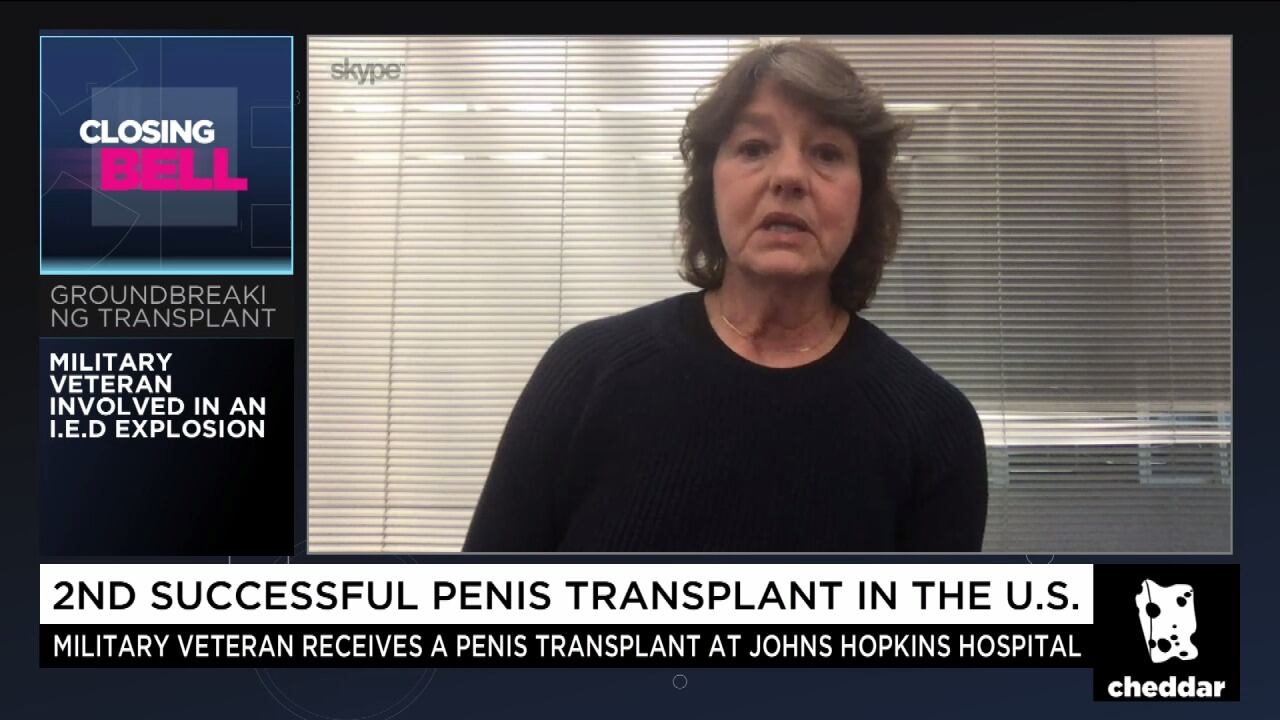
John Hopkins Hospital recently completed the second-ever successful penis transplant in the U.S., an incredibly complex surgery that lasted 14 hours. New York Times reporter Denise Grady explains why the vet needed the surgery in the first place.
A recent survey by Parents Magazine found that 62 percent of participants waited more than five weeks to get their children help with mental health issues. A majority of those said they were trying not to overreact to their child's behavior, explains Liz Vaccariello, Editor-in-Chief of Parents Magazine.