Once he and his wife, Jennifer, moved to a Boise suburb last year, Tim Kohl could finally express himself.
Kohl did what the couple never dared at their previous house outside Los Angeles — the newly-retired Los Angeles police officer flew a U.S. flag and a Thin Blue Line banner representing law enforcement outside his house.
“We were scared to put it up,” Jennifer Kohl acknowledged. But the Kohls knew they had moved to the right place when neighbors complimented him on the display.
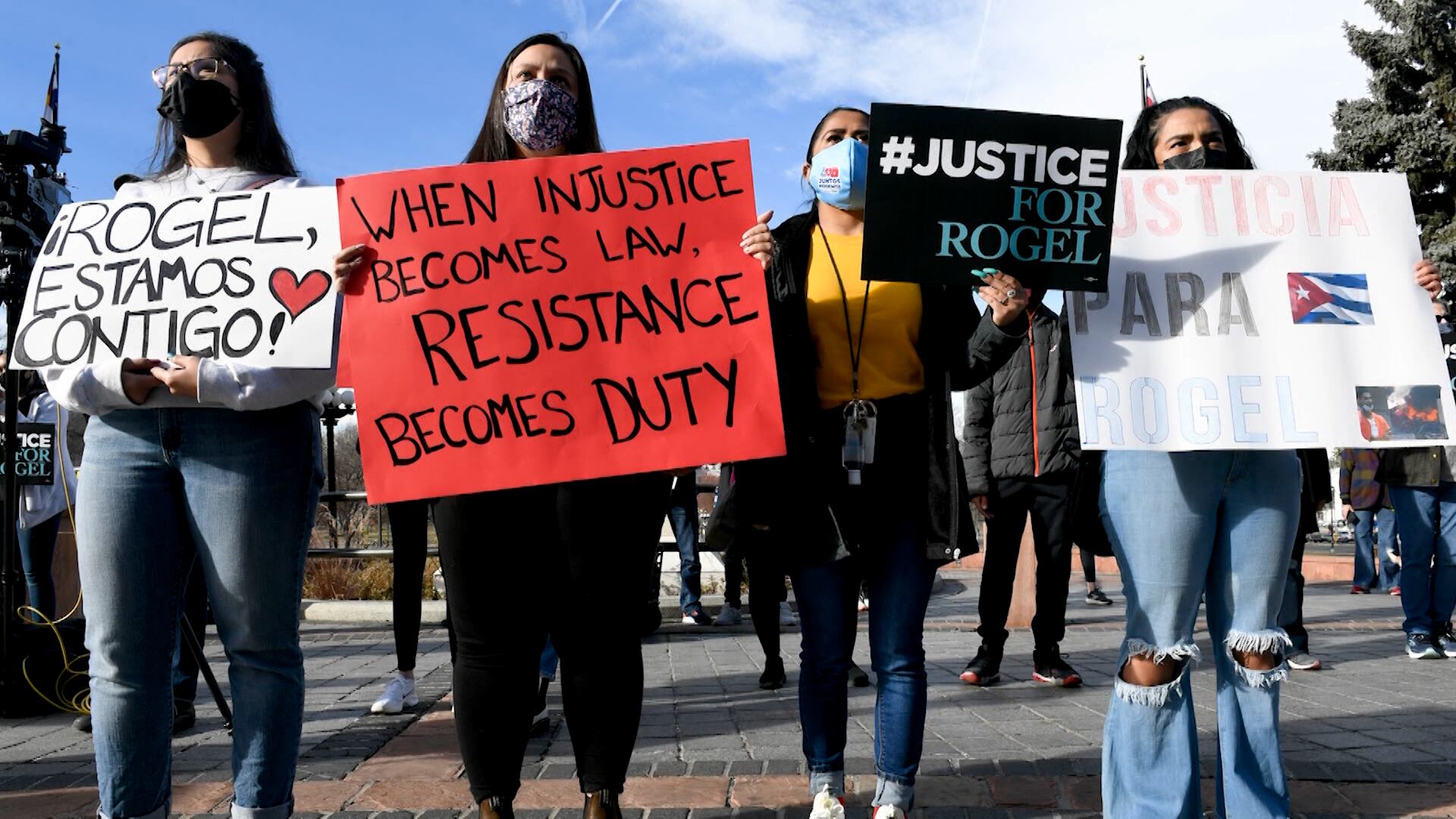
Leah Dean is on the opposite end of the political spectrum, but she knows how the Kohls feel. In Texas, Dean had been scared to fly an abortion rights banner outside her house. Around the time the Kohls were house-hunting in Idaho, she and her partner found a place in Denver, where their LGBTQ+ pride flag flies above the banner in front of their house that proclaims “Abortion access is a community responsibility."
“One thing we have really found is a place to feel comfortable being ourselves,” Dean said.
Americans are segregating by their politics at a rapid clip, helping fuel the greatest divide between the states in modern history.
One party controls the entire legislature in all but two states. In 28 states, the party in control has a supermajority in at least one legislative chamber — which means the majority party has so many lawmakers that they can override a governor's veto. Not that that would be necessary in most cases, as only 10 states have governors of different parties than the one that controls the legislature.
The split has sent states careening to the political left or right, adopting diametrically opposed laws on some of the hottest issues of the day. In Idaho, abortion is illegal once a heartbeat can be detected in a fetus — as early as five or six weeks — and a new law passed this year makes it a crime to help a minor travel out of state to obtain one. In Colorado, state law prevents any restrictions on abortion. In Idaho, a new law prevents minors from accessing gender-affirming care, while Colorado allows youths to come from other states to access the procedures.
Federalism — allowing each state to chart its own course within boundaries set by Congress and the Constitution — is at the core of the U.S. system. It lets the states, in the words of former Supreme Court Justice Louis Brandeis, be “laboratories of democracy."
Now, some wonder whether that's driving Americans apart.
“Does that work as well in a time when we are so politically divided, or does it just become an accelerant for people who want to re-segregate?” asked Rob Witwer, a former Republican Colorado state lawmaker.
Colorado and Idaho represent two poles of state-level political homogenization. Both are fast-growing Rocky Mountain states that have been transformed by an influx of like-minded residents. Life in the two states can be quite similar — conversations revolve around local ski areas, mountain bike trails, and how newcomers are making things too crowded. But, politically, they increasingly occupy two separate worlds.
Witwer watched Colorado steadily swing to the left as affluent, college-educated people fled the coasts for his home state starting in the late 1990s. For two decades, it was one of the nation's fastest-growing states, and during the Trump era it swung sharply to the left. Democrats control all statewide offices and have their largest majorities in history in the legislature, including a supermajority in the lower house.
In contrast, Idaho has become one of the nation's fastest-growing states during the past decade without losing its reputation as a conservative haven. It has moved even more sharply to the right during that time and become a beacon to those, like the Kohls, fleeing blue states where they no longer feel welcome.
The states' swings aren't simply due to transplants, of course. The increasing clustering of Americans into like-minded enclaves — dubbed “The Big Sort” — has many causes. Harvard professor Ryan Enos estimates that, at least before the pandemic, only 15% of the homogeneity was due to people moving. Other causes include political parties polarizing on hot-button issues that split neatly on demographic lines, such as guns and abortion, and voters adopting their neighbors' partisanship.
“A lot of this is driven by other sorting that is going on,” Enos said.
When Americans move, politics is not typically the explicit reason. But the lifestyle choices they make place them in communities dominated by their preferred party.
“Democrats want to live in places with artistic culture and craft breweries, and Republicans want to move to places where they can have a big yard,” said Ryan Strickler, a political scientist at Colorado State University-Pueblo.
But something may have changed as the country has become even more polarized. Businesses catering to conservatives fleeing blue states have sprouted, such as Blue Line Moving, which markets to families fleeing from blue states to Florida. In Texas, a "rainbow underground railroad” run by a Dallas realtor helps LGBTQ+ families flee the state's increased restrictions targeting that population.
The switch might have been flipped during the coronavirus pandemic in 2020, which created a class of mobile workers no longer bound to the states where their companies were based. Those who are now mobile are predominantly white-collar workers and retirees, the two most politically engaged parts of the national population.
Mike McCarter, who has spearheaded a quixotic campaign to have conservative eastern Oregon become part of Idaho, said most people didn't pay much attention to state government until the pandemic.
“Then it was like ‘Oh, they can shut down any church and they can shut down my kids’ school?'” McCarter said. “If state-level government has that much power, you'd better be sure it reflects your values, and not someone else's values that are forced on you.”
The pandemic helped push Aaron and Carrie Friesen to Idaho. When the pandemic hit, they realized they could take their marketing firm remote from its base near Hilton Head, South Carolina. They'd always planned to return to the West, but California, where Aaron, now 39, was born and raised, was disqualified because of its cost and progressive politics.
The Friesens and their three children settled on Boise. They loved the big skies, the mountains rearing up behind the town, the plethora of outdoor activities.
And they liked Idaho's pandemic policies. When the Friesens visited, almost no one was wearing masks, which they took as a good sign — they were happy to mask up when sick, but found constant masking pointless.
"This was a place that had like-minded people," Carrie Friesen said.
The Friesens are happy with the direction of their new state and the abortion and transgender restrictions out of the latest legislative session. But they don't see themselves as part of what they called “the crazy right,” referring to the families displaying Trump yard signs in the less-politically-mixed Boise suburbs. They like living close to the center of Boise, one of the more liberal areas in the state.
They try not to make too many decisions based on politics — to a point.
“With the temperature of politics nowadays, if people choose to move somewhere, they are going to choose to move to a place with like-minded people,” Aaron Friesen said.
That's apparently been happening in Idaho, said Mathew Hay, who oversees a regular survey of new arrivals for Boise State University. Historically, transplants mirrored the conservative population's leanings, with about 45% describing themselves as “conservative,” and the rest evenly split between liberal and moderate.
But something changed last year — the share of newcomers that said they lived in Idaho for the politics jumped to 9%, compared to 5% for long-timers. The percentage describing themselves as “very conservative” also rose.
When Melissa Wintrow rode her motorcycle across the U.S. in 1996, she was captivated by Idaho.
“It was this grounded, commonsense, reasonable group,” Wintrow said. “Of course they were conservative, but they weren't going to say openly racist and homophobic things.”
Now a Democratic state senator, Wintrow is aghast at how her adopted state has become more hardline.
“The state has just moved to a more extreme view,” she said. “It's a certain group of people that is afraid their ‘way of life’ is diminishing in the world.”
In Colorado, the reverse may be happening.
Bret Weinstein, owner of a realty firm in Denver, said politics has become the top issue for people buying a home.
“It's brought up in our initial conversations,” Weinstein said. “Three years ago, we didn't have those conversations, ever.”
Now, many entering the state tell him they're looking for a way to escape their red state — and homeowners leaving Colorado say they're fed up with it turning blue. Even within Colorado, Weinstein said, homebuyers are picking based on politics, with some avoiding conservative areas where debates on mask mandates and curriculum has dominated school board meetings.
One of those politically motivated migrants is Kathleen Rickerson, who works in human resources for Weinstein's firm. Rickerson, 35, lived in Minnesota for seven years, but during the pandemic grew weary of the blue state's vocal anti-masking, anti-vaccine minority.
Rickerson's parents and sister urged her to join them in Texas, but that was out of the question. Ready for a change, Rickerson instead zeroed in on Colorado. She moved to a Denver suburb in December 2021.
Cheered by the state's strong stance to protect abortion rights, Rickerson wants Colorado Democrats to go further.
“Colorado isn't as quick to take a stand on things, and I'd like to see that happen a bit more,” she said.
That was a sentiment shared by Colorado progressives, who were frustrated their party didn't muscle through an assault weapons ban and other priorities of the left during the most recent legislative session.
"There is a point at which we need to stop acting like trying to get along with our enemies is going to preserve our institution,” progressive state Rep. Stephanie Vigil said at the end of the session, after the chamber's Democratic leader said it was important that Republicans still feel like they have a voice.
The increasing political homogeneity in states makes it harder for both parties to feel invested, said Thad Kousser, a political scientist at the University of California, San Diego.
“It gives one party the ability to move a state further when they’re doing exactly what their constituency wants,” he said.
The system works as a sort of escape valve, Kousser said, letting the majority in the state feel in power regardless of what's happening in Washington, D.C. But the local minority party gets shortchanged.
The Kohls felt shortchanged in California. They said they watched their native state deteriorate before their eyes, and no one was willing to fix the problems. Trash piled up with homeless encampments. Tax money seemed to go to immigrants who had entered the country illegally rather than U.S. citizens. Jennifer's mother qualified for government assistance due to her low income, but was on dozens of wait lists that were seven years long. Tim's police station, in a former hippie colony in the mountains running through West Los Angeles, was firebombed during the George Floyd protests in 2020.
The Kohls wanted to live in a red state, but Jennifer said they're not just party-line voters. A nurse, she hasn't registered with either party and has a wide range of beliefs, including that abortion is sometimes necessary.
“I believe so many different things,” she said.
On balance, they feel more comfortable in a more conservative place.
“Here, the tax dollars naturally goes to the citizens, not the immigrants,” said Tim Kohl, who can understand why Idaho is growing so fast. “Most of the people we’ve met here are from California originally.”
In Denver, Dean has found other people who fled red states. She and her partner, Cassidy Dean, discovered that their neighbors fled Florida after the state's hard turn to the political right.
Leah Dean was a 19-year-old cosmetology college student in San Antonio in 2008 when she had an abortion. She chafed at the obstacles she faced — the state-mandated waiting period before the procedure, having to get a sonogram before the procedure — and became a committed Democratic activist. She met her partner at the Texas state party convention in 2016, and every year since then she’s felt the Republican state legislature and governor make the state less and less hospitable to people like her.
Now in Colorado, she and her partner both work from home, telecommuting to their old Texas jobs. They have limited social outlets, but took care of that by throwing themselves into politics again, with Leah Dean becoming vice chair of Denver Democrats.
“It’s also how we meet people,” she said. “We don’t have any other way to do that.”