A woman uses her phone as she passes by the ByteDance headquarters in Beijing, China, on Friday, Aug. 7, 2020. The Chinese government is complicating the U.S.-government-ordered sale of U.S. TikTok assets. China on Friday, Aug. 28, 2020 introduced export restrictions on artificial intelligence technology, seemingly including the type that TikTok uses to choose which videos to spool up to its users. That means TikTok's Chinese owner, ByteDance, would have to obtain a license to export any restricted technologies to a foreign company. (AP Photo/Ng Han Guan)
By Tali Arbel and Zen Soo
The Chinese government is complicating the U.S.-government-ordered sale of U.S. TikTok assets.
China on Friday introduced export restrictions on artificial intelligence technology, seemingly including the type that TikTok uses to choose which videos to spool up to its users. That means TikTok's Chinese owner, ByteDance, would have to obtain a license to export any restricted technologies to a foreign company.
The Trump administration has threatened to ban TikTok by mid-September and ordered ByteDance to sell its U.S. business, claiming national-security risks due to that Chinese ownership. The government worries about user data being funneled to Chinese authorities. TikTok denies it is a national-security risk and is suing to stop the administration from the threatened ban.
Prospective buyers for U.S. TikTok assets include Microsoft and Walmart and, reportedly, Oracle. Oracle has declined to comment.
On Saturday, Chinese state-owned media outlet Xinhua News Agency quoted government trade adviser and professor Cui Fan, who said that Bytedance should consider whether it should halt negotiations to sell TikTok in the U.S.
"As with any cross-border transaction, we will follow the applicable laws, which in this case include those of the U.S. and China," said ByteDance General Counsel Erich Andersen.
The Chinese government's new restrictions may be a "tactic to drive up valuation" of TikTok, said RBC Capital Markets analyst Alex Zukin, who still expects a deal announcement "relatively soon." The Wall Street Journal reported last week that ByteDance is asking for $30 billion for the U.S. operations, but has faced resistance from bidders. The Journal said in a Sunday story that deal talks had "slowed."
Microsoft and Walmart declined to comment on Monday.
White House press secretary Kayleigh McEnany, during a White House briefing, did not directly answer whether the administration would accept a sale of U.S. assets of TikTok if the deal were subject to Chinese government approval. "Negotiations are ongoing on a sale of TikTok so we are not going to get in the way of those negotiations," she said.
—
Associated Press writer Kevin Freking contributed to this report from Washington.
Meta, the parent company of Facebook, turned heads on Tuesday when it announced it will block some ad-targeting, specifically those of a political and religious nature.
This is one of the most direct moves the company has made in order to minimize ad-targeting by advertisers on its platforms. Hastie Afkhami, Head of Digital at S-3 Group, joins Cheddar News to discuss the impact of this move.
Wine subscription service Winc is officially a publicly-traded company after debuting on the New York Stock Exchange. CEO Geoff McFarlane and President Brian Smith joined Cheddar to talk about the decision behind the public offering and noted that its service goes beyond just subscriptions. "We're an omnichannel platform, so the subscription is a great way for us to really generate a ton of data from our customers, launch new products, and market our portfolio," McFarlane said. "But ultimately when we find great products that our customers really love, we want them to be everywhere." He went on to point to distribution partners like Whole Foods, Walmart, and Trader Joe's.
Roy Banks, CEO of Weave Communication, a cloud-based software company for small businesses, joined Cheddar to talk about the company's New York Stock Exchange debut. Banks broke down just how his company helps small businesses manage relationships with their customer base and also laid out how the funds raised will be used to grow the business and its short and long term goals.
Jeff Powell, Managing Partner & CIO at Polaris Wealth Advisory Group, discusses how supply chain issues and inflation will impact consumer spending, and discusses the future of the electric vehicle market.
Sotheby's is getting into the crypto game. The auction house announced it will now be accepting bids in increments of ETH, marking the first time that an auction will field live bids in crypto. This announcement comes just a week ahead of Sotheby's contemporary art auction 'The Now Evening Auction' for two works by Banksy: Trolley Hunters and Love is in the Air. Alex Branczik, Sotheby's Chairman for Modern & Contemporary Art joined Cheddar's Opening Bell to discuss what went into this move.
Jim Worden, Chief Investment Officer, Wealth Consulting Group, talks about the consumer spending headwinds and breaks down the bright spots from Disney's earnings and Rivian's IPO.
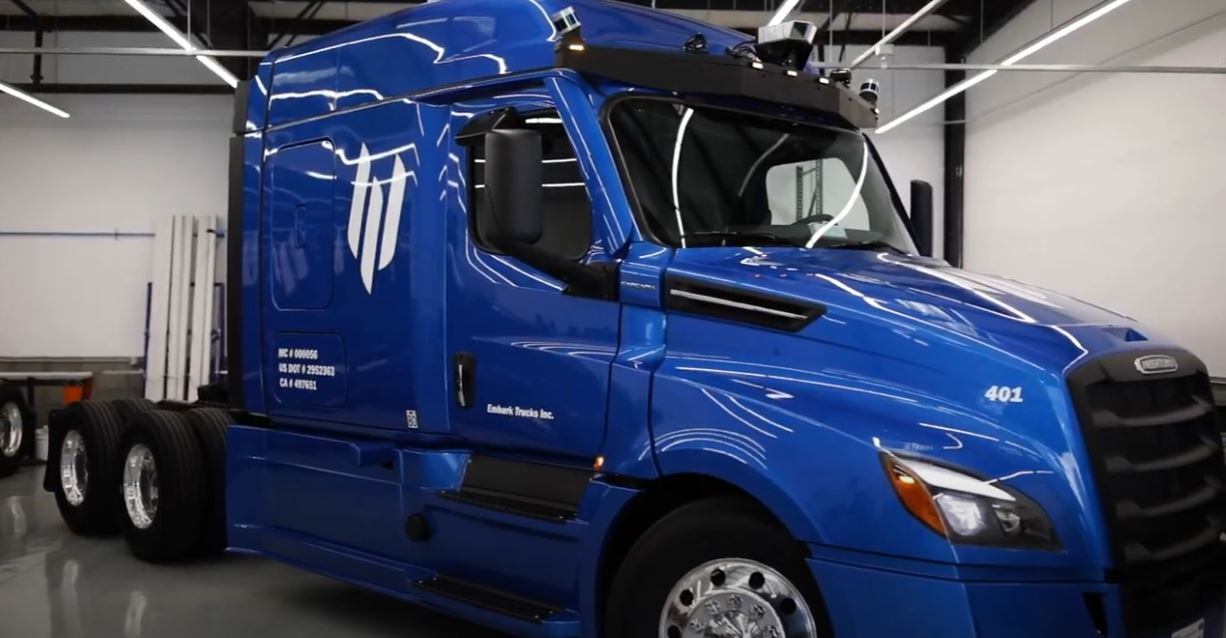
Autonomous tech developer Embark made its Nasdaq debut on Thursday via a SPAC merger, making its CEO Alex Rodrigues, the youngest chief executive of a publicly-traded company at the age of 26. He joined Cheddar's "Between Bells" to discuss what led to the IPO and what it means for the trucking industry as it looks to navigate ongoing supply chain issues. "I think there are really three major benefits to autonomous trucks. You think about the benefit from an efficiency perspective, from a safety perspective, and from an environmental perspective," Rodrigues noted.
AppHarvest CEO Jonathan Webb joined Cheddar's "Opening Bell" to talk about the company's Q3 earnings, stating sales data showed the indoor farming tech firm remained on track with its 2021 outlook. Webb also discussed a new campaign called "Fight The Food Fight," to encourage consumers to support a more resilient, sustainable food system.