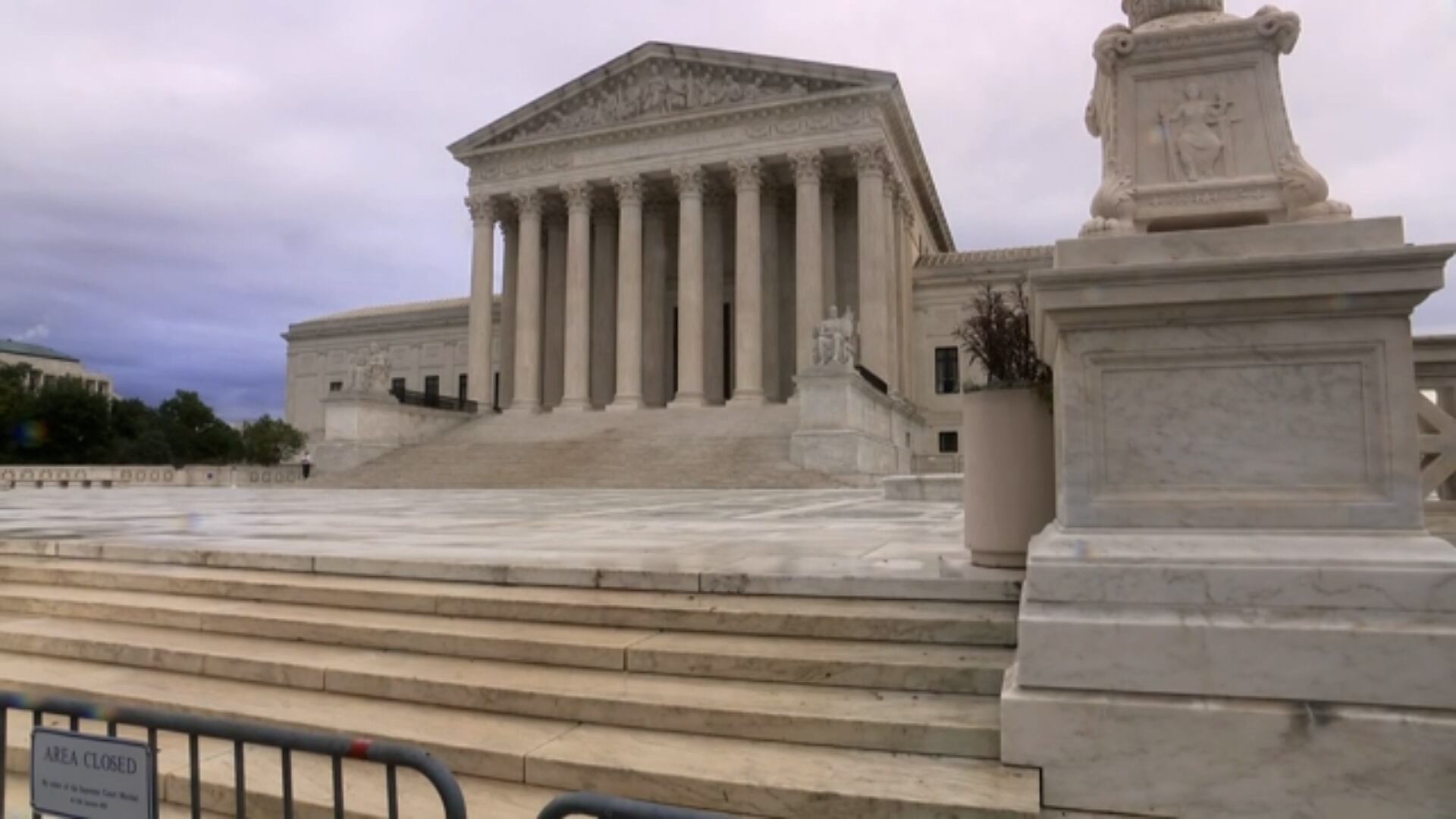
WASHINGTON (AP) — In a months-long inquiry, which included reviewing tens of thousands of pages of documents from more than 100 public records requests, The Associated Press has examined what happens behind the scenes when Supreme Court justices travel to colleges and universities for lectures and other events.
The AP learned the identities of donors and politicians invited to events with justices, details about the perks that have accompanied the school visits and information about how school trips have helped advance books sales.
Some of the key takeaways:
BOOK SALES
The documents reveal how university visits are a convenient way for justices to sell their own books. That’s especially true in the case of Justice Sonia Sotomayor, a prolific author who has kept the court’s most active travel schedule over the past decade, according to the records reviewed by the AP.
Emails and other documents show that Supreme Court staff members have been directly engaged in facilitating book sales by asking schools how many copies they want to buy and by helping to arrange the purchase of mass quantities.
At a 2019 event jointly hosted by the Multnomah County Library in Oregon and Portland Community College, a Sotomayor aide told organizers that “250 books is definitely not enough” for a program with an expected 1,000 guests in which people would be required to have a copy to meet the justice for a signing after the event.
Michigan State University purchased 11,000 copies to be distributed to incoming first-year students. When Clemson University in South Carolina worried that 60 copies might be too many for Sotomayor to sign, a staffer reassured the school that “most institutions order in the ranges of 400 and up.”
And before a scheduled visit to the law school at the University of California, Davis, for the 2018 commencement, the court staff proposed using the event as an opportunity to distribute books.
In a statement, a Supreme Court spokesperson said that staff members work to follow judicial ethics guidance and that “at no time have attendees been required to buy a book in order to attend an event.”
“Schools have occasionally invited Justice Sotomayor to take part in a program in which they select a book for an entire school or a freshman class, and the Justice gives a book talk,” the statement said. “When she is invited to participate in a book program, Chambers staff recommends the number of books based on the size of the audience so as not to disappoint attendees who may anticipate books being available at an event, and they will put colleges or universities in touch with the Justice’s publisher when asked to do so.”
A LURE FOR MONEY
Supreme Court justices insist that they cannot and do not participate in fundraising events. But the emails obtained by the AP show that the court’s definition of a fundraiser — an event that raises more than it costs or where guests are asked for contributions — excludes much of the work that typically goes into persuading a wealthy donor to cut a check.
That’s given schools wide latitude to court rich patrons.
For instance, ahead of a 2017 event with Justice Clarence Thomas, officials at McLennan Community College in Texas worked with the prominent conservative lawyer Ken Starr and his wife, Alice, to craft a guest list designed to reward school patrons and incentivize future contributions. In an interview, Starr's widow called it “friendraising.”
In an email planning the event, the executive director of the college’s foundation wrote that she had thoughts about whom to invite “mainly because they are wealthy conservative Catholics who would align with Clarence Thomas and who have not previously given.”
Thomas isn’t the only one whose status as a justice has been leveraged by schools eager to capitalize with donors. Before Justice Elena Kagan visited the University of Colorado's law school, one official suggested a “larger donor to staff ratio” for a 2019 dinner with her, emails show. Another event organizer said the organizer was “open to suggestions about which VIP donors to cultivate relationships with.” A school spokesperson said the attendees weren’t asked for any donations connected to the event.
Clemson University in South Carolina hosted Sotomayor for a 2017 session with students and for a private luncheon. One official said it was hoped the events, which included donors, would “ultimately generate resources” for the university’s Humanities Advancement Board that played a lead organizing role. As university officials devised a guest list, an alumni relations official wrote: “When you say $1M donors, please be sure to include our corporate donors at that level, too.”
In a statement, a court spokesperson said it “routinely asks event organizers to confirm that an event at which a Justice will speak is not a fundraiser, and it provides a definition of ‘fundraiser’ in order to avoid misunderstandings." The spokesperson said justices have occasionally declined to attend events even after being told expressly that they were not fundraisers.
POLITICAL COMMINGLING
Visits to universities are promoted as academic in nature, but they also have facilitated encounters between justices and elected officials.
Months after he was seated on the Supreme Court, Justice Neil Gorsuch attended an event at the University of Kentucky with then-Senate Minority Leader Mitch McConnell, hosted by a center to study the judiciary named after one of McConnell’s closest friends, a former federal judge.
In 2020, after teaching a weeklong course at the University of Florida's law school, Thomas extended his stay in the state to attend a gathering of the regional branch of the Federalist Society, where he was introduced with effusive praise by Gov. Ron DeSantis, with whom he also had a private dinner.
Thomas also attended a private dinner during a visit to the University of Texas at Tyler that was sponsored by a group of donors to then-Rep. Louie Gohmert. Six years later, Gohmert would spearhead a lawsuit that sought to empower Vice President Mike Pence to overturn the outcome of the 2020 presidential election that Donald Trump lost.
A court spokesperson said: “Justices exercise caution in attending events that might be described as political in nature, following guidance in the Code of Conduct which cautions judges against engaging in political activity. Merely attending an event where an elected official might also be in attendance — such as several of the events described in your email — does not necessarily render the event impermissibly political in nature.”
NO ETHICS CODE
Some of the conduct revealed by the AP likely would run afoul of ethics rules that cover officials in other branches of government as well as lower federal court judges.
Lower court judges, for instance, are generally barred from engaging in fundraising, political activity and “lending the prestige of judicial office” to advance a judge’s own “private interests." Supreme Court justices are asked only to adhere to what Chief Justice John Roberts referred to in April as a set of “foundational ethics principles and practices.”
The information in this review comes at a time of plummeting confidence in the court, brought on in part by a succession of news media revelations about members of the court, including reports by ProPublica that Thomas repeatedly accepted luxury vacations, including a $500,000 trip to Indonesia in 2019, and sold property to and accepted school tuition for a nephew from Harlan Crow, a billionaire businessman, Republican donor and longtime friend.