By Alan Fram and Lisa Mascaro
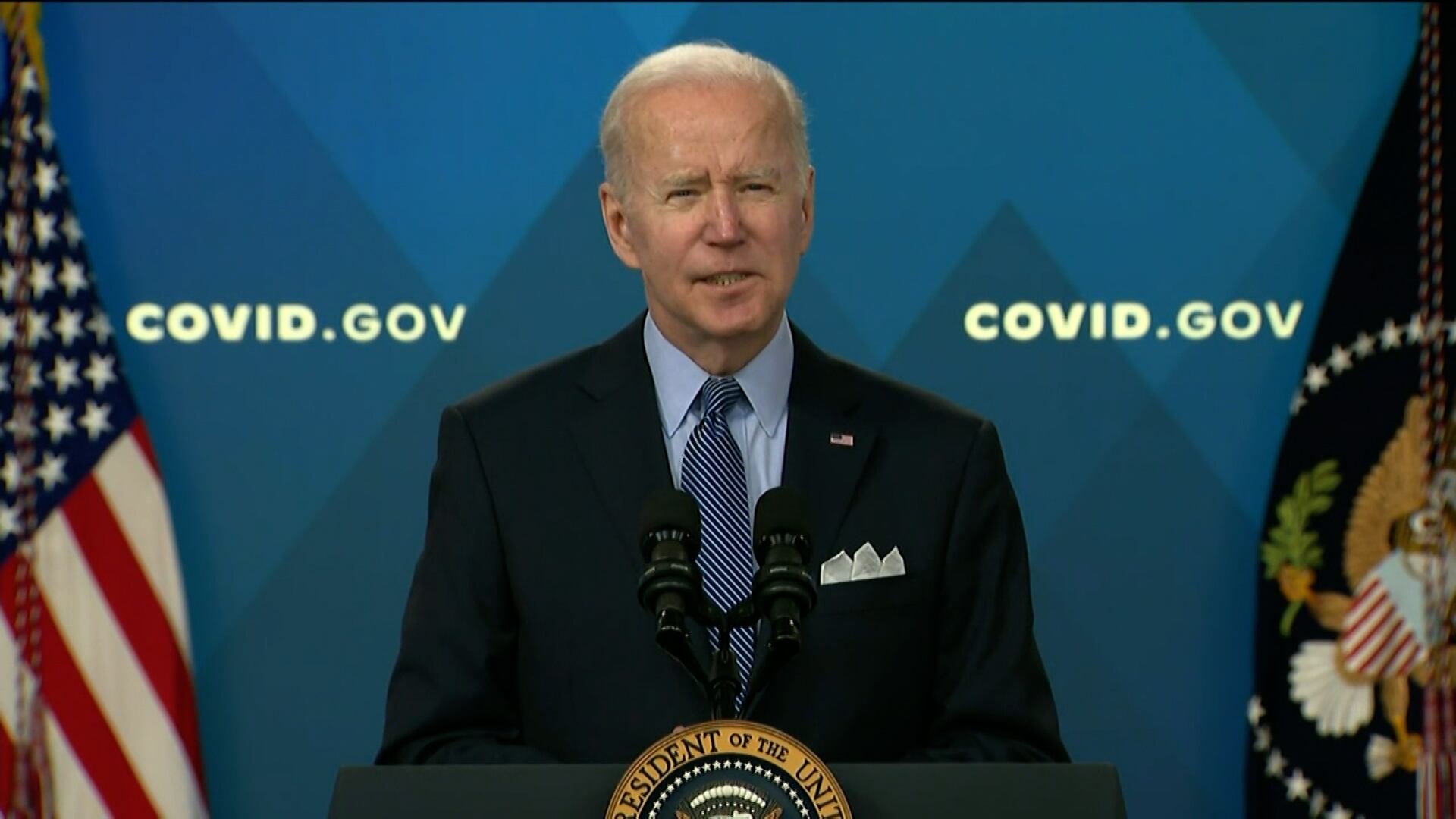
President Joe Biden stepped up his bid to push his multitrillion-dollar domestic plans through Congress Wednesday, lunching with Senate Democrats a day after party leaders announced a compromise for pouring federal resources into climate change, health care and family service programs.
“It is great to be home," Biden told reporters as he left the building where he spent 36 years as a Delaware senator. “It is great to be with my colleagues, and I think we are going to get a lot done."
The closed-door midday session, which lasted just under an hour, was Biden's first working meeting with lawmakers at the Capitol since becoming president. Sen. Chris Murphy of Connecticut said the president urged them to consider whether their plan would help people in his blue-collar hometown of Scranton, Pennsylvania.
“His point was that we need to be thinking about folks who have given up on democracy," Murphy said.
Biden received three standing ovations from his fellow Democrats, said Sen. Bob Casey of Pennsylvania.
The meeting was the start of Biden's efforts to firm up support for forthcoming legislation embodying his priorities among Democrats, whose skinny congressional majorities leave him with virtually no votes to lose.
Late Tuesday, top Democrats announced an agreement among themselves on plans to spend a mammoth $3.5 trillion over the coming decade on a wide range of domestic programs, an expansion Biden has proposed financing with tax boosts on the rich and big corporations. Included in the proposal would be a top priority for progressives — an expansion of Medicare, the health insurance program for older Americans, to include vision, dental and hearing coverage.
According to a senior Democratic aide, the party will also propose extensions of tax credits for children, child care and some low-income people; money for environmentally friendly energy technologies and a federal standard aimed at encouraging a shift to clean energy. The plan would also fund pre-kindergarten for toddlers and paid family leave and a pathway to citizenship for many immigrants, said the aide, who spoke on condition of anonymity to describe Democrats' plans.
Yet those ideas are merely proposals right now, and Democrats will have to decide which programs are affected and by how much in future legislation. That will likely take months.
The initial plans fall short of even bolder progressive goals, like extending overall Medicare coverage to people as young as 60. Biden and party leaders face a tricky task of winning over moderates wary about tax boosts and further ballooning budget deficits, and progressives demanding even more spending.
“We know the road ahead is gong to be long. There are bumps along the way," Senate Majority Leader Chuck Schumer of New York acknowledged Wednesday. But he said Democrats would press ahead because “we must make average American lives a whole lot better."
Underscoring the political complexities, West Virginia Sen. Joe Manchin stopped short of saying Wednesday that he would back all the policy initiatives that Biden and top Democrats are pursuing. “I really haven't seen everything yet,” Manchin, one of the chamber's more conservative Democrats, told a reporter.
Republicans could well oppose the effort unanimously, criticizing its costs and likely tax increases. Democrats will need support from all their lawmakers in the 50-50 Senate and could lose no more than three in the House.
Separately, a bipartisan group of senators is working to flesh out a related measure that would cost around $1 trillion — including around $579 billion in new spending — on roads, water systems and other more traditional infrastructure projects, another Biden priority. Biden and that group had agreed to an outline of that measure last month, and bargainers are hoping to craft a compromise bill in coming days.
Together, the infrastructure and social program packages fall a bit short of the roughly $4.5 trillion Biden had proposed to help communities and families in every corner of the country. That means some increases Biden has proposed will have to be curtailed or cut.
The Democrats' goal is to push a budget resolution reflecting Tuesday's agreement through the House and the Senate before lawmakers leave for their August recess. Budget passage would let Democrats move a follow-up spending bill that actually finances the party's priorities with just 50 votes and Vice President Kamala Harris' tie-breaking vote in the Senate, not the 60 votes Republicans could otherwise require with a bill-killing filibuster.
The actual spending legislation would likely not start moving through Congress until the fall.
On Wednesday, Biden will also push for public support of his infrastructure proposal by hosting bipartisan governors and mayors at the White House. He plans to emphasize the bipartisan aspects of the proposal, as senators work to finalize details for a Thursday deadline.
In discussing the budget agreement, Schumer and other lawmakers did not respond when asked if they had the support of all 50 Democratic senators.
Sen. Bernie Sanders, I-Vt., the Budget Committee chairman, and other progressives pushed initially for a $6 trillion budget top line, while party moderates insisted on a far lower price tag. Biden had proposed around $4.5 trillion.
The Democrats' announcement Tuesday left many questions about their budget accord. These included how much it would raise through tax increases on the wealthy and corporations and other revenue to pay for its costs, how much would be spent on specific programs, and how Biden’s proposals would be curtailed or eliminated to fit into the legislation.
Schumer said the proposal would call for financing Biden’s budget priorities “in a robust way.” He also said it would include the dental and hearing expansion of Medicare, a priority of Sanders.
Sanders said the agreement would end an era in which rich people and big companies aren’t bearing enough of the burden of financing government programs.
“Those days are gone,” he said. “The wealthy and large corporations are going to start paying their fair share of taxes, so that we can protect the working families of this country.”
Sen. Mark Warner, D-Va., a leading moderate who helped shape the budget package, said the measure would be fully paid for with offsetting revenue, but he provided no details. Besides higher taxes on the wealthy and corporations, Biden proposes beefing up the IRS budget so it can collect more revenue from scofflaws.
The budget will include language calling for no tax increases on people making less than $400,000 a year, a Biden demand, or on small businesses. The provision was described by a Democratic aide who insisted on anonymity to discuss the negotiations.
On infrastructure, lawmakers are aiming to wrap up the details by Thursday despite opposition from business leaders, outside activists and some GOP senators over how to pay for the $1 trillion plan, which includes the $579 billion beyond regular expenditures already funded by gas taxes and other sources.
___
Associated Press writers Jonathan Lemire, Alexandra Jaffe and Kevin Freking contributed to this report.
Updated on July 14, 2021, at 3:26 p.m. ET with the latest details.