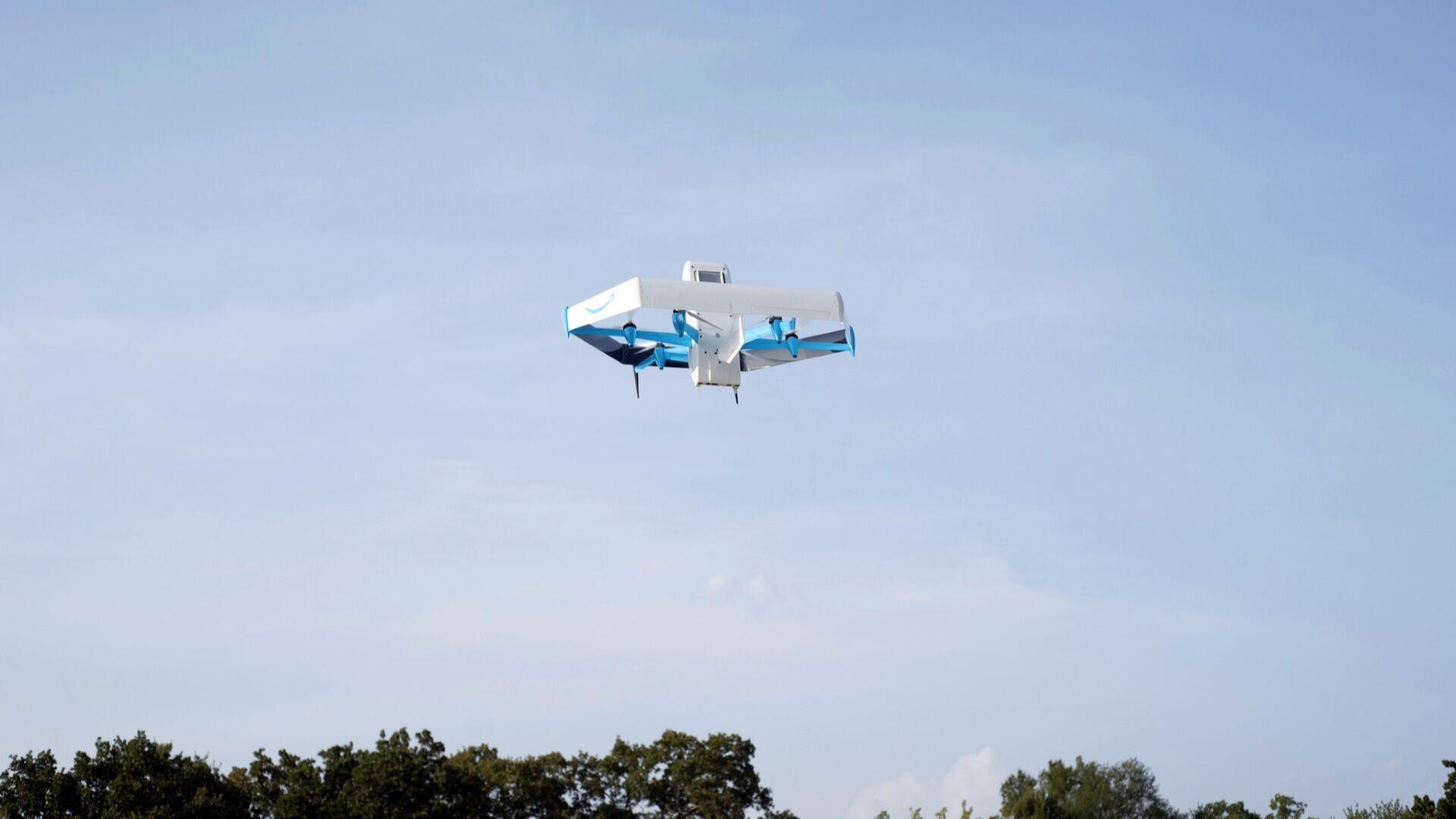
This photo provided by Amazon shows a drone delivering presciption drugs in College Station, Texas. Amazon will soon make prescription drugs fall from the sky when the e-commerce giant becomes the latest company to test drone deliveries for medications. The company said Wednesday, Oct. 18, 2023 that customers in College Station, Texas, can now get prescriptions delivered by a drone within an hour of placing their order. (Amazon via AP)
By Tom Murphy and Haleluya Hadero
Amazon will soon make prescription drugs fall from the sky when the e-commerce giant becomes the latest company to test drone deliveries for medications.
The company said Wednesday that customers in College Station, Texas, can now get prescriptions delivered by a drone within an hour of placing their order.
The drone, programmed to fly from a delivery center with a secure pharmacy, will travel to the customer’s address, descend to a height of about four meters — or 13 feet — and drop a padded package.
Amazon says customers will be able to choose from more than 500 medications, a list that includes common treatments for conditions like the flu or pneumonia, but not controlled substances.
The company's Prime Air division began testing drone deliveries of common household items last December in College Station and Lockeford, California. Amazon spokesperson Jessica Bardoulas said the company has made thousands of deliveries since launching the service and is expanding it to include prescriptions based in part on customer requests.
Amazon Prime already delivers some medications from the company’s pharmacy inside of two days. But pharmacy Vice President John Love said that doesn’t help someone with an acute illness like the flu.
“What we’re trying to do is figure out how can we bend the curve on speed,” he said.
Amazon Pharmacy Chief Medical Officer Dr. Vin Gupta says the U.S. health care system generally struggles with diagnosing and treating patients quickly for acute illnesses, something that was apparent throughout the COVID-19 pandemic.
Narrowing the window between diagnosis and treatment makes many treatments more effective, he said.
Amazon is not the first company to explore prescription deliveries by drone. The drugstore chain CVS Health worked with UPS to test deliveries in 2019 in North Carolina but that program has ended, a CVS spokesman said.
Intermountain Health started providing drone deliveries of prescriptions in 2021 in the Salt Lake City area and has been expanding the program, according to Daniel Duersch, supply chain director for the health care system. Intermountain is partnering with the logistics company Zipline to use drones that drop packages by parachute.
Companies seeking to use drones for commercial purposes have faced hurdles from regulators who want to make sure things are operating safely. Amazon founder Jeff Bezos had predicted a decade ago that drones would be making deliveries by 2018. Even now, the e-commerce giant is only using the technology in two markets.
Lisa Ellman, the executive director of the Commercial Drone Alliance, an industry group that counts Amazon as one of its members, said to date, regulatory approvals have been limited to specific geographic areas and “in terms of their scope and usefulness to companies.”
That said, she noted regulators have also been issuing more approvals. Last month, the FAA gave the OK for Zipline and UPS to fly longer-range drones.
Amazon says its drones will fly as high as 120 meters, or nearly 400 feet, before slowly descending when they reach the customer’s home. The drone will check to make sure the delivery zone is clear of pets, children or any other obstructions before dropping the package on a delivery marker.
The company said it hopes to expand the program to other markets, but it has no time frame for that.
Amazon has been growing its presence in health care for a few years now.
Aside from adding a pharmacy, it also spent nearly $4 billion to buy primary care provider One Medical. In August, the company added video telemedicine visits in all 50 states.
Chen Arad, Chief Operating Officer for Solidus Labs, joins Cheddar News' Closing Bell, where he explains why Wormhole was particularly vulnerable to a $320+ million crypto hack and discusses what new investors need to do in order to protect their assets.
E-commerce platform for construction and building materials RenoRun has raised $142 million in a Series B round, which the company says is the fourth largest Series B round in Canadian history. RenoRun’s platform offers same-day delivery of construction materials to job sites in Canada and the United States. The company aims to revolutionize the construction industry by maximizing productivity and efficiency. RenoRun co-founder and CEO Eamonn O’Rourke joins Cheddar News' Closing Bell to discuss.
Facebook parent company Meta reported weaker-than-expected fourth quarter earnings, and also issued disappointing guidance for Q1 2022. The tech giant is also under pressure due to Apple's iOS privacy change, as well as continued multi-billion dollar losses for its metaverse focused business unit. Angelo Zino, Tech Analyst at CFRA Research, joins Closing Bell to discuss the earnings results, how Apple's iOS privacy change will impact revenue, whether the metaverse is an underrated investment opportunity, and more.
Rental prices are rising across the country, causing millions to relocate. Average rents rose 14 percent last year, and Americans expect rents will continue to rise by about 10 percent just this year. Daryl Fairweather, chief economist at Redfin, joins Cheddar News to discuss.
The video game industry has seen monumental growth the past few years - with an increasing amount of companies jumping head first into the space. In January alone, Microsoft announced its plan to acquire Activision Blizzard, game publisher Take-Two agreed to buy Zynga, and most recently, Sony announced it has agreed to buy game developer Bungie for $3.6 billion. Tobias Batton, CEO and founder of Ex Populus, joined Cheddar Movers to discuss the surge in M&A activity in the gaming space.
Facebook parent Meta reported disappointing results in its first quarterly earnings report since rebranding to focus on the metaverse. The tech giant delivered mixed results with quarterly profit falling well below Wall Street expectations. Shares plunged more than 20 percent in after hours trading as a result. Martin Garner, COO of CCS Insight, joined Cheddar Movers to break down the company's results.
Karyn Cavanaugh, Chief Investment Officer at Carolinas Wealth Management, breaks down which industries investors should watch this earnings season and highlights which sectors have upside potential.
Super Group, the company behind leading global online sports betting and gaming businesses Betway and Spin, has landed on Wall Street. The company went public via SPAC with Sports Entertainment Acquisition Corp., and now lists on the NYSE under the ticker symbol 'SGHC.' This debut comes as the U.S. sports betting market continues to heat up with more and more states legalizing the practice. Eric Grubman, chairman of Super Group, joined Cheddar to discuss.
Miami wants to be the crypto capital of the world. Mayor Francis Suarez has gone all in on the blockchain, even accepting one of his first paychecks in Bitcoin, hosting one of the world's largest digital cryptocurrency conferences, and marketing Miami as a great place for tech experts to work. Maja Vujinovic, managing director of OGroupLLC, joined Cheddar's Fast Forward to discuss Miami's enthusiasm toward crypto, some of the potential risks that entails, and where the city might be heading when it comes to the crypto takeover.
Like so many other cities, Miami experienced a tourism boom over the summer after vaccines were distributed. But, the Omicron variant has thrown the travel industry for a loop. David Whitaker, president and CEO of the Greater Miami Convention and Visitors Bureau, joined Cheddar to discuss the city as a tourist destination, and how it has handled headwinds from the pandemic.