Airlines are looking to turn the blue skies green.
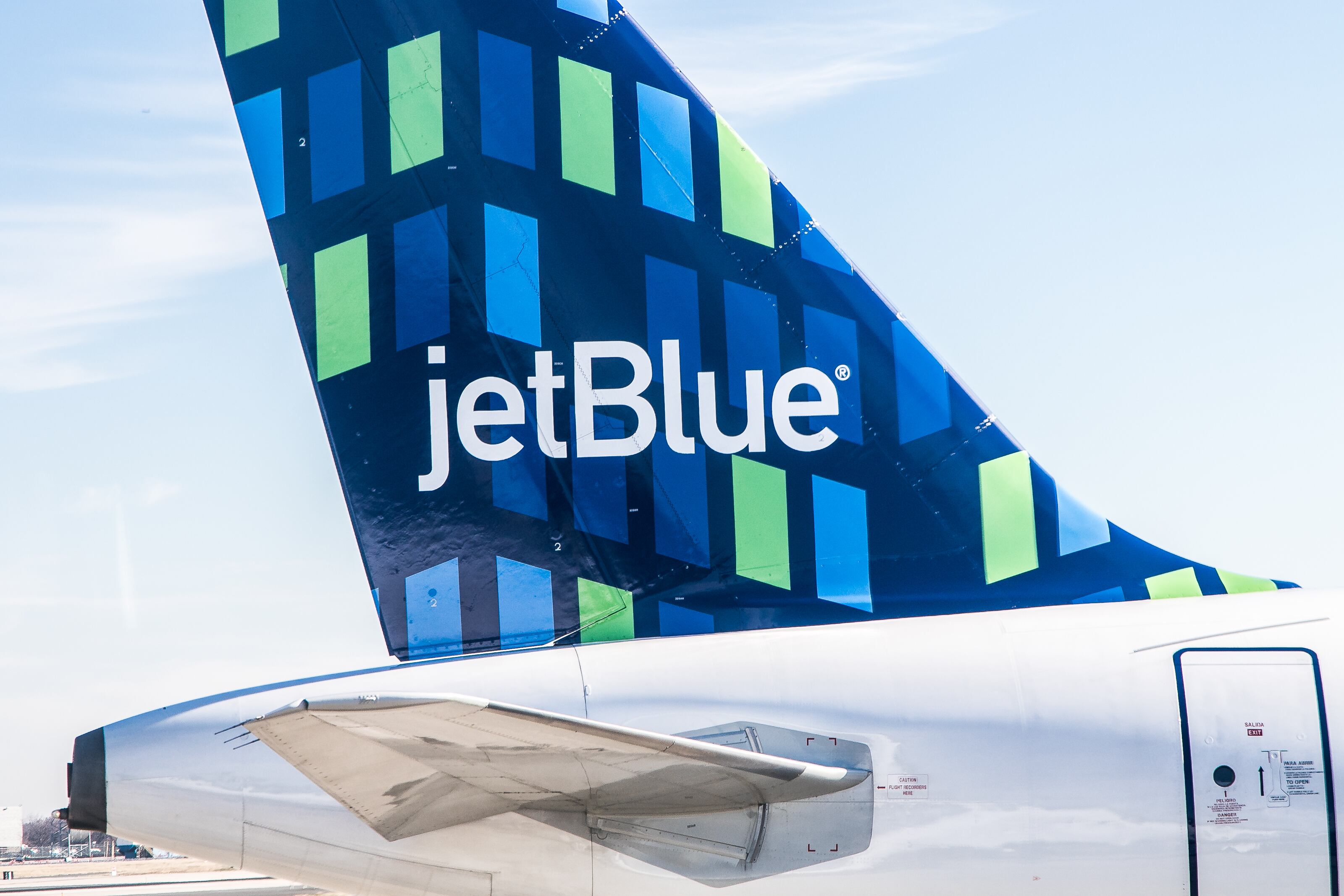
JetBlue this week became the first U.S. airline to announce plans to go carbon-neutral on all of its domestic flights by buying so-called "carbon offsets."
While the flightpath to a truly zero-emissions plane remains years away – the first all-electric commercial aircraft, a battery-powered four-seater, just took its first test flight near Vancouver last month – JetBlue plans to invest in green projects designed to absorb or avoid the greenhouse gas emissions being produced by the airline's 1,000 daily flights.
The idea is that for every ton of carbon produced by the airline's jets, JetBlue will invest in forestry programs, gas-capture mechanisms, and renewable energy projects that will essentially "offset" the planes' greenhouse gases. Domestic and international flights generated about 2.4 percent of the world's energy-related carbon dioxide emissions in 2018, soaring 26 percent from just five years earlier.
"We can't eliminate the emissions and pollution coming out of the tailpipes of our airplanes, but we can find solutions on the ground, like supporting solar and wind farms and capturing methane pollution from a landfill," Sophia Mendelsohn, JetBlue's head of sustainability, said in an interview with Cheddar. "When we do that, we essentially get a credit that offsets your flight."
The announcement came two months after the European budget carrier EasyJet became the world's first airline to declare that it would offset all of its emissions. Airlines are facing heightened scrutiny on the climate impacts of air travel and the rise of so-called "flight shame," much of it precipitated by, or at least attributed to, Swedish teenage climate activist – and Time person of the year – Greta Thunberg.
"The airline industry knows that they have a carbon problem, they've known it for a long time, and they have started working on a solution to it," said Annie Petsonk, international counsel for the Environmental Defense Fund and an expert on sustainability efforts in the aviation sector. "In the face of Greta Thunberg, the airlines are really scrambling."
With few technologies yet available to replace flights – especially for long-haul travel – offsets offer a relatively easy and, notably, inexpensive way for airlines to show that they're addressing fliers' concerns. That has spurred some experts to question whether such schemes go far enough.
"For flyers, who have very limited control over emissions from their flight, I consider personal offsetting reasonable. For airlines, which control every lever available to limit emissions – they buy the planes, fuel them, route them, pilot them, fill them – I consider offsets to be basically kicking the can down the road," Dan Rutherford, program director for marine and aviation at the International Council on Clean Transportation, wrote in an email to Cheddar. "The focus should be on reducing emissions through improved operations, more fuel-efficient aircraft and engines, and clean fuels starting today."
The airplane maker Airbus, for example, announced last fall that it plans to examine "vortex surfing," where long-haul aircraft draft off one another to cut fuel consumption and carbon emissions by as much as 10 percent. But testing the program, getting sign-offs from regulators, and implementing it, will likely take years; the U.S. Air Force nixed a similar idea after testing it in 2013 due to logistical challenges.
"There are not near-term, off-the-shelf technology solutions to reducing emissions from aviation," Petsonk said. "For people who fly, what do they have in the interim? If they can have high-quality offsets that are not double-counted, that's better than not."
Double-counting is one of the main concerns with carbon offset schemes. The programs aren't new, but they can be opaque – and, without the right accounting mechanisms or safeguards, can actually make emissions worse by allowing polluters to mask just how much heat-trapping gas their factories and vehicles are generating.
The United Nations' Clean Development Mechanism, for example, which became the central carbon-offset regime in Europe, failed to reduce the vast majority of emissions, largely because the same credits could be counted for multiple emissions sources.
"Some of those projects were good, some of those projects were very bad, but it's very much true that under that approach, one bad apple spoiled the bunch, because on the surface the programs look the same," said Peter Miller, director of the Western Region of the Climate and Clean Energy Program at the Natural Resources Defense Council.
There is little to no domestic regulation of carbon offsets, although international organizations and verification regimes have emerged to certify various offset programs. JetBlue, in its description of its carbon offset investment, meanwhile said that it would avoid double-counting by ensuring that each carbon credit it buys has "a unique serial number." Environmental advocates and experts say that they're encouraged – with qualifications.
"JetBlue's announcement is very significant, but there is this proof-in-the pudding question," Petsonk said.
The move should cheer business travelers in particular – or, viewed another way, may have been designed with business travelers in mind. While most fliers seem to be guided by ticket price alone, companies whose employees frequently travel often negotiate lower fares with airlines in exchange for loyalty or exclusivity agreements. As those companies have faced new pressure from younger employees to address climate change, they've in turn put the screws to airlines.
"Companies are getting increasingly asked by their employees, 'What is our company doing about climate change?' So they go to their airlines and say, 'What are you doing about emissions?'" Petsonk said. "We think there is tremendous potential in this sector, and airlines can drive that innovation by demanding lower-emitting flights and, in the interim, until they can get there, by offsetting."
Ukrainian President Volodymyr Zelenskyy has signed an application for Ukraine's membership in the European Union, pleading with the bloc to accept this request. It comes as Russian forces push further into Ukraine, forcing at least half a million refugees to flee. Benjamin Schmitt, Postdoctoral Research Fellow at Harvard University and Senior Fellow at the Center for European Policy Analysis, breaks down the latest in Ukraine.
A growing wave of major U.S. companies have taken steps to cut ties with Russia or offer support to Ukraine, as tensions escalate in the region. Exxon, Apple and Boeing are just the latest companies to make the move, following the likes of Google, Meta and BP who have all announced plans to exit the region in response to the conflict. Courtney Vinopal, Breaking News Reporter, Quartz joined Cheddar's Opening Bell for more.
Uber is rolling out a new feature on its app called Explore that will allow users to discover things to do in their area such as dining. The new service is now available in 14 U.S. cities.
Traci Gusher, EY Americas data and analytics leader, joins Cheddar News to discuss how companies have made strides within data and analytics throughout the pandemic and what the chief information officers of today need to focus on and dedicate resources to.
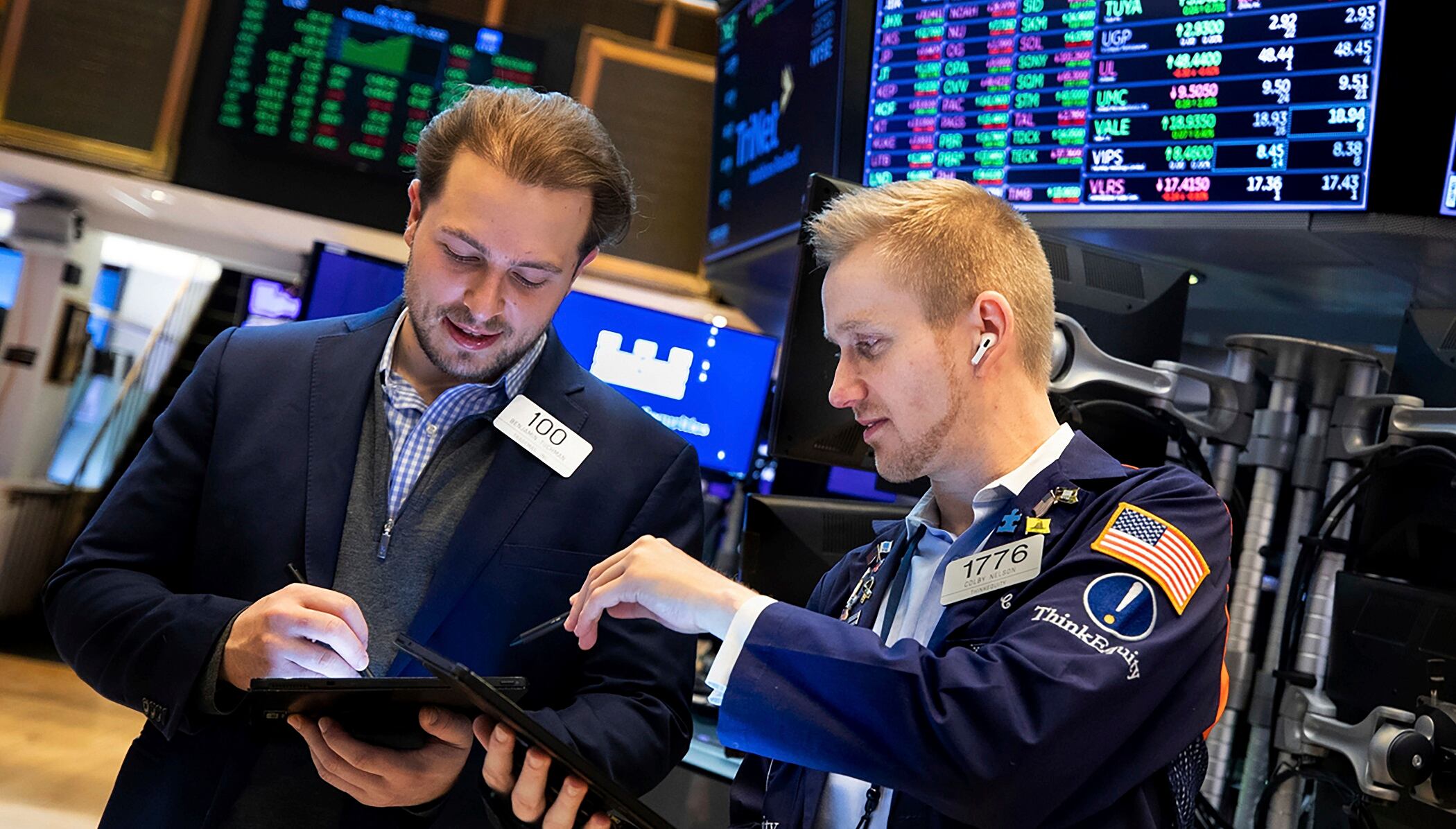
Wall Street took another sharp swing Wednesday, this time back to rally mode, as stocks and Treasury yields rose even as U.S. crude oil prices climbed to the highest level in more than a decade.
The S&P 500 rose 1.9%, recouping its losses from earlier in the week, after Federal Reserve Chair Jerome Powell said he supports a more modest rise in interest rates this month than some investors had feared. He also said he still expects inflation, which is at its highest level in 40 years, to moderate through the year.
“Although we’ve had some Fed governors lately saying ‘Oh my God, this is such a huge crisis,’ the conventional wisdom is slow and steady wins the race right now,” said J.J. Kinahan, chief strategist with TD Ameritrade.
The comments helped drive the market higher, adding to modest gains from earlier in the morning. Other areas of the market also gained ground a day after worries about Russia’s invasion of Ukraine sent the S&P 500 tumbling 1.5% and prices soaring for all kinds of commodities.
Treasury yields jumped to recover some of their steep losses from the past week. Gold receded, and a measure of nervousness among stock investors on Wall Street eased after swinging sharply in recent days.
“We’ve seen wild swings, but not major changes in the indexes,” said Jeff Kleintop, chief global investment strategist at Charles Schwab. “Geopolitical conflicts can be very unsettling, but you don’t tend to get bear markets from these, just periods of volatility.”
Markets have been spinning wildly as investors try, sometimes blindly, to gauge how high Russia's attack on Ukraine will push prices for oil, wheat and other commodities where the region is a major producer. On top of that are worries about what upcoming hikes in interest rates by the Federal Reserve and other central banks around the world will do to the economy and inflation.
Powell said in testimony to Congress that the Fed is set to raise its key interest rate for the first time since 2018. But he also said the attack on Ukraine may have muddied conditions, with its impact on the U.S. economy “highly uncertain,” adding that “we're never on autopilot.”
The Fed is balancing a tightrope where it needs to raise interest rates enough to rein in the highest inflation in generations but not so much that it pushes the economy into a recession. All the while, higher interest rates tend to put downward pressure on stocks and most other investments.
The yield on the 10-year Treasury leaped to 1.89% from 1.72% late Tuesday, while the two-year Treasury surged to 1.53% from 1.31%. Yields, though, remain well below where they were before Russia’s invasion. The 10-year yield was above 2% last month, before it plunged as investors plowed into investments seen as safer amid worries about war.
The price of U.S. oil jumped another 7% to $110.60 per barrel, the highest level in just over a decade. Brent crude, the international standard, climbed 7.6% to $112.93 per barrel.
Leaders of OPEC and other major oil-producing countries decided Wednesday to stick with their plan to gradually increase oil production. The OPEC+ coalition of oil producers, made up of OPEC members led by Saudi Arabia and non-cartel members led by Russia, chose to increase oil production by 400,000 barrels per day in April.
The move follows a perhaps less impactful decision by the United States and other major governments in the International Energy Agency to release 60 million barrels from strategic reserves to boost supplies.
“Markets dismissed the notion that 60 million barrels of strategic reserves released will be consequential to the risks of Russian supply jeopardized,” Tan Boon Heng of Mizuho Bank said in a report. “Russia pumps more than that in just six days.”
In the stock market, all the uncertainty about oil prices and inflation has led to big swings not only by the day but also by the hour. The S&P 500 swung between gains of 0.4% and 2.2% Wednesday. It closed 80.28 points higher to 4,386.54.
The Dow Jones Industrial Average rose 596.40 points, or 1.8%, to 33,891.35, while the Nasdaq composite gained 219.56 points, or 1.6%, to 13,752.02.
More than 90% of stocks in the S&P 500 rose, with technology, financial and health care companies accounting for a big share of the rally. Bank stocks led the gainers, climbing 2.6%, as higher longer-term interest rates can mean bigger profits for them making loans. Energy stocks also helped lift the index as they rode higher energy prices.
Ross Stores climbed 6.1% after the retail chain reported stronger profit for its last quarter than analysts expected.
Ford jumped 8.4% after it said it was accelerating its transformation into an electric-vehicle company and split its EV and internal combustion operations into two individual businesses.
Stock markets around the world were mixed. France’s CAC 40 rose 1.6%, Germany’s DAX returned 0.7% and Japan’s Nikkei 225 fell 1.7%.
Russia’s central bank said stock trading on the Moscow exchange would remain closed Wednesday for a third day, though trading of currencies and precious metals would resume for the first time this week.
Late Tuesday, President Joe Biden announced he was joining U.S. allies in closing the country’s air space to Russian aircraft, the latest in a set of sanctions and other measures meant to isolate Russia.
But Biden also said in his annual State of the Union speech that he would try to cushion Americans against the impact of higher oil prices. “I will use every tool at our disposal to protect American businesses and consumers,” Biden said.
To kick off Women's History Month, Luminary will be hosting its first annual #InThisTogether Summit. Cate Luzio, founder and CEO of Luminary, joins Cheddar News to discuss the event.