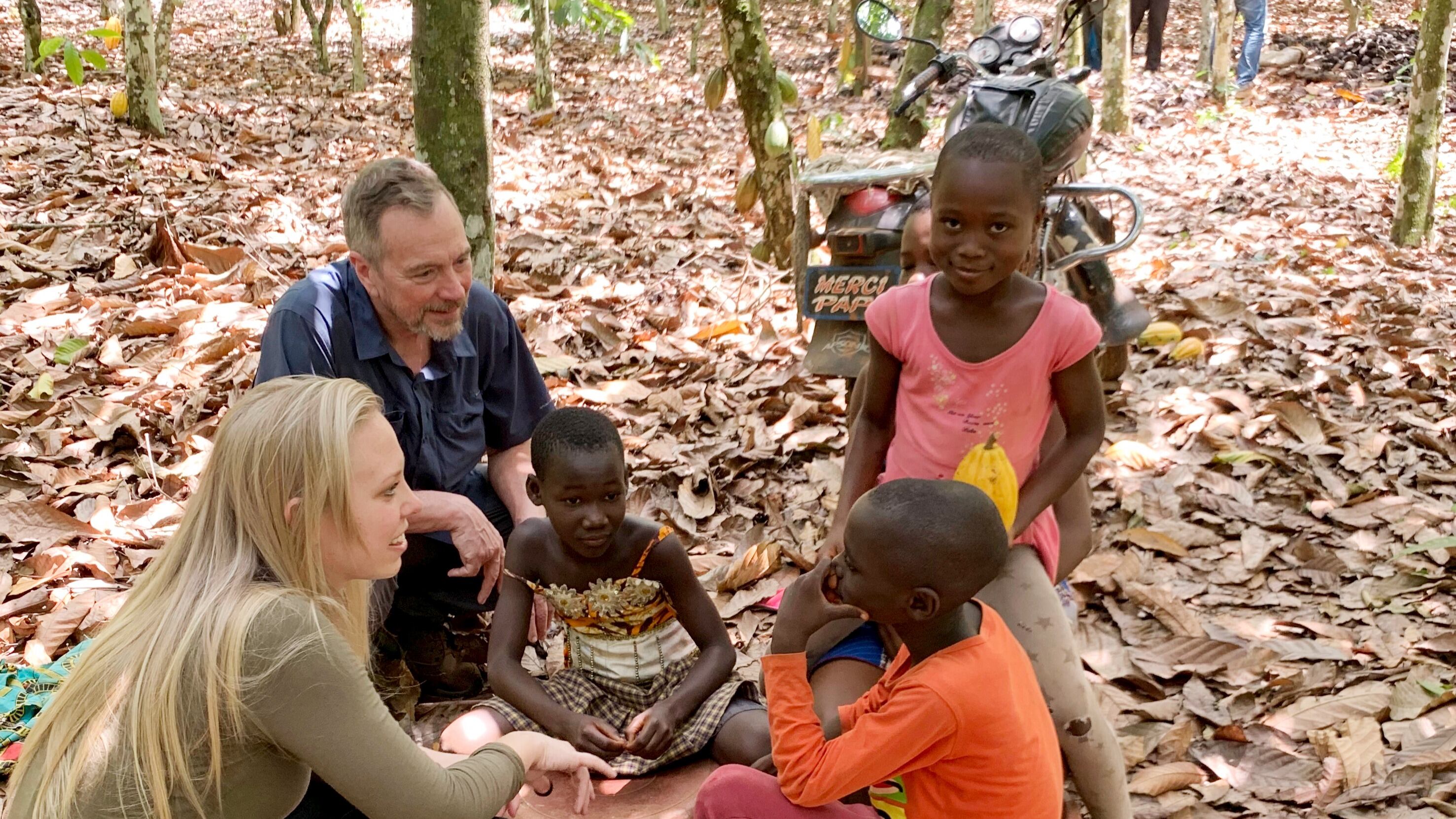
In this April, 2020 image provided by International Rights Advocates, Executive Director Terrence Collingsworth and translator Melina Cardinal Bradette, talk to teenage children, ages 12 to 15, from Burkina Faso, who were working on a cocoa plantation in Ivory Coast in Daloa. Child welfare advocates are suing the Biden administration for failing to block imports of cocoa picked by children in West Africa bound for America’s most popular chocolate bars. (Miki Mistrati/International Rights Advocates via AP)
By Martha Mendoza
Child welfare advocates filed a federal lawsuit Tuesday asking a judge to force the Biden administration to block imports of cocoa harvested by children in West Africa that can end up in America's most popular chocolate desserts and candies.
The lawsuit, brought by International Rights Advocates, seeks to have the federal government enforce a 1930s era federal law that requires the government to ban products created by child labor from entering the U.S.
The nonprofit group says it filed the suit because Customs and Border Protection and the Department of Homeland Security have ignored extensive evidence documenting children cultivating cocoa destined for well-known U.S. candy makers, including Hershey, Mars, Nestle and Cargill.
The major chocolate companies pledged to end their reliance on child labor to harvest their cocoa by 2005. Now they say they will eliminate the worst forms of child labor in their supply chains by 2025.
“They will never stop until they are forced to," said Terry Collingsworth, International Rights Advocates' executive director. He added that the U.S. government has "the power to end this incredible abuse of African children by enforcing the law.”
Spokespeople for CBP declined to comment on the suit, which was filed in the U.S. Court of International Trade. When asked more generally about cocoa produced by child labor, the federal agency said it was “unable to disclose additional information or plans regarding forced labor enforcement activities due to protections of law enforcement sensitive and business confidential information.”
Cocoa cultivation by children in Cote d’Ivoire, also known as the Ivory Coast, as well as neighboring Ghana, is not a new phenomenon. Human rights leaders, academics, news organizations and even federal agencies have spent the last two decades exposing the plight of children working on cocoa plantations in the West African nations, which produce about 70% of the world's cocoa supply.
A 2019 study by the University of Chicago, commissioned by the U.S. government, found 790,000 children, some as young as 5, were working on Ivory Coast cocoa plantations. The situation was similar in neighboring Ghana, researchers found.
The U.S. government has long recognized that child labor is a major problem in the Ivory Coast. The Department of Labor reported in 2021 that “children in Côte d’Ivoire are subjected to the worst forms of child labor, including in the harvesting of cocoa and coffee.”
The State Department in a recent report said that agriculture companies in the Ivory Coast rely on child labor to produce a range of products, including cocoa. The department said this year that human traffickers “exploit Ivoirian boys and boys from West African countries, especially Burkina Faso, in forced labor in agriculture, especially cocoa production."
To try to force companies to abandon cocoa produced by child labor, International Rights Advocates has sued some of the world’s large chocolate companies over the use of child labor in harvesting cocoa beans. It lost a case before the Supreme Court in 2021. Several others are pending.
Pressured by lawmakers and advocates, major chocolate makers in 2001 agreed to stop purchasing cocoa produced by child labor. That goal, experts and industry officials say, has not been met.
“These companies kept saying, ‘We can’t trace it back.’ That’s BS," said former Sen. Tom Harkin, who led a push for legislation to reform the industry, but ended up agreeing to a protocol that allows corporations to regulate themselves. “They just won’t do it because it will cost them money.”
Harkin said Americans don’t realize the treats they hand their children originate with child abuse.
“It’s not just the chocolate you eat, it’s the chocolate syrup you put on your ice cream, the cocoa you drink, the chocolate chip cookies you bake," he said.
The World Cocoa Foundation, which represents major cocoa companies, said it is committed to “improving livelihoods of cocoa farmers and their communities.”
A Hershey spokesperson said the company “does not tolerate child labor within our supply chain.” Cargill, Nestle and Mars did not respond to requests for comment. Their websites all describe their work to end child labor in cocoa plantations.
“We don’t want to un-employ the whole country,” said Collingsworth, the labor advocate who brought Tuesday's lawsuit. “We just want children replaced by adults in cocoa plantations.”
Collingsworth was in the Ivory Coast investigating working conditions when he noticed children chopping through brush and harvesting cocoa. He pulled out a phone and took video and photographs of the boys and girls at work. He also stopped by a nearby processing facility and took a photos of burlap sacks with labels of U.S. companies.
International Rights Advocates decided to petition the CBP to block imports of the cocoa, filing a 24-page petition in 2020 asking the agency take such action. The petition contained what it said was photographic and other evidence detailing how the companies were violating the law.
Collingsworth said his group also provided CBP with interviews with children as young as 12 who said their wages were being withheld, and that they had been tricked by recruiters into working long hours on a false promise they would be given land of their own.
CBP failed to take any action on the petition, the lawsuit alleges.
Jason Moser, Senior Analyst at The Motley Fool, breaks down AMC's third quarter earnings and discusses the future of the theater chain despite low ticket sales.
IBM's spinoff, Kyndryl, is officially an independent public company. The $19 billion business is now listed on the NYSE under the ticker KD, becoming one of the largest players in the IT services market. David Wyshner, CFO of Kyndryl, joined Cheddar to discuss what this milestone means for the company moving forward.
Emma Searson, an author on the just-released Renewables on the Rise report and the director, 100% Renewable Campaign at Environment America, joined Cheddar to discuss the rapidly growing renewable energy sector. Between 2011 and 2020, the report shows that wind, solar, and geothermal energy production grew about 15 percent annually and that wind and solar alone account for 11 percent of electricity in the country. "There are a few really important drivers of the renewable energy progress that we're seeing all across the country," Searson said, highlighting falling prices, technology improvements, and supportive policies.
Wendy O, host of 'The O Show' joins Cheddar News to discuss the recent rally from cryptocurrency, Ether. She also discussed incoming New York City mayor Eric Adams wanting to teach kids crypto in schools.
Professional sports is facing a reckoning right now over several stories painting an ugly picture of a toxic work environment, encompassing multiple teams in multiple leagues and dealing with different issues.
This week, the NHL's Chicago Blackhawks ousted their general manager and senior director of hockey operations after an investigation confirmed former player Kyle Beach's claims that the team's former video coach Brad Aldrich sexual assaulted him back in 2010, with upper management ignoring his claims until after the team won the Stanley Cup that season. Last night, Joel Quenneville, now the coach of the Florida Panthers but Chicago's coach that season, stepped down from his post.
This comes just a few weeks after the NFL was rocked by leaked emails showing now-former Las Vegas Raiders Head Coach Jon Gruden using racist, sexist and homophobic language. He resigned soon after the emails came to light. We can't forget, though, that those emails come from a much broader investigation of the toxic work environment in the offices of the Washington Football Team. NFL Commissioner Roger Goodell said this week the league wouldn't publicly release anything from its investigation of the team, but lawyers for many of the women interviewed in the case say they want a public report.
And last January, just one month after hiring him, the New York Mets had to fire then-General manager Jared Porter, who admitted to sending explicit, unsolicited texts and images to a female reporter in 2016 when he worked for the Chicago Cubs. ESPN had been in possession of the texts since 2017, but the woman in question asked the network not to run the story out of fear her career would be harmed. She only reached back out to ESPN after she left the field of journalism altogether. Porter has been banned from the sport through next season.
If you believe in the phrase "where there's smoke, there's fire," professional sports is a five-alarm blaze.
Julie DiCaro, senior writer and editor at Deadspin, joins None of the Above to discuss.
Curaleaf CEO Joe Bayern joined Cheddar's "Closing Bell" to discuss the cannabis company's Q3 earnings report, which came in under expectations and included widening losses. Bayern discussed taking a hit on profitability based on the slower-than-expected expansion in some Northeast markets. While the company reduced its fiscal guidance for 2021 due to a general slowing of the cannabis market, he did note that he still sees much room for growth in 2022 and beyond.
Online consignment and thrift shop thredUP reported a Q3 earnings beat on Monday, and CEO James Reinhart joined Cheddar to discuss exceeding expectations and the state of the business overall. Reinhart said the company is thriving while other businesses may face supply chain issues due to the convenience of its system of acquiring secondhand clothing. "In a world where most consumers are feeling squeezed by prices and seeing apparel shortages, everything we have on thredUP is 100 percent in stock and ready to ship," he said. "And so I think it speaks to real opportunity for resale and a company like thredUP during the holiday season and into 2022."
Former NBA star, commentator, and entrepreneur Baron Davis and Deluxe Corporation Chief Brand Officer Amanda Brinkman, joined Cheddar to discuss Season 6 of the reality show "Small Business Revolution," premiering Tuesday. The season will focus on helping six Black-owned businesses in the Twin Cities, Minneapolis and St. Paul. Davis noted learning about the lack of resources, connections, and opportunities for Black business owners during the show. "There are so many things we need to do as a society to address racial injustice and inequity, however, one of the ways for it is economic empowerment," Brinkman added.
Katia Beauchamp, strategic advisor for FemTec Health and former Birchbox CEO, joined Cheddar to discuss the health and beauty sciences company's recent acquisition of subscription beauty supply provider Birchbox. She noted that FemTec wants to change the perception of the brand to include health as well as beauty. "This is something where we are reimagining how can we help consumers discover beauty products that really help them take great care of themselves, have beautiful underlying health that is shown on the exterior too," she added.