By Martha Mendoza

Child welfare advocates filed a federal lawsuit Tuesday asking a judge to force the Biden administration to block imports of cocoa harvested by children in West Africa that can end up in America's most popular chocolate desserts and candies.

The lawsuit, brought by International Rights Advocates, seeks to have the federal government enforce a 1930s era federal law that requires the government to ban products created by child labor from entering the U.S.

The nonprofit group says it filed the suit because Customs and Border Protection and the Department of Homeland Security have ignored extensive evidence documenting children cultivating cocoa destined for well-known U.S. candy makers, including Hershey, Mars, Nestle and Cargill.

The major chocolate companies pledged to end their reliance on child labor to harvest their cocoa by 2005. Now they say they will eliminate the worst forms of child labor in their supply chains by 2025.

“They will never stop until they are forced to," said Terry Collingsworth, International Rights Advocates' executive director. He added that the U.S. government has "the power to end this incredible abuse of African children by enforcing the law.”

Spokespeople for CBP declined to comment on the suit, which was filed in the U.S. Court of International Trade. When asked more generally about cocoa produced by child labor, the federal agency said it was “unable to disclose additional information or plans regarding forced labor enforcement activities due to protections of law enforcement sensitive and business confidential information.”

Cocoa cultivation by children in Cote d’Ivoire, also known as the Ivory Coast, as well as neighboring Ghana, is not a new phenomenon. Human rights leaders, academics, news organizations and even federal agencies have spent the last two decades exposing the plight of children working on cocoa plantations in the West African nations, which produce about 70% of the world's cocoa supply.

A 2019 study by the University of Chicago, commissioned by the U.S. government, found 790,000 children, some as young as 5, were working on Ivory Coast cocoa plantations. The situation was similar in neighboring Ghana, researchers found.

The U.S. government has long recognized that child labor is a major problem in the Ivory Coast. The Department of Labor reported in 2021 that “children in Côte d’Ivoire are subjected to the worst forms of child labor, including in the harvesting of cocoa and coffee.”

The State Department in a recent report said that agriculture companies in the Ivory Coast rely on child labor to produce a range of products, including cocoa. The department said this year that human traffickers “exploit Ivoirian boys and boys from West African countries, especially Burkina Faso, in forced labor in agriculture, especially cocoa production."

To try to force companies to abandon cocoa produced by child labor, International Rights Advocates has sued some of the world’s large chocolate companies over the use of child labor in harvesting cocoa beans. It lost a case before the Supreme Court in 2021. Several others are pending.

Pressured by lawmakers and advocates, major chocolate makers in 2001 agreed to stop purchasing cocoa produced by child labor. That goal, experts and industry officials say, has not been met.

“These companies kept saying, ‘We can’t trace it back.’ That’s BS," said former Sen. Tom Harkin, who led a push for legislation to reform the industry, but ended up agreeing to a protocol that allows corporations to regulate themselves. “They just won’t do it because it will cost them money.”

Harkin said Americans don’t realize the treats they hand their children originate with child abuse.

“It’s not just the chocolate you eat, it’s the chocolate syrup you put on your ice cream, the cocoa you drink, the chocolate chip cookies you bake," he said.

The World Cocoa Foundation, which represents major cocoa companies, said it is committed to “improving livelihoods of cocoa farmers and their communities.”

A Hershey spokesperson said the company “does not tolerate child labor within our supply chain.” Cargill, Nestle and Mars did not respond to requests for comment. Their websites all describe their work to end child labor in cocoa plantations.

Ivory Coast officials have said they are taking steps to eradicate child labor but blocking imports of the nation's cocoa would devastate the nation's economy.

“We don’t want to un-employ the whole country,” said Collingsworth, the labor advocate who brought Tuesday's lawsuit. “We just want children replaced by adults in cocoa plantations.”

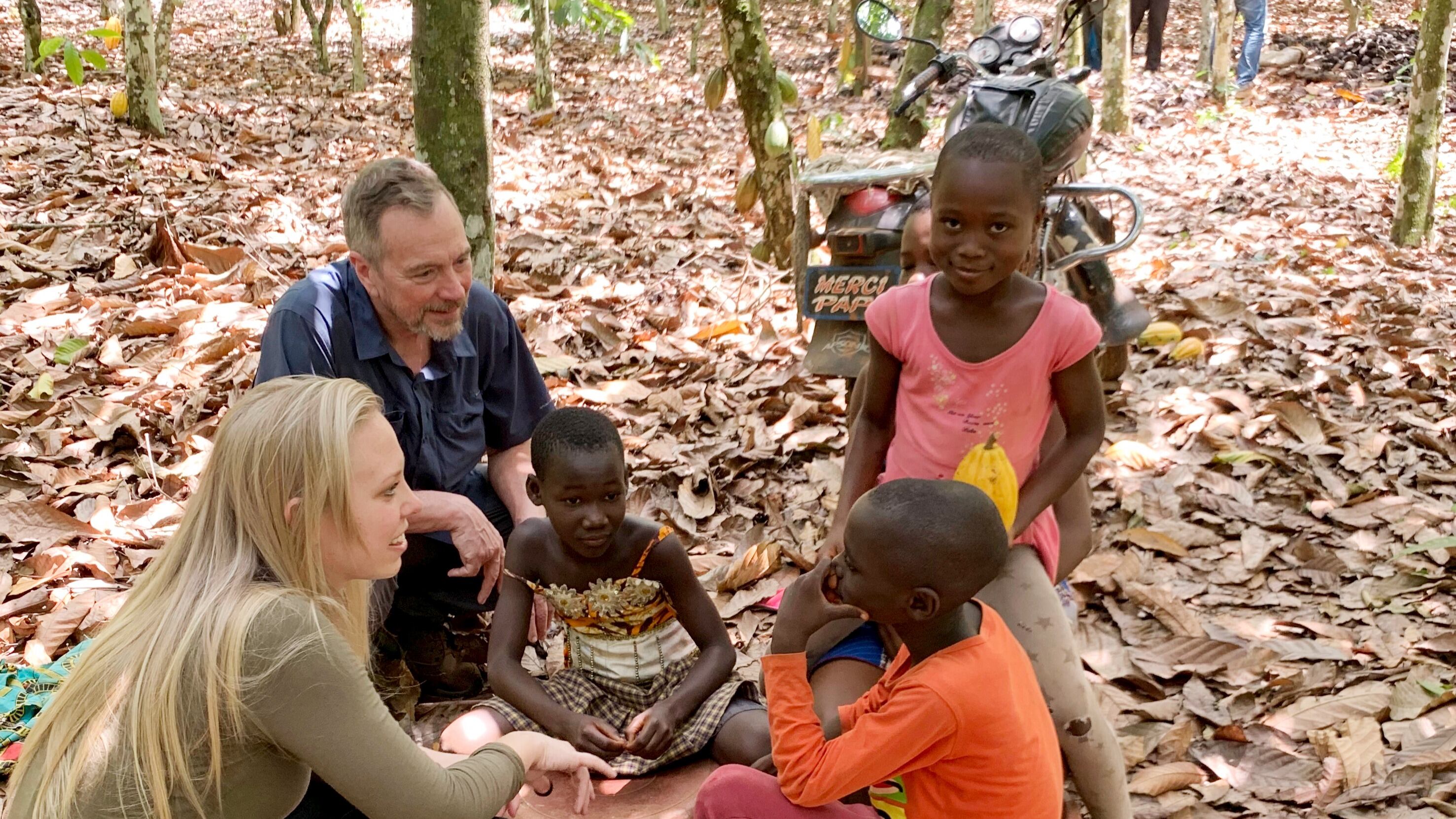
Collingsworth was in the Ivory Coast investigating working conditions when he noticed children chopping through brush and harvesting cocoa. He pulled out a phone and took video and photographs of the boys and girls at work. He also stopped by a nearby processing facility and took a photos of burlap sacks with labels of U.S. companies.

International Rights Advocates decided to petition the CBP to block imports of the cocoa, filing a 24-page petition in 2020 asking the agency take such action. The petition contained what it said was photographic and other evidence detailing how the companies were violating the law.

Collingsworth said his group also provided CBP with interviews with children as young as 12 who said their wages were being withheld, and that they had been tricked by recruiters into working long hours on a false promise they would be given land of their own.

CBP failed to take any action on the petition, the lawsuit alleges.
Share:
More In Business
Dow Slips into Red Late in Session as Stocks End Friday Lower
Stocks closed lower on Friday as investors continue to worry over rate hikes. John Lynch, CIO of Comerica Wealth Management, joins Cheddar News' Closing Bell, where he says value is back in play with investors. Lynch also believes the market has overreacted to the latest Fed minutes, suggesting a bounce-back at some point.
2021 Sees Record Number of Tech Deals; Will 2022 Bring Even Bigger Tech Investments?
Private equity firms in 2021 spent $401.71 billion in U.S. tech investments — doubling 2020's level of $196.34 billion. As tech becomes increasingly interwoven into our lives amid the pandemic, investors grow bullish on the sector, especially software-as-a-service companies. How will 2022 stack up to 2021, and is there potential for parts of the tech sector to sink this year? John Jannarone, Editor in Chief at IPO-Edge, joins Cheddar News' Closing Bell to discuss 2021's record year of deals, how potential interest rate hikes will impact tech investments in 2022, the fastest-growing IPOs, and more.
Bed Bath & Beyond's Stock Jumps Despite Earnings Miss as Meme Stock Mania Reappears
Bed Bath & Beyond delivered disappointing fiscal third-quarter results for 2022. Shares initially dove more than 9% in premarket trading on the news but finished the day up nearly 8%. Bed Bath & Beyond has been a meme-stock target for online investors in the past -- so was meme-stock mania a factor in the recent stock movement for the company? Jaime Rogozinski, the founder of the subreddit WallStreetBets, joins Cheddar News' Closing Bell for more, as his forum helped spark the meme stock phenomena. He also discussed some decentralized finance services and trends for the retail investor to watch for in 2022.
As College Athletes Earn Wealth From NIL, Financial Management Becomes Key
College athletes scored big in 2021 when they were finally allowed to begin earning money based off of their name, image, and likeness, known as NIL. But how can young athletes best manage their money so they can set themselves up for years of success? Nicole Pullen Ross, Head of Goldman Sachs Sports and Entertainment Solutions, joins Cheddar News' Closing Bell to discuss why financial management for college athletes is important, common pitfalls they could run into, and more.
December Jobs Report Weaker Than Expected, But Unemployment Hits New Pandemic Low
December's jobs report was weaker than expected: the economy only added 199,000 nonfarm payrolls compared to an estimate of 422,000. However, the unemployment rate hit a new pandemic-era low of 3.9%, beating expectations. One thing to consider is the fact that the impact of the COVID-19 omicron variant is not factored into these results as the read is taken around the middle of the month. So — how might the variant impact job reports over the next few months? Mark Zandi, Chief Economist at Moody's Analytics, joins Cheddar News' Closing Bell to discuss December's jobs numbers, his 2022 labor market outlook, how COVID-19 will continue to impact the labor market, and more.
Pear Therapeutics CEO on How Its Apps Work for Conditions Like Addiction
Digital medical care provider Pear Therapeutics rang the closing bell on the Nasdaq Friday and President and CEO Dr. Corey McCann, joined Cheddar to talk about how the company plans to grow the business of software-based therapeutics and how the first FDA authorized prescription digital therapeutics company will go about treating illnesses like insomnia and addiction. "These really are pieces of software. In many cases, they're apps and in the cases of our addiction products, these are based on something called cognitive behavioral therapy or CBT," he said. "These products change the patient's brain circuitry to help them be abstinent, to help them stay in treatment, and that's exactly what we see in randomized clinical trials and that's what we see in the real world." He also addressed the ongoing mental health crises brought on by the pandemic. **copy updated to remove IPO information as Pear Therapeutics went public in December**
Behind Gamestop's Reported Plan Enter NFT, Crypto Space
Gamestop shares were up on The Wall Street Journal report that the video game retail company plans to enter the NFT and crypto space. Adam Hollander, the founder of Hungry Wolves NFT, joined Cheddar to break down how it could be a lifeline for the struggling meme stock darling. "They're not resigning themselves to becoming the next Blockbuster story, and so while people may not be buying as many video games in a retail environment anymore, NFTs, in particular, people are starting to expect more gaming utility on the backend — at least for a variety of projects — and I personally think its a very smart move for them to do this," Hollander told Cheddar.
Draftkings on NY Mobile Sports Betting Cannibalizing Business in Neighboring States
On Saturday, New York will join neighboring New Jersey and Connecticut in authorizing mobile sports betting. Matt Kalish, president and co-founder of Draftkings North America, joined Cheddar to talk about the landmark change that is estimated to rake in $500 million in annual tax revenue on a potential billion-dollar market. Kalish also addressed the possibility that legalized sports betting in the Empire State could cannibalize his company's revenues in the bordering states. "It's pretty inconvenient, you know, to go across the border to make a bet. And people were doing it, but I think it really stifled a lot of the opportunity," he said. "So while there's some of that going on, I think really a tremendous amount, like a giant percent, of New York will be very incremental."
Load More