By Rodney Muhumuza

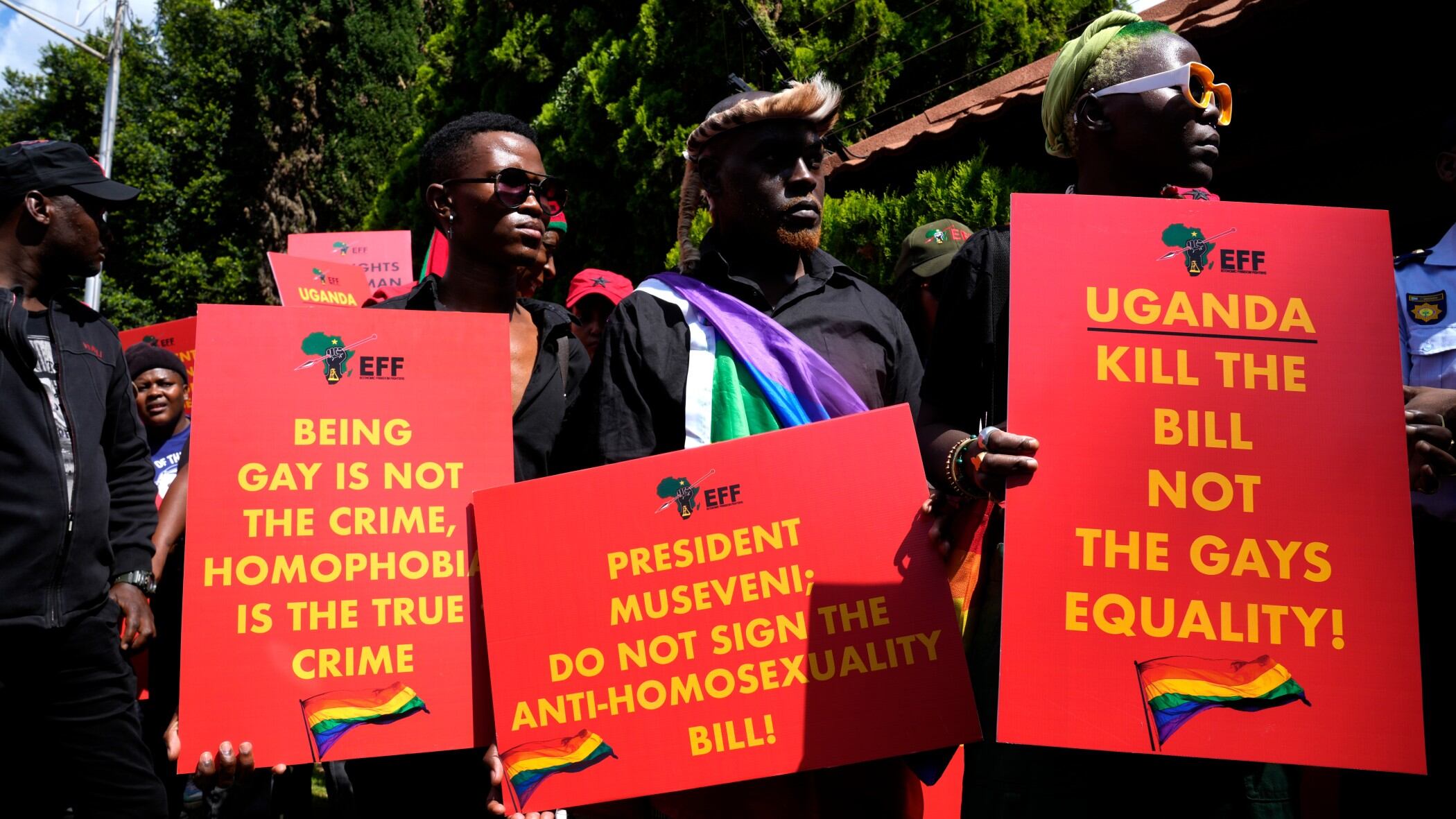
Uganda's president has signed into law anti-gay legislation supported by many in this East African country but widely condemned by rights activists and others abroad.

The version of the bill signed by President Yoweri Museveni doesn't criminalize those who identify as LGBTQ, a key concern for some rights campaigners who condemned an earlier draft of the legislation as an egregious attack on human rights.

But the new law still prescribes the death penalty for “aggravated homosexuality,” which is defined as cases of sexual relations involving people infected with HIV, as well as with minors and other categories of vulnerable people.

A suspect convicted of “attempted aggravated homosexuality” can be imprisoned for up to 14 years, according to the legislation.

Parliamentary Speaker Anita Among said in a statement that the president had “answered the cries of our people” in signing the bill.

“With a lot of humility, I thank my colleagues the Members of Parliament for withstanding all the pressure from bullies and doomsday conspiracy theorists in the interest of our country,” the statement said.

Museveni had returned the bill to the national assembly in April, asking for changes that would differentiate between identifying as LGBTQ and actually engaging in homosexual acts. That angered some lawmakers, including some who feared the president would proceed to veto the bill amid international pressure. Lawmakers passed an amended version of the bill earlier in May.

LGBTQ rights campaigners say the new legislation is unnecessary in a country where homosexuality has long been illegal under a colonial-era law criminalizing sexual activity “against the order of nature.” The punishment for that offense is life imprisonment.

The U.S. had warned of economic consequences over legislation described by Amnesty International as “draconian and overly broad.” In a statement from the White House later on Monday, U.S. President Joe Biden called the new law “a tragic violation of universal human rights — one that is not worthy of the Ugandan people, and one that jeopardizes the prospects of critical economic growth for the entire country.”

"I join with people around the world — including many in Uganda — in calling for its immediate repeal. No one should have to live in constant fear for their life or being subjected to violence and discrimination. It is wrong," Biden said.

The U.N. Human Rights Office said it was “appalled that the draconian and discriminatory anti-gay bill is now law," describing the legislation as ”a recipe for systematic violations of the rights" of LGBTQ people and others.

In a joint statement the leaders of the U.N. AIDS program, the U.S. President's Emergency Plan for AIDS Relief and the Global Fund said they were “deeply concerned about the harmful impact” of the legislation on public health and the HIV response.

“Uganda’s progress on its HIV response is now in grave jeopardy,” the statement said. “The Anti-Homosexuality Act 2023 will obstruct health education and the outreach that can help end AIDS as a public health threat.”

That statement noted that “stigma and discrimination associated with the passage of the Act has already led to reduced access to prevention as well as treatment services" for LGBTQ people.

Rights activists have the option of appealing the legislation before the courts. One group of activists and academics later on Monday petitioned the constitutional court seeking an injunction against enforcement of the law.

An anti-gay bill enacted in 2014 was later nullified by a panel of judges who cited a lack of quorum in the plenary session that had passed that particular bill. Any legal challenge this time is likely to be heard on the merits, rather than on technical questions.

Anti-gay sentiment in Uganda has grown in recent weeks amid news coverage alleging sodomy in boarding schools, including a prestigious school for boys where a parent accused a teacher of abusing her son.

The February decision of the Church of England ’s national assembly to continue banning church weddings for same-sex couples while allowing priests to bless same-sex marriages and civil partnerships outraged many in Uganda and elsewhere in Africa.

Homosexuality is criminalized in more than 30 of Africa’s 54 countries. Some Africans see it as behavior imported from abroad and not a sexual orientation.

Share:
More In Politics
US tariffs are having an uneven effect on holiday prices and purchases
Many U.S. consumers say they’ve noticed higher than usual prices for holiday gifts in recent months, according to a a December poll from The Associated Press-NORC Center for Public Affairs Research. A contributing factor is the unusually high import taxes the Trump administration put on foreign goods. While the worst-case consumer impact that many economists foresaw from the administration’s trade policies hasn’t materialized, some popular gift items have been affected more than others. Most toys and electronics sold in the U.S. come from China. So do most holiday decorations. Jewelry prices have risen due to the cost of gold.
Serbia organized crime prosecutors charge minister, others in connection with Kushner-linked project
Serbia’s prosecutor for organized crime has charged a government minister and three others with abuse of position and falsifying of documents related to a luxury real estate project linked to U.S. President Donald Trump’s son-in-law Jared Kushner. The charges came on Monday. The investigation centers on a controversy over a a bombed-out military complex in central Belgrade that was a protected cultural heritage zone but that is facing redevelopment as a luxury compound by a company linked to Kushner. The $500 million proposal to build a high-rise hotel, offices and shops at the site has met fierce opposition from experts at home and abroad. Selakovic and others allegedly illegally lifted the protection status for the site by falsifying documentation.
Trump signs executive order to block state AI regulations
President Donald Trump has signed an executive order to block states from regulating artificial intelligence. He argues that heavy regulations could stifle the industry, especially given competition from China. Trump says the U.S. needs a unified approach to AI regulation to avoid complications from state-by-state rules. The order directs the administration to draw up a list of problematic regulations for the Attorney General to challenge. States with laws could lose access to broadband funding, according to the text of the order. Some states have already passed AI laws focusing on transparency and limiting data collection.
New York Times, after Trump post, says it won’t be deterred from writing about his health
The New York Times and President Donald Trump are fighting again. The news outlet said Wednesday it won't be deterred by Trump's “false and inflammatory language” from writing about the 79-year-old president's health. The Times has done a handful of stories on that topic recently, including an opinion column that said Trump is “starting to give President Joe Biden vibes.” In a Truth Social post, Trump said it might be treasonous for outlets like the Times to do “FAKE” reports about his health and "we should do something about it.” The Republican president already has a pending lawsuit against the newspaper for its past reports on his finances.
Trump approves sale of more advanced Nvidia computer chips used in AI to China
President Donald Trump says he will allow Nvidia to sell its H200 computer chip used in the development of artificial intelligence to “approved customers” in China. Trump said Monday on his social media site that he had informed China’s leader Xi Jinping and “President Xi responded positively!” There had been concerns about allowing advanced computer chips into China as it could help them to compete against the U.S. in building out AI capabilities. But there has also been a desire to develop the AI ecosystem with American companies such as chipmaker Nvidia.
Swing district Republicans brace for political fallout if health care subsidies expire
House Republicans in key battleground districts are working to contain the political fallout expected when thousands of their constituents face higher bills for health insurance coverage obtained through the Affordable Care Act. For a critical sliver of the GOP majority, the impending expiration of the enhanced premium tax credits after Dec. 31 could be a major political liability as they potentially face midterm headwinds in a 2026 election critical to President Donald Trump’s agenda. For Democrats, the party’s strategy for capturing the House majority revolves around pinning higher bills for groceries, health insurance and utilities on Republicans.
Load More